Populist movements don't build themselves ...

... It doesn't matter what the "horse race" outcome of the campaign is, if we fight the campaign. Fighting it, we learn how to fight. Learning how to fight political battles, we become citizens again. Becoming citizens again, we reclaim the Republic that lies dormant beneath the bread and circuses of modern American society.

Showing posts with label A Brawny Recovery. Show all posts

Monday, July 27, 2009

Looking Past the End of the End of the Recession

Bonddad at the Daily Kos has YERRD (yet another reclisted Rosenberg diary) up, on the issue of whether the recession is coming to an end, or the sky is falling and we face an unending recession from now through to the visible horizon.

But the Great Depression was not made of a recession that did not end for ten years. It was, indeed, made up of one and a half complete business cycles ... the post-Crash Recession, from late 1929 to 1932, the New Deal Recovery, from 1932 to 1937, the Roosevelt Recession of 1937/38, and then the recovery that merged with the start of WWII, which was the government spending program substantial enough to actually bring us back to a full employment macro equilibrium.

So the question of whether or not we face another Depression is not, "will this Recession ever end?" ... but rather, "After this recession, what comes next?"

Indeed, that is the important aspect of Rosenberg's analysis ... we have played the "consumers borrow us out of recession" card too many times, and its no longer in our hand to play.

At the same time, Rosenberg may well be too optimistic, since there is evidence relating oil prices to oil production (Oil Drum) that we are on a "reverse L" oil supply curve, and since production capacity will be lower next year than it was in 2008, it will not take as much economic activity to generate the same crude oil prices.

And our economy is far more exposed than the Japanese, European or Chinese economies to crude oil price shocks.

So putting two and two together, we need an investment-led recovery, and we need a sustained crash program to address our oil addiction.

That adds up to a Brawny Recovery in pursuit of Living Energy Independence as the alternative available to us that can possibly offer a recovery that can last long enough to generate substantial employment gains.

And if NIMBY's and some misguided environmentalists try to get in our way (California HSR blog), we have to organize to run right through their opposition.


What are the "Seed" Projects to Drive an "Brawny" Recovery

I call an Investment-led recovery a "Brawny" recovery, because the idea is that our capacity to do things increases, in line with the spending of money in the short term.

However, finding these projects is not the problem. The problem is shaking off the dead hand of Reagan Framing and understanding that if there is a $1T+ gap between our current GDP and our full-employment capacity, that means there will be $100b's of gap for the next six years ahead. Especially given that the "easy" aggregate demand of consumer-debt-fueled growth is not going to be available to us over the next decade.

So, we can spend $75b per year over the next six years to electrify the Dept. of Defense "STrategic RAil Corridor NETwork - STRACNET. That requires capital funding, but only when oil is cheap ... in the context of expensive oil, bonds to electrify STRACNET are readily self-funding through user charges. A form of crude oil import tariff that slides off as crude oil approaches $80/barrel would suffice to "fund" that. Or else, we can simply deficit spend for that ... since cutting off 10% of our demand for petroleum imports is an investment that pays for itself in multiple ways.

We can spend $75b per year over the next decade to build local electric transport corridors ... from trolley buses and Rapid Streetcars through conventional Light Rail and commuter heavy rail all the way to the mass transit niche for the biggest cities. Fund those projects on an 80:20 federal match, include both direct and indirect impacts on Energy Independence and Congestion Relief, and there will be no difficulty finding projects that justify the public investment. And, again, we can simply deficit spend for that ... if we can spent $1T+ on trying and failing to gain access to the last big pools of cheap crude oil in the world, we can definitely spend $750b on permanent alternatives to crude oil based transport.

We can spend $5b a year over six years on Electricity Superhighways to connect our main regional consumption grids to renewable resource areas. We can spend $20b a year on electric inter-urban transport over the next decade, from Express HSR through Regional and Emerging HSR to electric stopping trains. We can spend $25b a year on interest subsidies for Connie Mae finance for decentralized CO2 emission reduction and energy efficiency improvements, repaid out of the reduction in operating costs, on an ongoing basis.

My, word, $200b over the next six years, $120b over the next decade. The Deficit! My God! The Deficit! screams the ghost of Reagan.


Yeah, What About the Deficit?

We are so heavily indoctrinated in this frame that its normal for people to think they have escaped it, when they have just escaped from one part of the frame into another part of it.

Now, look around at State Governments. Look at Medicaid funding and Unemployment Insurance funding. Look at Federal tax receipts. How's the biggest recession since the Roosevelt Recession (itself generated by giving in to "balanced budget" ideology) working for creating budget surpluses?

Now, think about what happens next after this recession is over. "Recession" is a term that just means changes in economic turnover, focusing on sales of newly produced goods and services. And while unemployment is directly related to GDP growth:
  • GDP growth around 1% per year implies falling employment


So, suppose that we just stand up and cheer when the recession is over, and do not do anything about the massive mess we have made of the economy over the past thirty years by abandoning the industrial development approach we followed for most of the period from the 1790's to the 1970's and adopting Reagan's Do-Nothing-Republicanism instead.

We are going to muddle along, perhaps for years, without any employment growth.

Then, somewhere in the world, someone will get their act together, and get some substantial economic growth going. And the price of crude oil will zoom up and the United States will slide into an oil price shock recession.

Lather, rinse, repeat.

What's that going to do for our "deficit" ... especially with $500b+ a year in government spending on military production dragging down our trade account ... especially considering that if we do not get our act together and someone else does, that'll spell the end of the US dollar as a global reserve currency.

Indeed, we could be treated to the wonderful prospect of a currency collapse inflation in the middle of an oil price shock recession.

Contrast that with the prospect of making serious investment in housing and transportation that can withstand an oil price shock, while generating economic growth sufficient to generate employment growth.

And remember that the key comparison is not the dollar value of the national debt, but the national debt compared to the size of the national economy.

$200b is under 1.5% of a $14T economy ... and the difference in growth rates between the Brawny Recovery policy and the Republican Après Moi, Le Déluge policy approach will easily be 2% or more.

Now, if we put together tricks and gimmicks to "pay for" $200b in Brawny Recovery spending over the next six years and $120b in Brawny Recovery spending over the next decade, and those tricks and gimmicks help the politics of getting it passed, fine.

But, between you and me, the argument that we cannot "afford" to invest in programs that will directly generate hundreds of billions in private investment and will start to close the massive bleeding hole in our trade account ... its pretty moronic. We have followed that policy of not being able to invest in the things we need for the future for thirty years, under Democratic and Republican Presidents and Congressional Majorities ... and the results of that policy are in.

We have already relinquished the title of highest income nation on the face of the planet, when you look at median rather than average incomes. Our claim to be the "wealthiest" nation on the face of the planet will collapse if our currency does.

Before that happens, time to try going back to the policy of substantial investment in infrastructure that brought the US from one among many developing nations to the highest income, wealthiest economy on earth.


And on it goes

It goes without saying that no matter how heavily the "sustainable" in Sustainable Energy Independence is stressed ... its only one dimension of a big, complex problem. Join the Daily Kos Environmentalist group for a multi-dimension look at all sides of an ecologically sustainable economy.

Monday, July 20, 2009

The New Hooverism versus High Speed Rail

Burning the Midnight Oil for Living Energy Independence

Dan Walters in the Sacramento Bee asks:

Is this the time to launch construction of a high-speed railroad line between Northern and Southern California that will cost at least $40 billion, much of it from bonds to be repaid from a state budget that's already gushing red ink?

Yes, say its fervent advocates, contending that a bullet train, similar to those in Europe and Japan, will reduce air and auto congestion, reduce greenhouse gases and generate many billions of dollars in economic benefits.


Dan Walters then throws all the complaints about HSR he can find into a big pot, and stirs. Underneath the individual "points", lies the main New Hooverist thesis ... in hard times, we cannot afford to invest in the future.

Robert Cruickshank at the California HSR blog debunks Dan Walters exercise point by point, but starts out by taking aim at the New Hooverist thesis and landing a bulls-eye:
What do the Golden Gate Bridge, Shasta Dam, and the Central Valley Water Project have in common? They are all products of the Great Depression. At a time when both California and the federal government were strapped for cash and suffering the effects of a major economic downturn, government decided to use infrastructure projects to provide economic recovery in both the short and the long term. Each project continues to provide economic activity 70 years later. Each has paid for itself many times over.


In other words, as Robert's blog title says, Now is the Perfect Time to Build a Railroad.

Now, I am one of those advocates of HSR ... at all three levels ... that Dan Walters is arguing against. But the plain fact is, you don't have to be an advocate of a particular project to see the point that now is the time to find big infrastructure projects to build the New Energy Economy. You only have to look at the current account ... the trade and income balances between the United States and the Rest of the World. The collapse of household spending and calming of oil prices has pushed the US balance of trade (and overall current account deficit) to just about its lowest level since we opted for the corporate-profit-oriented version of NAFTA.

And we still have our structural dependency on energy imports. We still remain exposed to the risk that if the rest of the world recovers before we do, the oil price spike that follows will prevent us from seeing robust recovery until we fix the problem.

Even though the "top notch" economists believe that in the "long run" the economy will automatically tend toward full employment (dKos comment) ... that is only belief. Since it is built into their models rather than emerging from the empirical evidence, there is no reason to trust them as opposed to the lessons of economic history (which, it should be noted, "top notch" economists are no longer required to study), that economic downturns can indeed be followed by extended periods of high unemployment, unless government takes action to address the critical economic challenges facing the nation.

And, yes, we have to keep debunking both those dedicated to the New Hooverism and their fellow travelers, like the fervent contra-advocates of investment in the most energy efficient commercially viable form of inter-regional transport for a transport task over the distance separating the Bay from the LA Basin ... electric Express HSR. Such as "Morris Brown" at the California HSR blog, who jumps in with a comment including this rhetorical gem:
Now Robert is quite willing to claim that SJ was being effectively by-passed with Altamont, but what about Sacramento being effectively being cut off from SF by the Pacheco routing.


Those are two cities that are 79 miles apart as the crow flies ... even an alignment that doubles that distance leaves them a "mere" 160 route miles apart. That is, after all, why the current Capital Corridor route is successful in attracting ridership.

Now, this certainly is a distance that will benefit from trains traveling faster than 79mph ... but 110mph or 125mph is fast enough to reap most of the benefit. Pretending that 220mph trains are required to prevent Sacramento from being "cut off" from San Francisco ...

... well, as I replied at the California HSR blog:
How can you pretend to be writing about a HSR project while ignoring differences in distances between locations? Sacramento and San Francisco are not far enough apart to require 220mph trains to yield trips of under two hours, let alone under three hours. 110mph and 125mph is plenty fast enough for that transport task.

By contrast, effectively linking the LA Basin and the Bay by rail, which is more capital efficient than the equivalent air and ground inter-regional transport capacity under current energy costs, and less exposed to the risk of crude oil price shocks, requires 220mph Express HSR rail technology.

So "cutting off Sacramento from San Francisco" is just an empty rhetorical flourish, and using it brands the user as either ignorant or willing to deceive in pursuit of his objectives. Misled or misleading ... the only third option is "or both".


The New Hooverism is well entrenched in the vested interests of the large transnational corporations, and supported by a broad network of lackeys, paid henchmen, and those who have fallen for the frames of argument that they have invested so much time and effort in putting into place.

If we hope to bring about the Brawny Income-led Recovery, we must find ways to cooperate in uprooting the New Hooverism.

Sunday, July 12, 2009

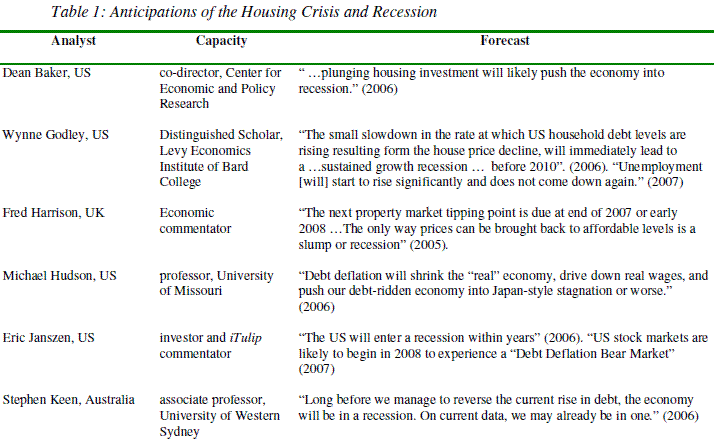
Waddya know ... some people saw the meltdown coming. UPDATED

(h/t ChrisCook)


Click for full size table image


As a commentator ARGeezer said at the EuroTrib:
No one saw it coming? More like no Serious PeopleTM listened to those who did see it coming. Our society currently is not organized in such a way as to allow any significant prior constraint on the machinations of the big money boys, and they own enough of the system to veto any attempt to change this fact. Hell, we can't even get enforcement of existing laws that should constrain them.


In terms of the "football team" filter of American governance, the "Democratic Team" has a majority and the "Republican Team" a minority ... but in terms of power politics, its a Corporate Majority, who have had to swing their focus in terms of what lies to tell to which party base in order to get what they want.

It is, IOW, like a swing in the balance of power between the Whig Lords and the Tory Lords in pre-Reform England. There are, indeed, policy differences between the Oil Patch Republicans and the Hedge Fund Democrats, but they have far more in common in terms of their basic support for the status quo.

UPDATE: Senator Dorgan 1999:

Tuesday, June 16, 2009

A Brawny Recovery Instead of Unsustainable Consumption-Led Growth

Burning the Midnight Oil for a Brawny Recovery

On Agent Orange, bonddad writes:
Among the most important of the rules Rosie laid down, in my opinion, is #12: Get the US consumer right and everything else will take care of itself. The reason is fairly simple: The U.S. consumer has the biggest balance sheet on the planet. The U.S. consumer represents 70 percent of our GDP and about 18 percent of global GDP.


This is, however, following the entrenched habits of thought that got us into this mess in the first place. In a comment in reply, I write:
The problem with the 70% figure ...
... is that only a portion of that is free-standing spending, that is not financed out of income. Sustainable growth in aggregate demand occurs when there is a sustainable increase in spending that is not financed by income ... because the portion that is financed by income follows growth in incomes, it cannot lead growth in income.

If we are importing roughly 1/5 of our GDP, 15% of that consumption is imports and 55% is domestic.

If our income-expenditure multiplier is around 1.5, that implies about 2/3 leakages, 1/3 income financed consumption of domestic goods and services. So 55%-33%= about 22% debt-financed consumption of US goods and services that acts as a domestic growth driver. The rest of the 70% figure is domestic recirculation of income and income spill-over to the rest of the world.

Now, that is still a big chunk of change, and under Bushonomics, with the anti-export and anti-real-investment policies that were in place, was the main growth driver we were counting on.

However, it is clearly a growth driver that we can replace if we pursue an aggressive plan of government investment in energy efficiency and infrastructure in support of sustainable energy independence, combined with government policies that ensure ongoing growth in private investment in energy efficiency and production of energy for sustainable energy independence.

And unlike the growth regime founded on unsustainable increase in degree of leverage, its a growth regime founded on the real increase in both the quantity of domestic resources and the efficiency with which they are used.


Certainly, as our economy has evolved in the past three decades, debt-financed consumption has become the largest of the four sources of new injections into Aggregate Demand:
  • Government spending, which creates new fiat-currency
  • Real investment in new productive capacity, which is based on newly created credit-money
  • Debt-financed consumption, which is based on newly created credit-money
  • Exports, which is based on either kind of newly created money, depending on the source of the domestic currency flows into the foreign exchange market that were the ultimate source of the domestic currency paid for the exported products


The Brawny Recovery strategy shifts the focus, toward the transitional economy in which investment in the foundations of a sustainable economy are the source of new aggregate demand.

Saturday, June 13, 2009

Beware of Geeks Bearing VATs

Burning the Midnight Oil for a Brawny Recovery also posted at My Left Wing, cross-posted to ProgressiveBlue, Docudharma and more TBA

If you wander around the fringes of economic discussion on these Interwebs, you may encounter sites extolling the wondrous vitrues of the VAT. "If only we would adopt a massive VAT, our two decade long decline in manufacturing output would be gone, and we would be an exporting powerhouse once again." ... well, no, that would be a stereotyping of the argument. A real sample of the claims sound more like this, from tradereform.org:
I Squared R Element Company is in Akron, New York. It makes industrial heating elements which are used for many processes to make other things, including glass and computer chips. The company was the low bidder on a contract to export to China.

However, the company lost the bid. Why?

I squared R was told it did not include, in its bid, China's 10% customs duty or the 17% value added tax(VAT) that must be paid at the border.

All our goods pay a 17% VAT at the Chinese border. And the uninformed say we are a high cost producer. Chinese exporters also get a 17% VAT rebate, i.e. they get paid to export.


And, yes, I have picked out this quote to pick on VAT-uber-alles advocates, precisely because it focuses on the part of the argument that is simply wrong.

The protection against imports is the tariff, not the VAT. The Chinese company that beat out the producer in that other Akron also has to pay 17% VAT on its production. If omitting the 17% VAT alone was what made the Akron, NY producer the "low bidder", its simply lying to call them the low bidder ... its like two different companies in the same state competing for a contract, and one claiming to be the low bidder because they left sales tax off their bid, which the other company included.

That element of VAT advocacy is nothing but hypocritical posturing at some stage along the line ... though not necessarily on the part of a particular VAT advocate, since it may well be that a particular VAT advocate has been misinformed by hypocritical posturing polluting their sources of information.


VAT and Trade

The other part of VAT that is raised is the export rebate (again from tradereform.org:
Companies are put out of business because of VAT subsidies. Foreign exporters are paid to export, in the form of VAT rebates. The products are relieved of tax burden.


This is the real effect of VAT on trade. A natural side effect of heavy, regressive, indirect taxes is that it increases the costs of exports. That is true of VAT, over-taxing for Social Security or other payroll taxes, retail sales taxes, (hidden) wholesale sales taxes, stamp duties ... its a general effect of heavy indirect taxes.

Now, from the perspective of the wealthy, a massive benefit of heavy indirect taxes is that those with freely disposable income can normally duck out on paying the indirect taxes if they direct their income to wealth accumulation instead of consumption. So if the poor, who spend all of their income, are paying 20% of their income in indirect taxes, the very wealthy, who devote much of their income to perpetuating their status as a member of a stable aristocracy of wealth, would only pay 10% if they only consume half of their income, and the more of their income they devote to accumulating wealth and economic power, the less of their income is subject to tax.

Further impoverishing the working poor, and pushing the shrinking middle class toward poverty ... well, them's the hazards. However, from the perspective of the wealthy, there is a downside ... that nasty trade effect.

However, the WTO permits indirect taxes to be rebated on exports. We do this in the US for some of our indirect tax burden ... indeed, we do it on a state by state basis, with sales taxes assessed in one state one payable by residents of that state. But if a particular municipality in Ohio has a total of 7% of state, county and city sales taxes, any exports from Ohio to China have a 7% "export rebate".

VAT is as easy to rebate as retail sales taxes, because of the way it works. Each business pays VAT on its inputs, and collects VAT on its sales, and hands over to government the difference between what it collected and what it paid. In other words, the government receives the VAT on every step in the production chain on the increase in the value of sales over the value of outlays.

Since each step of the way, the VAT that is owed is a simple percentage of the sale price, computing the amount to rebate at the border is straightforward.

By contrast to China and most of Europe, in the US our biggest indirect taxes are payroll taxes, and we do not have a mechanism in place to rebate the payroll taxes.

The rebate of indirect taxes on exports ... that's the trade effect of a VAT. Claiming that there is an impact on the import side is as silly as if a Chinese firm claimed we had unfair protection against Chinese products because "The Wal-Mart between Kent and Ravenna in Ohio charges sales tax on imports!!!".


Pushing Progressive Options Out of the Frame

Now, if the US wishes to pursue the neo-mercantalist policies of China, most of Southeast Asia, and etcetera ... what would that policy package be?
  • Peg our currency at a steep discount, for exchange rate stability and competitive advantage
  • Levy steep indirect taxes on domestic consumption, and rebate those taxes on exports
  • Maintain protective imports and discriminatory trade practices for those industries that we are trying to develop


Some of the people pushing for the VAT would happily accept that full package. Others, however, might criticize it.

The progressive critique is that neo-mercantalism is an effort to export our unemployment overseas by pursuing trade surpluses, at the expense of the standard of living of the majority of the our population. Some few at the top will benefit from successful neo-mercantalist policy, while for the majority of the population, its a policy of taxing domestic consumers to finance infrastructure used for domestic production and export production alike.

And just like old-fashioned mercantalism, neo-mercantalism only works if there are countries that are in a position to run sustained trade deficits. After all, one country's exports is another country's imports - so the whole world cannot run a global trade surplus with itself. If everyone pursues a trade surplus, then on average half must fail.

Back in the days of "paleo-mercantalism", that country running the perpetual trade deficits was Imperial Spain, possessor of two mountains of silver in Mexico and Peru, which could be acquired by merchants in other European nations by selling things to wealth Spaniards, and then used to buy into the lucrative Asian carrying trade. More recently, it has been trade deficits by the United States as we have progressively hollowed out our industrial capacity while maintaining consumption on the back of credit extended to us ... as a side effect of the cheap currency policy.

But one reason the world experienced a financial crisis is that the US was in a financially fragile position, where our financial sector did not have the resilience to withstand a nasty shock ... which came in the form of an oil price shock. And if the US is the country chasing trade surpluses ... how then plays the trade deficit role we used to play?

While balanced trade can be sustainable over the long term, trade surpluses for all is strictly impossible, They are more than unsustainable, they cannot happen in the first place. So a policy regime in which economic success requires trade surpluses is a policy regime that, by definition, dooms at least half of the economies in the world to failure.

The corporatist critique of that policy package is different. Pegging the currency at a steep discount undermines the economic strength of corporations earning income in that currency. Further, it makes the maintenance of a 700+ strong foreign base network more difficult, and so undermines the coercive force that can be deployed in support of corporate economic power. And protective tariffs in high income nations undermines the ability of large transnational corporations to benefit from their relative advantage in operating cross-border production systems.

So the only element from the neo-mercantalist policy package that seems appealing to the corporatist is the VAT itself.

Of course, when we read David Brooks extolling the virtues of the VAT in the NYT ... we can be confident that it is not in a policy package including an exporters exchange rate for the US$, nor one that includes a general revenue tariff on all imports.


Naive populism deployed against the interests of the populace

This is not to say that a VAT is an unambiguously bad thing. Any tax is an element of a tax structure, and what matters is the shape of the entire tax structure. This is, of course, itself a critique of much VAT advocacy, which treats the VAT as a good thing in and of itself, no matter what the context.

Consider two different scenarios:
  • (1) A VAT is put into place in order to avoid restoring capital gains taxes to a two-tier structure, placing a SSI levy on incomes in excess of $250,000 and simplification of the personal income tax structure to close loopholes used primarily by those earning over $250,000
  • (2) A VAT is put into place that is large enough to eliminate the 12%+ payroll income tax that funds Social Security and Medicare


These two VAT's have quite different impacts, both in terms of trade and in terms of impact on the working poor and the middle class.

In the first scenario, the relative tax burden is shifted onto the working poor and middle class. A VAT of, say, 10%, taken on top of the 12%+ payroll income tax, would mean that the working poor would be paying 22%+ of their income in taxes. And the rebate of the VAT is primarily a way to increase indirect taxation without making the trade impact worse ... there is no substantial trade loss from a two-tiered capital gains tax or from closing income tax loopholes, and a payroll tax on incomes over $250,000 is not going to affect the decision whether production facilities should be located in the US or some other country.

In the second scenario, the relative tax burden is shifted away from the working poor and the middle class. VAT is levied on all "Value Added", and not on wage and salary "Value Added" alone. This is a net progressive impact, and its stronger then the regressive impact of shifting the tax burden off of production for export ... so over-all, its a net progressive change.

Now, which of the two do you think David Brooks is really arguing for ... using VAT to shift more of the tax burden onto the working poor and shrinking middle class, or using VAT to shift the tax burden off the working poor and shrinking middle class?

Naive VAT advocacy which overstates the trade benefits of the VAT and is, underneath that, founded on the impossibility of all countries replicating the trade surpluses of China ...

... that form of VAT advocacy plays into the hands of the corporatist version of VAT, where VAT is used because we have started to reach the limits of sales tax and payroll tax, and some other mechanism is needed to drive regressive indirect taxes up still further.

There is no way to achieve a progressive use of VAT if the political alliance that is formed in support of VAT includes the paymasters of the David Brook's of the world ... because under that political alliance, VAT will be use as a regressive tool. And once the machinery of VAT collection is put into place, and people become accustomed to it, it becomes entrenched ... it is far easier to defend against VAT used in a regressive way than it will be to restructure the system once it is in place.

So Beware of Geeks Bearing VATs.

Monday, May 25, 2009

So that we won't need a Memorial Day for the US economy

... or perhaps that should be, so we no longer need a memorial day for the US economy.

In It need not be a calamity, I wrote:
But ... well, we know this. We have known since the 1970's that we would become increasingly dependent under the Old Energy Economy. We have known since the 1970's that our four centuries of energy self-sufficiency since European Settlement of the eastern seaboard of North America would be coming to an end unless we made substantial changes.

And then our ruling elites collectively decided to pretend that social division of national product is a more fundamental question than the ability to continue producing it, and we descended into the last thirty years of the wealthy focusing in grabbing a bigger share of the pie, while assuming that the baking of the pie would magically take care of itself.


Of course, the radical reactionary movement to roll back not just the Democratic Roosevelt's New Deal, but the Republican Roosevelt's Square Deal as well did not start in 1980. It has been with us for quite a while. It reached the point of being able to capture a "major party" nomination in 1964.

But, clearly, a potential governing coalition had not been worked out by 1964. That began to be stitched together by Nixon and his Southern Strategy. Despite representing too much of the Eisenhower style accommodation with the post-WWII version of pro-middle class economic policies ... to much for the radical reactionaries, that is ... Nixon showed the way in terms of a governing political coalition.

And then Reagan ... the Sainted Ronnie Raygun ... stitched the coalition together, the cynical combination of racist voters, socially conservative voters, and libertarian leaning voters in service of the dissolution of the Great American Middle Class and the restoration of the Gilded Age on the back of crony capitalism on a massive scale.

I was first old enough to vote in time to cast a vote for Carter (AFAIR, I did not vote in the primary) in his defeat at the hand of Ronnie Raygun. So the radical reactionary movement is the political movement that has been the primary malevolent force my entire adult life. I had no idea about CO2 and climate chaos in the early 80's, but had learned of the ecological overstretch of our industrial technological base in the 70's, so I already understood the economic policy stance pursued by Ronnie for the long term social suicide that it is.


But what now?

Clearly, if the latest edition of the Reagan Coalition could muster the turnout to defeat an African-America candidate, its a spent force.

So what now?

Time has not stood still while we were trapped for three decades in one side advancing and the other side fighting against wish fulfillment fantasies about the economy being a magical source of eternal growth in standard of living if we only step back and let the private governments of corporations make all our decisions for us.

Time continued moving on.

And we have a generation of putatively Democratic politicians who have been fighting rear guard defensive actions their entire political life, and who do not know what it is to go on the offense.

What is our political aim to be, at least with respect to the economy? Well, first it has to be ecological sustainable. Second, it has to be socially sustainable. Third, it has to be biased in favor of peace rather than war.

That is the basis for the focus on a Brawny Recovery from the current economic downturn ... a recovery on the back of hard work and production of real, long term, economic wealth, with broad based income growth as the primary economic engine, and the Finance Sector restored to its proper position as a complement to the Productive Sector, rather than the ill-advised and ultimately disastrous system in which the Finance Sector is the master.


We can, of course, start doing it as soon as we can elect Congressmen willing to push it. $80b a year for six years to build a coast to coast and border to border electric national rail network to cut our petroleum imports by 10%, including long distance HVDC transmission corridors to connect grids in resource areas to grids in population centers. $50b a year for ten years to build the electric regional rail, light rail, and trolley bus systems we need to ensure that the majority of metropolitan populations are able to get around during the coming series of price shocks coming, and $10b a year for conventional and HSR passenger rail to ensure that the clusters of metropolitan areas are able to continue functioning during those same oil price shocks. $50b a year for commercial and resident improvement and retrofit for energy efficiency.

Basically an investment program of $250b annually until we get our economy back on the track after the Reagan Derailment.

And not just government spending on fundamental investment, either. Feed-in tariffs to ensure that the wind farms and wind turbine manufacturing capacity, and other renewable resource capabilities, are in fact invested in by the private sector. Access to finance for state and local governments to buy into the insurance against energy price shocks from owning a share of renewable energy harvesting equipment.


All complemented by a restoration of the right for all employees hired by fictitious persons representing organized capital to in turn organize as labor and enter into binding negotiations for employment contracts. This, after all, was the primary target of the radical reactionary coalition. After a recovery in which basically all productivity gains were directed to corporate profits and none was directed to employment income, we can say with certainty that they gained their primary goal.

And we can now see what an unmitigated disaster it has been to roll back the Pro-Middle Class Policies that created the Great American Middle Class. So we must restore that element of the post-WWII Economic Policy, even as we shift it to a 21st Century Energy Economy.


But, that is politically impossible!

The objection is that economic policies bold enough to prevent the United States from collapsing to "banana republic" status are politically impossible.

The answer is, yes, of course it is. Things that are worth doing are quite often politically impossible. It has been, at various times in our nation's history, politically impossible to abolish slavery, to regulate food and drug safety, to regulate the health and safety of work conditions, to mandate the right to organize labor, to offer a job guarantee in the face of widespread national unemployment, to give more than lip service to civil rights for African Americans, to regulate the dumping of poisons and other garbage into our soil, streams, and air.

Indeed, it was at one time politically impossible to roll back the Pro-Middle Class policy regime that was the foundation of Post-WWII economic prosperity, but the Reaganites figured out a way to make it possible.

If something is important enough, politically impossible means that it is necessary to build the movement to make it politically possible. In this case, a movement consisting of:
  • organized labor
  • green activists
  • family farmers
  • progressive patriots
  • trial attorneys
  • and as many more as required to make it add up


The big political events in constructing the coalition are the mid-term elections of 2010 and 2014. Because with the current bunch of hard right wing idealogues dominating the Republicans and combination of Hedge Fund Democrats and gutless whipped curs representing the Democrats, we are well and truly mired.

Tuesday, May 19, 2009

It Need Not Be a Calamity

Burning the Midnight Oil for Living Energy Independence

Betwixt and Between, I find myself. I observe the validity of D00m.P0rn shrill warnings about the future ... when seen as possible outcomes rather than when seen as certainties. Yet I also see the potential for better outcomes.

And with respect to the strategy of sitting on the sidelines, weighing the likelihood of one versus the other ... I'm against it. Simply the decision to sit on the sidelines makes the calamity more likely as a result. So I am for getting into the fray and trying to make the calamity less likely and the hopeful outcome more likely.


The Calamity Cavalcade

As far as potential calamities, we do not have to look far for those.

We are on track to have a higher concentration of CO2 in the atmosphere than at any other time in the Holocene. We are engaged in this experiments with absolutely no serious evidence to suggest that it is known to be safe. Indeed, those benefiting in the short term from the reckless experiment will even try to reverse the sane burden of proof and place it on those who do not approve of undertaking the reckless experiment.

The argument being, in essence, that if you are driving through a thick fog, then as long as you don't see any cars coming, its OK to speed.

And of course, before the peril of climate chaos came to our attention, there was already the risk of ecosystem collapse hanging over our head, as more and more populations on the planet rely on an industrial technology that is quite clearly ecologically unsustainable and therefore certain to collapse sooner or later, unless we restructure our technological base to approach sustainability faster than we approach ecosystem collapse.

And then of course, even before the risk of ecosystem collapse was widely understood, the threat of nuclear holocaust.

Flood, Nuclear fire followed by Nuclear Winter, Famine and Plague ... and all three involved in or certainly leading to War ... surely rather than Four Horsemen of the Apocolypse, there is a whole Cavalry Unit.

Against that backdrop, it may seem provincial to worry about a mere collapse of a single national economy from first world to banana republic status, but that is the specific calamity that I am focusing on here.


The Structural Import Dependency

When I was growing up and became old enough to notice such things, Brazil was the code-word to be used for runaway inflation. While it was responsible for an impressive amount of industrialization during the 40's and 50's, Brazil's import-substitution policy eventually ran into a structural flaw. That was, as Brazil moved into more and more complex manufactures, the capital intensity of the new industries kept rising. Which meant more and more funds required to buy the capital equipment, produced overseas.

And yet, more and more of the "import substitution" involved creation of new income to demand new consumption, rather than swapping existing imports for domestic products. So the current account benefit of the policy, in terms of imports actually saved, tended to shrink, and the current account cost of the policy, in terms of structural dependency on imports of productive equipment, tended to rise.

Then the first Oil Price Shock hit, and its current accounts got into serious trouble. Conventional exports of tropical commodities had their prices hammered by the various oil price shock recessions, while Brazil was hit by an unexpected rise in the price of oil.

The need to recycle the oil revenues meant that for a while Brazil could close the gap with borrowing. But over time, debt service from borrowing made the gap in the current account even worse, and as the Brazilian economic position looked less rosy, Brazil started to find it harder to attract capital inflows to balance the current account deficit.

So the exchange rate started dropping.

Now, what happens when you are in an economy with a structural dependency on imports, and your exchange rate starts dropping? You need the imports ... all manner of industries will shut down without an ability to import parts and materials ... so you have to throw more of your domestic money at the foreign exchange (FX) markets, so your exchange rate falls, so you have to throw even more of your domestic money at FX markets, and etc.

Meanwhile the costs of production are going up, so there is cost-push inflation. If you are also trying to maintain the legitimacy of government by maintaining demand in the face of falling real income ... that is a recipe for hyperinflation.


That's Brazil ... what does that have to do with the US?

OK, so that's the Current United States Option Number 1. The US, after a 30 year diversion from the industrial development policies we pursued from the 1790's to the 1970's, is heading in that direction, should the price of crude oil return to its pre-Panic of 2008{1} levels.

And if the global recover is strong enough, it will, of course. Supply of oil is like the figure to the right. A steep enough drop in demand will leave oil selling for the cost of production, and then push the price down further, as the oil that is more expensive to produce drops out of production. On the other hand, once we hit the amount of supply available in a given period of time, the price will just keep going up until potential buyers are squeezed out to match the amount of oil available.

On the other hand, its not just the structural dependency that leads to the runaway inflation. There's also the policy that is founded on refusing to face up to the structural dependency, pumping up demand even though it leads to a free fall of exchange rates in FX markets.

Indeed, an international consensus emerged among the high income countries as to what to do when a country is faced with that kind of position. In order to ensure the ability of the country to meet its foreign obligations, it must through its economy into an extended period of depressed economic activity. Then collapsing incomes will mean fewer imports, and willingness to work at near starvation wages and attract foreign direct investment.

The "Washington Consensus".

A bit more pleasant, of course, if you are propounding it in the air conditioned meeting rooms of a five star international hotel in the capital of the country that has to impose a depression on its economy as part of an "economic restructuring" ... than if you have to live through it as an ordinary citizen of that country.

So that's option 2. We work to ensure that the recession continues on as an extended depression. First, as the consumer of roughly a quarter of the world's crude oil, that in itself will have keep the price of crude oil down. And second, by depressing our incomes and depressing the domestic prices of our real resources, we reduce our imports across the board while making the US more attractive for capital inflows aiming to exploit our real resources for export.

There is the choice between the Devil and the Hard Place, or the Rocky Shore or the Stormy Strait.


But It Need Not Happen: Option Three

But we know what the holes in the US current accounts are. We don't make much of anything that other people want to buy except for armaments and, like a banana republic, natural resources. And for armaments, we are half the world demand, while for natural resources, we are a net importer when Energy resources are taken into account.

An economy like the US that cannot power itself without imports is in an even more exposed position than an economy like Brazil that cannot equip itself without imports. You can ration, defer or postpone investment in equipment for a period of time and still keep the economy ticking over. This is much harder with the energy required for residences and workplaces, for transport to work, for shipment of goods, and for harvest of food and other natural resources.

But ... well, we know this. We have known since the 1970's that we would become increasingly dependent under the Old Energy Economy. We have known since the 1970's that our four centuries of energy self-sufficiency since European Settlement of the eastern seaboard of North America would be coming to an end unless we made substantial changes.

And then our ruling elites collectively decided to pretend that social division of national product is a more fundamental question than the ability to continue producing it, and we descended into the last thirty years of the wealthy focusing in grabbing a bigger share of the pie, while assuming that the baking of the pie would magically take care of itself.

But ... still, the fundamental physical reality is still there. Option Three involves reconnecting to physical reality and leveraging enough of our strengths while eliminating enough of our weaknesses so that the risk of collapse does not become a certainty of collapse.

According to the rough estimates of the Global Footprint Network, we have twice the world average biocapacity per person. That means that we should aim for more than just Sustainable Energy Independence ... we should aim for Sustainable Energy Abundance, taking care of all of our own needs with renewable, sustainable energy and providing energy for a value added products made with a surplus.

Pursuing the narrower technical and broader technological capabilities to meet that goal also means producing the equipment to harvest that energy. And since, unlike armaments, the biocapacity of the rest of the world is many times the biocapacity of the US alone, that will be an ability to produce things that many countries in the rest of the world will wish to buy.

And, indeed, unlike the armaments industry, the equipment to harvest sustainable renewable energy is an export that enriches rather than impoverishes the country that is our customer. And selling exports that enrich rather than impoverish our trading partners is a more sustainable long term proposition in a commercial sense as well.

Of all the high income nations of the world, we have done the most to allow our real productive capacity to stagnate and then decline. That means that, yes, pursuing the SEA Strategy ... the Sustainable Energy Abundance Strategy ... will involve quite a bit of investment in productive capacity to produce the equipment to produce the equipment to harvest the energy.

Government must intervene to ensure the market for Sustainable Energy, and intervene to ensure that there is US capacity to sell into that market. The alternatives are hyperinflation or ongoing stagnation.

But ... if government does intervene in this way, we can steadily cut into our structural current account deficit. Indeed, in terms of our external accounts, the SEA Strategy is self-funding, since the extra imports from the extra demand will be compensated for by reducing our dependence on energy imports.

_________________
Notes.

{1. This is before living memory, but now that we have returned to the boom and bust economic structure of the "Gilded Age", we may as well recall that the "Panic" that launched a period of "depressed activity" is name by the year that the financial crisis first hit, not by the duration of the period of depressed economic activity. Just as the depressed period of economic activity after the Panic of 1993 lasted from roughly 1993-1996, so too the depressed period of economic activity following the Panic of 2008 will last from the end of 2007 through early 2009 at the soonest, and possibly through to 2010 or 2011.}

Sunday, May 10, 2009

The Bad News and the Worse News on Unemployment.

Burning the Midnight Oil for a Brawny Recovery

From Docudharma

The April employment numbers are out. The Broad Based (U6) unemployment figures ... the best measure of the "total people available to take on more work" ... give, on the one hand, bad news, and on the other hand, worse news. This is, of course, treated as "good news", because the expectation was that it would be on the one hand worse news and on the other hand catastrophic news.


U6 seasonally adjusted JANFEBMARAPRMAYJUN JUL AUGSEPOCTNOVDEC
20089.0%8.9%9.1%9.2%9.7% 9.9%10.3%10.9%11.2%12.0%12.6%13.5%
200913.9%14.8%15.6%15.8%


... or in terms of changes in the unemployment rate.


Change in U6 JANFEBMARAPRMAYJUN JUL AUGSEPOCTNOVDEC
2008-0.1%+0.2%+0.1%+0.5% +0.2%+0.4%+0.6%+0.3%+0.8%+0.6%+0.9%
2009+0.4%+0.9%+0.8%+0.2%


The bad news is, of course broad based unemployment is still rising. The worse news is that it is more than halfway to the "depths of the Great Depression" benchmark of around 1 in 4 out of work.

Even more, the populace has been trained to accept as "normal" unemployment rates what would have been considered an economic emergency back in the 1960's.


What's the Broader Picture?

Now, this is not firm evidence that the recession is going to bottom out this month or next. Even if the May numbers showed a drop in broad unemployment, that would not be definite evidence that we have hit bottom ... and the April numbers could turn out to be nothing but the lull in an ongoing storm, if the May numbers are another increase of 0.8% or 0.9%.

So there is still tremendous uncertainty about the short term situation.

However, each month that passes increases the certainty about the need for a Brawny Recovery.

When the economy gets going, we cannot afford another recovery gimmicked on the back of dubious debt, like the 2001 to 2007 business cycle. Instead, it has to be a recovery built on the back of doing and making useful things and, even, making things that can be used to make useful things.

Otherwise, we are in for something quite like a "Medium Big Depression".

The fragility of our finance sector was a long term problem due to reckless decisions to remove government regulation of the finance sector, and banks in particular. A century of experience with an industrial monetary production economy taught that an unregulated financial finance sector leads to one financial crisis after another. A half century of experience after the 1930's taught that a well-regulated finance sector is remarkably resilient in the face of quite substantial challenges. And so, our elected officials, on the various payrolls of the various banks and other financial firms, picked "unregulated, thanks".

But it was no accident that the fragility was revealed last year ... we were in an oil price shock by 2007, finally passing the previous (inflation adjusted) peak crude oil price of around $80/barrel, and the surging to $140/barrel before financial and economic collapse slashed at demand.


"Useful" = Energy Efficiency and Domestic Renewable Energy Harvest

The Achilles Heel of our Economy is our exposure to the risk of an oil price shock.

And its our economy in particular that is exposed. While other large economies have had policies to reduce their exposure to oil price shocks, and have been actively pursuing new ones, we had policies to increase our exposure to oil price shocks. Policies like a 25% tariff on imported trucks compared to a 2.5% tariff on imported cars, bribing our auto makers to design trucks that pretended to be cars and then market the benefits of driving trucks that pretended to be cars to the American public.

So if global recovery comes, with it will come higher crude oil prices, and the economy most likely to get hit the hardest by those prices is the US economy.

For the medium term, we will need to "keep on stimulating" to keep a recovery going in the face of that headwind. And for the longer term, unless that stimulus is reducing our dependence on imported energy, it will simply be unsustainable.

There is no "prosperity, but never mind improved energy independence" option here.

We do have choices:
  • Seriously pursue substantially improved energy independence
  • Tolerate a lost decade or more as the US economy shifts from recession to stagnation to recession to stagnation
  • ... Or, the US$ loses its standing as a global reserve currency, exchange rates begin to fall, prices of imported commodities and manufactured goods that we are dependent upon begin to rise, fueling further falls in exchange rates, fueling further price increase ... in other words, the hyperinflationary spiral familiar in economic history from the Confederate States in the 1860's to Brazil in the 70's and Argentina in the early years of this decade.


The newspapers will be full of "green shoots" stories. Indeed, there will be places in the blogosphere where there will be an effort to promote "green shoots" stories "to support the Obama administration".

But green shoots in the real world are always a bit fragile. And if these metaphorical green shoots are hit with the frost of a succession of oil price shock recessions, or the wildfire of a hyper-inflationary breakdown of the US$, "green shoots" will end up being the same ironic joke as "prosperity is just around the corner".


Midnight Oil: (You Wouldn't) Read About It

The bosses want decisions, the workers need ambitions
There won't be no collisions when they move so slow
Nothing ever happens, nothing really matters
No one ever tells me so what am I to know

You wouldn't read about it, read about it
Just another incredible scene, there's no doubt about it

Saturday, April 18, 2009

How To Build a National High Speed Rail system

Burning the Midnight Oil for Living Energy Independence

Cross-posted to ProgressiveBlue, Docudharma, the European Tribune, My Left Wing and Agent Orange

... A Four Step Program

Step 1. Give states a framework to develop plans, either individually or in groups, and present them to the Federal government for vetting, approval, and funding support.

Step 2. States do that.

Step 3. Fund a substantial number of seed corridors, so that a large number of metro areas (House) and States (Senate) have a stake in maintaining ongoing Federal HSR funding.

Step 4. Keep funding the construction of more.

That is my plan. But, OTOH, I'm just an obscure Development Economist with a field specialization in Regional Economics, so the fact that its my plan is neither here nor there.

More newsworthy, it seems to be the plan of the Obama administration. So, unlike the Bank Bail-out, I find myself on the "cheerleader" side of Administration activity.

Give Me an H! Give Me an S! Give Me an R! What's It Spell? One Piece of the Energy Independent Transport Puzzle! YEAH!!!!


Wait a minute, what about the network map?

What about it? You want a network map, here's a network map:


That from a crude spreadsheet of pairs of 1m+ metro areas within a line-of-sight radius for Express HSR, based on geometric mean population per mile. Its main flaws, of course, are lack of detailed knowledge of local conditions ... for example, the Pacheco Alignment selected for the California HSR system, with HSR train running up the Caltrain Corridor from San Jose to San Francisco, has the impact on an HSR service of making San Jose and San Francisco into a single destination zone from Southern California, and adjusting for that adjustment would make for a much stronger corridor between LA and the BAY.

But, that's the point of the strategy, above. Those dots and lines are not a corridor map, they are a service map. One strong network economy of HSR is the ability to provide multiple trip-pair services on a single train with far less difficulty than an airplane.

Here is the (newly buffed and polished) Department of Transportation map of the HSR corridors that have already won official designation:


These corridors are shown laid out over a ghost of the existing Amtrak intercity network, which is reasonable since connection to existing passenger rail service is one of the criteria for designation.

They are not a design for a future HSR network. What they are is the result of the pieces of the four part strategy that were already in place. To make a long story short, we had everything in the above strategy except the money.

IOW, Shorter Obama: "High Speed Rail makes sense. Let's take our HSR plans and start funding them".


zOMG, some of those are not Bullet Trains! MASSIVE FAIL

There is some hyperventilating about the fact that many of the systems being talked about receiving funding are not going to be among the fastest trains on the face of the earth.

This hyperventilation is based on a fundamental misconception about how HSR works.

High Speed Rail does not work by being the fastest mode of transport on the planet. The fastest mode of transport on the planet is the Rocket. After that the Supersonic Plane. After that regular Jet Aircraft ... which, should be noted, is the mode that has commercial passenger operations ... then short-haul commuter jets, then prop planes, then ... I'm not sure what is next. Sooner or later we get to bullet trains.

High Speed Rail works be being fast enough so that it can offer competitive trip speeds, and then leveraging the other competitive advantages of rail over air and car transport to carve out a successful market niche.

How fast is fast enough depends on the distance between two cities.

Outside of congested areas, conventional rail cannot compete for speed against cars on the Interstate Highway system, so for most of the country, conventional rail relies entirely on its other competitive advantages in order to attract patronage ... not everyone has a car, some people dislike driving and view it as a tedious chore, on a train you can watch a movie on a portable DVD player or get work done on a laptop, there are some (mostly urban) destinations where having a car is a pain rather than a benefit, etc.

For conventional rail with conventional signaling and running over conventional level crossings, Federal Railroad Administration regulations typically mandate a top speed of 79mph. Add in slow zones for curves, station stops, etc., and conventional rail is only faster than the Interstate in congested areas.

Raise the top speed to 110mph and the effective trip speed to the 80mph-90mph range, and for most non-insane drivers a train trip begins to be faster than driving. This is the "Emerging HSR" class of HSR. When you take an existing rail corridor and upgrade it to take faster than conventional trains, this is the first step up from there. 110mph here is a limit for a specific class of upgraded level crossings.

Raise the top speed to 125mph and the effective trip speed to the 90mph to 110mph range, and for all non-insane drivers, a train trip of 2 to 3 hours begins to be significantly faster than driving. This is the "Regional HSR" class of HSR. 125mph here is the limit for trains relying on conventional signaling with lights and information next to the track ... beyond 125mph, signals have to be brought into the cab.

Most of the planned corridors on the DoT map above are Emerging HSR corridors ... and by the same token, since they were the ones that states took seriously enough to push through the process, they are mostly strategic enough corridors that they are likely to end up as Regional HSR corridors.

For many metro areas trip pairs, an effective trip speed of 100mph, which is a radius of 300mph, is fast enough to bring trips down to 3 hours or less. For others, its not. For Cleveland/Cincinnati, Regional HSR is certainly "High Speed Enough". For the LA Basin to the Bay Area, Regional HSR is not "High Speed Enough".

And that brings the final class of HSR, "Express HSR", also known as bullet trains. This is the class which would be referred to as HSR basically anywhere in the world. It requires all grade separated corridors ... 200mph is too fast to take across a level crossing, no matter how "hardened" the crossing may be. It requires that the track be banked for operation far above the speeds of normal container freight cars. It requires an ability to broadcast signals into the driver cabs of the trains. It requires broader, more sweeping turns than conventional rail. In order to keep the mass down and the driving energy up, it essentially requires an all-electrified corridor.

It is, in other words, no an incremental upgrade to an existing rail corridor. It might use an appropriate existing rail Right of Way, but it would use that right of way as a location to lay new bullet train tracks. And its not uncommon for bullet train systems to use the margins of rural and suburban Expressways for their Right of Way.


Fighting HSR Segregation

Now, assuming good design, you get what you pay for. Or as a programmer I am acquainted with writes, "Good, Fast, Cheap ... pick any Two out of Three".

The danger in providing only Express HSR funding is that an Express HSR corridor is expensive. Not every part of the country will find it possible to justify the required state contribution.

That means that if we segregate Express HSR out as the "only true and holy" HSR, we leave it politically exposed to counterattack in the areas that are left out.

And where, precisely, is left in? Well, California has passed $9b in state bond funding for a California HSR system that is Express HSR. The Northeast Corridor is the only place in the country that has established a "Regional HSR" system (though because it is operating in such a congested rail corridor with substantial legacy constraints, it operates in effect as an Emerging HSR system).

Florida and Texas have at various times flirted with bullet train systems ... indeed, a Governor Bush helped kill the flirtation in both instances.

That's it.

Now, instead of fighting over the "true and holy meaning of HSR", suppose that all of the systems that met the original Department of Transportation HSR corridor designation are given a definition as a "class of" HSR.

Now you have Southeastern Corridor, the Gulf Corridor, the Empire and Keystone corridors, the Ohio Hub, the Midwest Hub, possibilities for Emerging HSR corridor development in Texas, the Cascade Corridor in the Pacific Northwest, the New England Corridor connecting into the NEC. Add to that the Front Range corridor presently in early exploratory stages, and there is a massive footprint ... in total number of beneficiary states, for the Senate, in metro populations served, for the House, and even in terms of Swing States, for Presidential Politics.

And unlike bullet train corridors, those are systems that can have their foundation corridors built and put into operation in five years or less, which means corridors that can see ground broken before 2012 and passengers being served before the 2014 midterm elections.


Express and Regional HSR Should Be Friends

When built out, one way that Express HSR and Regional HSR work together is by sharing transfer passengers.

However, by electrifying the Regional HSR line, the Express HSR train can also simply continue on the Regional HSR to a destination that is off the HSR corridor.

So consider the following Express HSR alignment: New York City directly through northern Pennsylvania to North Central Ohio to Fort Wayne Indiana and on to Chicago.

"But it doesn't go to..." is the first reaction. If I set out that map, then assuming anyone was reading, the reaction would be to point out all the places it does not go. But that is ignoring the Midwest and Ohio Hubs. Which is a silly thing to do. Consider the following (note that this is from the Ohio Hub site ... it does not include the entire Midwest Hub, but only the eastern corridors ... the Midwest Hub does actually extend from the Great Lakes into the Midwest proper):


Only the far western stretch of that bullet train alignment appears in this map ...

... but from where it crosses the "Pittsburgh to Cleveland via the Rail Line I Cycle Commute Over" alignment, a bullet train can run from New York City to Cleveland, Toledo, and Detroit, from where it crosses the Triple-C from New York City to Columbus to Cincinnati (and likely on to Louisville and Memphis).

... from Chicago, Chicago to the Triple C to Buffalo and Albany, Chicago to the Cleveland / Pittsburgh corridor to Pittsburgh / Harrisburg / Philadelphia, as well as after upgrading the Pittsburgh / DC alignment, Chicago / Pittsburgh / DC.

That is, after all, how it is done overseas ... quite a large number of the French TGV routes, for instance, keep going for quite a way beyond the end of the bullet train corridor.

Indeed, much of the French TGV system was built in stages, with individual segments of a corridor brought into service on completion, with each segment reducing the travel time on that corridor until all bullet train corridors are completed.


Anyway, that's how to build a HSR system

It doesn't actually matter whether someone is an "Amtrak incrementalist", a "Rapid Rail advocate", or a "HSR advocate" ... its the same plan.

Which is why its not big deal if "Emerging HSR" and "Regional HSR" is not what some Europeans would call "Real HSR". Now that we have the blueprint, we have the language to say "Express HSR" when we mean bullet trains, "Regional HSR" when we mean full fledged Rapid Rail, and "Emerging HSR" when we mean turbocharged conventional rail corridors with plans to build toward full fledged Rapid Rail.

Its a natural coalition of interests, which is a durable foundation for a political coalition among the supporters of the full range of systems.

We may not be building the "Regional HSR" lines in the outback, but we do need to be building systems between the Appalchians and the Rockies if we want the robust political coalition that will allow the building of ten and twenty year infrastructure projects in the new century ahead.

Sunday, April 5, 2009

An HSR Station Grows at Transbay (SF), Grand Finale (pt 3)

Crossposted to: ProgressiveBlue, Docudharma, THE European Tribune, and Daily Kos.

Burning the Midnight Oil for Living Energy Independence

In Part 1, the testimony representing the Transbay Joint Power Authority, managing the Transbay project, resulted in such a pile of red herring left behind that it seemed that there was something fishy going on.

What that something fishy seemed to be was whether the Transbay Terminal "train box" was suited for serving as the main northern terminus for both California High Speed Rail (HSR) services and for Caltrain services.

An effort was made in part 1 to squeeze the California High Speed Rail Authority's requested turn-around time into the confines of the TBT "train box". As a design exercise, it seemed that it might be remotely possible, but doing so would put Caltrain onto short platforms that would limit its opportunity for future growth in patronage.

In Part 2, I looked more closely at the CHSRA request, and argued that if four HSR platform tracks, plus two Caltrain platform tracks, is not enough ... then six HSR platform tracks, plus two Caltrain platform tracks, ought to be. I looked at two alternatives for the train box.

But ... what if the Transbay Terminal is not the terminus of the HSR services?


Terminal Versus Terminus: A Critical Distinction

Thanks to Richard Mlynarik commenting at the Focus on: SF Transbay Transit Center post (Caltrain HSR Compatibility Blog), real world European performance at busy terminal stations can be compared to the CHSRA request. Here's a snapshot of individual trains "that pass though the stub-end Frankfurt (am Main) main station (Hauptbahnhof)" ... "ICE" is the German HSR service, the number after that is the specific service number, then the platform number, then the arriving time, then the departing time:
ICE 824 10 06:56 07:02
ICE 874 8 07:08 07:13
ICE 2273 13 07:33 07:38
ICE 2028 7 07:36 07:42
ICE 591 9 07:44 07:50
ICE 525 6 07:48 07:54
ICE 670 8 07:52 07:58

In practice, they use five different platforms, but that's because they have common platform heights for their commuter services and their HSR services, so they can do things like bring make a connection between a regional rail service and an HSR service across the same platform island.

Still, looking at the schedule, even if the required separation inside the TBT is nine minutes ... three minutes separation, six minutes spare to avoid delays at one service from cascading across the schedule ... then the above schedule could still run on three platforms:

ICE 874 A 07:08 07:13 ... A will be available at 7:22
ICE 2273 B 07:33 07:38 ... B will be available at 7:47
ICE 2028 C 07:36 07:42 ... C will be available at 7:51
ICE 591 A 07:44 07:50 ... A will be available at 7:59
ICE 525 B 07:48 07:54 ... B will be available at 8:03
ICE 670 C 07:52 07:58 ... C will be available at 8:07

How do they do in Germany what the CHSRA thinks is impossible? By not ending the service at the busy platform. Instead, the busy platform has people waiting to get on as soon as arriving passengers has debarked ... just like at a through platform. Sure, all the people arriving will be debarking, and all the leaving on the train will be getting on at that station ...

... but this is not clearing out the train, restocking the food and drinks, doing end of service safety checks, then letting passengers onto the platform to board the train. Instead, its just passengers debark, passengers embark, and the train goes.

The services, in other words, terminate or originate somewhere else. A train coming into service in the early morning can be brought in ready to go from the service center. When a train goes out of service late in the evening, it can head off to the service center. But in the busy period, the trains come from somewhere else, and then head off again.

In short, economize on the expensive underground platform space, and do the more time consuming service terminus operations somewhere else.


Problem solved ... yes? Maybe Not? WHAT'S THE PROBLEM NOW?

Now, does that fix the problem? Well, yes and no.

Yes, it fixes the problem of the number of platforms. Ten minutes to embark and debark, and even with nine minutes slack to avoid a "domino effect" from delays, and four terminal platforms is enough platform capacity to serve twelve non-terminating services.

And if, as argued in Part 2, demand for a capacity to serve 8 HSR services is reasonable, an ability to serve 12 HSR services is room to spare.

But ... close one problem, and another problem opens up.

If the TBT is no longer the terminus of the services ... then that means it is in the middle of HSR service schedules. It might be the physical end of the line, but the solution to the platform problem means that services past through it. So it is within the HSR network of services. And that means it cannot duck out on the requirements for parts of the HSR network.

And in November of 2008, California Voters passed 2008-Prop1A (pdf), which says, in part:
The high-speed train system to be constructed pursuant to this chapter shall be designed to achieve the following characteristics:
...
(c) Achievable operating headway (time between successive trains) shall be five minutes or less."


What is a "headway". When the front ("head") of a train passes a point, how much time has to pass until the head of the next train is allowed to pass the same point? That's the headway.

Safe operating headways are mainly made up of two parts ... the time it takes for the train to pass, and the safe stopping distance for the following train. The faster the trains are running, the more its safe stopping distance that matters ... the slower the trains are running, the more its the time required to physically get the tail of the train past the point that matters.

At 220mph, even a full length, quarter of a mile long train is there and gone in a flash, and headways are mostly a matter of safe stopping distance. But when a full length HSR train is creeping along, getting that quarter of a mile of train past a point can take a noticeable period of time.

One thing had to be stressed. Headways are not averages, they are minimum time separations. The Transbay project people are getting making a lot of noise and getting a lot of political allies to make fun of the idea of twelve HSR trains per hour. And, indeed, I think it was probably a serious public relations blunder of the CHSRA to make their demand in terms of "you need to give us the facilities to terminate twelve trains per hour".

However, 2008-Prop1A Says that even if there are only three trains per hour, the network has to be designed to allow the second train five minutes after the first, and the third train five minutes after the second. If the Transbay Joint Power Authority wants to ask for HSR money to help build their train box ... they better be able to show they can support 5 minute headways for HSR.

Even more than the funding, there was a local San Francisco proposition passed in 1999, Proposition H, which specifies the TBT as the San Francisco terminal for High Speed Rail. So, arguably, if the TBT train box design does not meet the Prop 1A headway requirement, which rules it out of being a part of the HSR network, that is violating local statute, in addition to the risk to its chances of HSR stimulus funding.

Now, I'm not a rail engineer, so I cannot say for sure that they cannot show 5 minute headways ... but they sure as hell have made their job hard by putting together such a poor design for their train box.


Transbay: how not to design an underground train station

Most of the rest of this I draw from Clem's post on the Caltrain HSR Compatibility Blog, Focus on: SF Transbay Transit Center, and I highly recommend anyone interested in the issue read the post. Clem notes three things that a rail operator wants from a train station:
We can draw up a simple list of three key requirements for a good terminal station design:

1. High train throughput. By definition, all trains arriving at a terminus must reverse direction. The station must be able to turn back trains at the highest possible rate; otherwise, the station itself becomes a worse bottleneck than the tracks leading to it.

2. High passenger throughput. The flows of passengers into and out of trains must be made as simple and direct as possible. This involves an optimization of street access, ticketing facilities, and vertical access to station platforms. Limited and circuitous passenger throughput can become a bottleneck at peak hours.

3. Operational flexibility. The station must provide flexibility to adjust service patterns in response to real-time conditions. It must degrade gracefully in the event of a service disruption, minimizing the possibility of cascading delays.


... and then notes that the TBT train box design falls down on all three points. The focus of the Among those, here are a few of the most critical points in terms of throughput, which is the focus of the headway question:

Throat Cancer. The TJPA station throat design is a bottleneck that promises low speeds, long traversals and frequent conflicts (when a key piece of track is occupied by one train, preventing other trains from passing.) The train throughput of a station throat, which sets a limit on the throughput of the station itself, is related to its overall length (shorter is better), train speeds (higher is better) and most importantly, topology (track switches thoughtfully laid out to allow conflict-free parallel moves.) The station throat begins a full 3/4 mile (1150 m) from the end bumpers, causing trains to occupy the throat for far longer than necessary and increasing the delay required for a platform to be re-occupied by the next arriving train, thus limiting train throughput. The station throat does not allow simultaneous arrivals and departures from most platforms (such conflict-free parallel moves are the holy grail of throat design because they minimize the re-occupancy delay), severely limiting train throughput and operational flexibility.
...
Extremely Tight Curves. While curve radii at the location of the TTC itself are dictated by the street grid and surrounding building foundations, the two curves in the DTX tunnel approach (to turn from 7th onto Townsend and from Townsend onto 2nd) are much sharper than they need to be, and beyond the capability of some off-the-shelf high speed trains. High speed trains aren't MUNI street cars and won't turn on a dime; they are longitudinally stiff to provide good stability at high speeds. At these two curves on the 1.5-mile approach to the station, the radius could be easily increased from 150 m to at least 200 m, saving 30 to 40 valuable seconds in the long, slow crawl into the TTC, and increasing the train throughput of the station throat. If the throat can be straightened as well, a 200 m minimum radius would allow off-the-shelf procurement of trains without the need for expensive modifications to fit the extreme curves of the DTX, which threaten to set a standard for the entire California high speed rail system.
...
Inefficient 4th & Townsend Layout. The new underground station at 4th & Townsend should have four tracks to allow overtaking stopped trains in both directions (to improve train throughput) and its platforms should be lengthened to 400 m to allow HSR trains to use them in the event of a disruption at the TTC, thus improving operational flexibility to HSR and Caltrain's benefit.


To get a better handle on these problems, consider the following diagram of the "switching" system of the Downtown Tunnel Extension (click on picture for a full sized version):


Now, because Caltrain services and HSR services will have different platform heights, the side platforms at the "4th and Townsend" station (right hand of picture) will be only for the Caltrain services, up to six per hour, and one of the three islands at the end of the line (left hand side of picture) ... with a pair of platform tracks ... will be dedicated to Caltrain. Two terminal islands, with a total of four platform tracks, will be dedicated to HSR.

Quoting myself:
In the diagram, a Caltrain service departing either T-21 or T-22 will either crossover MT-2 at around +1050m or use the next switch to occupy MT-2 from there to +1720m, to allow an outbound HSR (not stopping at the local platform) to pass. In that case, an inbound HSR express can bypass a Caltrain inbound at the inbound platform on MT-2, then use the next switch to MT-5.

That is setting up that HSR to occupy MT-5 until the only switch back to the HSR platforms at about +900m. And of course the Caltrain local has to stay on MT-5 until the end.

I guess that means that MT-5 with a Caltrain inbound is a critical path. After the passing HSR uses the 2/5 switch at +1800m, how many minutes until the Caltrain local at the platform gets its green light and then passes by that switch, how many minutes until a following HSR can use / pass by that switch, and then how many minutes until an HSR passing the next local at the platform.

On the strictest reading of Prop 1A, the passing HSR and a following HSR can be five minutes apart and the Caltrain local has to fit in between ... on a more flexible reading, if two HSR are through and its clear for a third to pass inside of ten minutes, that would be close enough.

Now, an HSR outbound passing a Caltrain local outbound so the Caltrain local can use the outbound platform ... I got that. But an HSR outbound five minutes later would want to be on MT-2 all the way to pass. That's going to occupy MT-2 either all the way or from +700m to the 2/4 switch at +2450.

So that pins down the inbound pattern on MT-5. An inbound HSR uses MT-2 to pass a Caltrain local at the 4th and King platform on MT-5. Then the local pulls out of the platform. Then the following HSR uses the 2/5 switch at 2450 so that MT-2 is open for an outbound HSR passing a Caltrain local on the outbound platform, and chases the Caltrain Local up MT-5.

And ten minutes or less after the first passing HSR switched onto MT-5, another passing HSR must be clear to switch onto MT-5.


On a strict reading of the Prop 1A headway requirement, the headways inside the tunnel have to be two and a half minutes, to allow a Caltrain service to slot in between two HSR services that are running five minutes apart. And because of the design at 4th and Townsend of only one express track, alternating between inbound and outbound use, they have a very rigid operating schedule to maintain both ways through 4th and Townsend if they hope to be able to accommodate two or three HSR in a row at five minute intervals ... as required to be part of the HSR network.

The TJPA staff claim that trains can run 30mph through their tunnel design, but they have very tight curves, and its not clear that they can maintain 30mph all the way through. And there is a lot of inflexibility in getting a service from a particular tunnel track to a particular platform track and then out again.

And that's where my ability to squeeze information out of that diagram runs out. But the point is, the TJPA has to be able to prove that they can. They need to put together the timing of the system with trains coming in, trains going out, and meet two and a half minute headways.


Mind You, a Good Design Could Probably Do It

Can it be done? Well, it seems like it can, just not with the design they are working with. The layout proposed by Richard Mlynarik (pdf) looks like it probably can meet the requirement. Since navigating a pdf composed of so many design layers is tricky, let me take snapshots of particular points of interest.


First, at 4th and Townsend, there are three through platforms, one passing track, and one terminating platform. When Caltrain locals are mixing with HSR services, Caltrain services would normally use two of the platforms, and the inbound HSR could pass by on the track by the island at the bottom of the platform. So when two platforms are in use, there are two platforms and two passing tracks.

So Richard's design seems to eliminate the 4th and Townsend bottleneck, allowing any HSR in either direction to pass any Caltrain local, at any point in time.


The next point is easy to overlook if you are just scanning the diagram, but its a critical point. High Speed Rail trains are not streetcars ... they need to be relatively stiff to have lateral stability when running at high speeds ... including when there is another HSR service on the next track over, running over 200mph the opposite direction. And those numbers are "turn radius" ... they describe the tightness of the curve in terms of the radius of a circle it would lie on.

The dotted black lines are the proposed TJPA design at the time Richard put together this layout, with a turn radius of 169.2m, or 555ft ... which is too tight for at least one of the HSR trains presently in operation, and tight enough to force many of them run relatively slowly in order to cope. In Richard's layout, those particular curves are loosened to 250m (820ft), and the tightest curve in his layout is 190m (623ft). Looser curves allow faster train operations, getting trains over switches more quickly.


This complicated part is the station throat. The TJPA design simply extends the platform tracks around the curve, and does not start connecting them until it enters the tunnel. Richard's design allows more trains to be leaving platforms and arriving at platforms at the same time.


For the HSR platforms themselves, the platforms are all long enough for full length HSR trains, and the platforms are either straight or have a curve radius of 1000m (3,280ft), which allows the platforms to be built without a "gap" between the platform and the train. So if in the future, Caltrain services are upgraded to allow level wheelchair roll-on, roll-off boarding, the Caltrain platform can be upgraded to HSR heights, and the bottleneck of inflexible platform assignments can be eliminated as well.


Plus, it'd be cheaper too

This is the weird thing about design. With two equally good designs, "you get what you pay for". But one "feature" of a bad design is ... a lot of what you are paying for is coping with the bad design.

For the final point, don't focus on the switches ... count the tracks. These are the switches at opposite ends of the track underneath 2nd street:


I count two. Is that what you got?

The thing is, all that the extra track the length of the tunnel provides is a way for HSR trains to pass local trains at 4th and Townsend. That's the only purpose it really serves if the system is being stretched to capacity ... and that, of course, is when it matters the most.

Since Richard's design makes the allowance for HSR trains to pass local trains at 4th and Townsend ... it doesn't need that extra tunnel track.

And tunneling costs money. Lots of money. So the TJPA design is an inflexible design that might not even qualify to be part of the HSR network in the first place. If it does, it imposes a very rigid schedule of operations during peak demand, so that any delay or problem is likely to affect the whole system.

Plus, it seems certain to cost more than a better design would do.


Back to the Coalition Building

Progressive politics is about coalition building. Richard's design costs less and would appear to meet the needs of both HSR services and of Caltrain services more effectively. So, there could well be a coalition of interests there.

Now, sure, the CHSRA could do the same analysis, come to the same conclusion, comes out counter-attacking hard on the "costs too much, does too little" line, and come from behind to win a propaganda war, where at the moment they are getting absolutely clobbered.

The prospects for that do not appear to be too strong, however. It seems very much as if the CHSRA is going to try to play hardball. Why, I am not sure ... perhaps it is an effort to make sure that none of the cost of the downtown extension tunnel and the TBT train-box is penciled in as "Federal money handed to California HSR". Perhaps they are long on civil engineering experience and short on train operating experience, and trying to throw concrete at the problems with the TJPA design under the "better safe than sorry" philosophy.

Ah, but Caltrain ... Caltrain has a lot riding on this project as well. Right now they are facing the headaches of expanding the Caltrain corridor through the towns of the Peninsula to accommodate HSR while electrifying and grade separating the whole corridor, to support their upgrade to electric passenger trains.

One third of their board is from the transit authority for the Peninsula, and a target for Peninsula NIMBY's roped in by HSR deniers ... they will want to see the TBT problem resolved as soon as possible with as little deep seated grudges as possible, if only to encourage a similar approach in the towns on the Peninsula along the Caltrain corridor.

One third of their board is from San Francisco, which is heavily invested in getting the TBT established as the main downtown intermodal transit center.

One third of their board is from the transit authority for San Jose and area, which wants to see the HSR service operating through downtown San Jose, wants to see effective Caltrain services, and are not likely to be heavily invested in the specifics of the San Francisco terminal.

It would seem to be a good thing for Caltrain all around if there is a solution to the TBT puzzle that:
  • meets the legitimate needs of the CHSRA and respects the statutory requirements they are working under (even if it might not meet the full list of demands of the CHSRA);
  • meets the needs of Caltrain better than the existing design;
  • allows San Francisco to make a legitimate claim to fund part of the TBT train-box with HSR funds; and
  • reduces the amount of money that San Francisco has to scrape together to build the Downtown Extension Tunnel.


And, in the end, while the TJPA certainly seems to be more into playing political games than seeking out quality design ... a solution that can recruit a broader coalition support is better for them as well.

So, unlike the Procrustrean Bed of the Part 1 Train Box design, and the trade-off in the Part 2 Train Box designs between tight fit and extra expense of different eight track, two-tier train boxes ... I'm happy enough with Richard Mlynarik to close the series here.

In other words, enough investigating the problem ... time to start rabble rousing.

And lest we forget why getting inter-regional transportation that can be powered by sustainable energy sources is so urgent ...

So we came and we conquered and found
Riches of commons and kings
Who strangled and wrestled the ground
But they never put back anything
Now I'm trapped like a dog in a cage
Wherever the truth is pursued
It must be the curse of the age
Whats taken is never renewed