Populist movements don't build themselves ...

... It doesn't matter what the "horse race" outcome of the campaign is, if we fight the campaign. Fighting it, we learn how to fight. Learning how to fight political battles, we become citizens again. Becoming citizens again, we reclaim the Republic that lies dormant beneath the bread and circuses of modern American society.

Showing posts with label Amtrak. Show all posts

Sunday, June 17, 2012

Sunday Train: Putting Steel into the Amtrak Long Distance Backbone

Burning the Midnight Oil for Living Energy Independence

Express HSR is sexy. Indeed, its sexy enough that when Big Oil propagandizes against it, they have to paint it as too expensive or something that America is too incompetent to handle, since the idea of sitting in an actually comfortable rail seat, watching a movie on a laptop or snacking on a sandwich while flying along at two to three times highway speeds, "just like in France or Japan or Spain", that's too appealing to convince a big majority of people that it would be anything but nice to have. So they have to con people into thinking of it as an unrealistic pipe dream that the US can do what Spain has been doing for a decade, France for three decades, and Japan for half a century.

Rapid Rail is not as sexy as Express HSR, but at least it is as fast as driving for most drivers on most corridors, and appreciably faster than driving on the corridor with the "best bones", like either Cleveland / Columbus or Davenport / Des Moines / Iowa wold be at 110mph top passenger speed. And it is much cheaper than Express HSR, with lots of potential corridors that local residents will start lobbying for once the first of the Rapid Passenger Rail services come into service.

But conventional long haul rail? Surely plodding along at 50mph to as slow as 30mph on heavy freight rail corridors is an obsolete holdover from an earlier time?

Well, no. Conventional long haul rail has a 21st century role to play, if the United States should declare Economic Independence and start working to regain the economic freedom that we surrendered to the Big Oil and the oil exporting regions in the 70's and 80's.

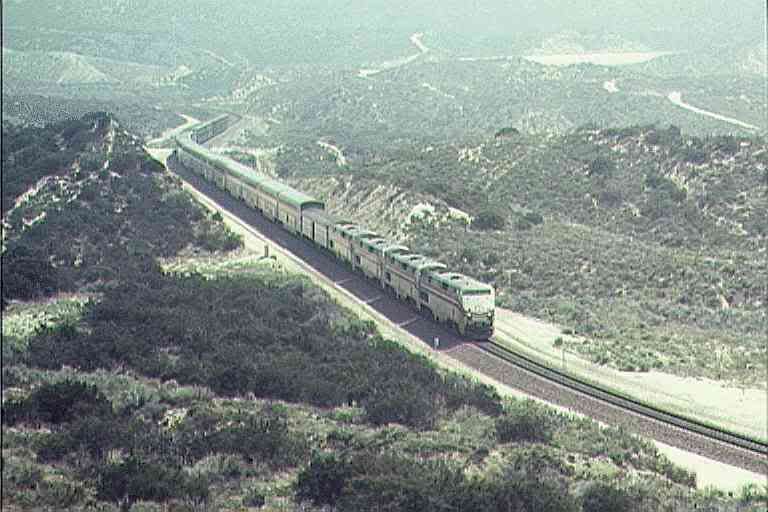
And so, in this evening's Sunday Train, we look at the "PRIIA Section 210" plans that Amtrak has developed for the five weakest of its fifteen long distance corridors: the California Zephyr, the Capitol Limited, the Cardinal, the Sunset Limited, and the Texas Eagle.

______________________

Join the discussion at:

The Stars Hollow Gazette

HillbillyReport.org

Progressive Blue

Daily Kos

Sunday, June 19, 2011

Sunday Train: Chairman Mica aims to block equipment Amtrak needs to expand

Burning the Midnight Oil for Living Energy Independence

The headline spin on House Chairman of the Transport Committee is that he is proposing to privatize the NEC to allow HSR to be built in this decade.

However, if you follow the money trail, while he proposes a process to do that, there is no funding proposed to do that. And without a funding stream for the federal share of anywhere from $40b to $100b to bring the NEC up to a state of good repair and then to make the improvements required, under current FRA regulations, to meet Mica's modest speed targets ... that part of it is not a real proposal yet.

The real proposal is to have talking points to use to object to any funding that gets out of the Senate to allow Amtrak to buy more equipment so it can expand the capacity and frequency to meet the steady increase in demand for its services.
__________________
More:

ProgressiveBlue ;
HillbillyReport.org ;
Docudharma ;
Stars Hollow Gazette ; and,
Agent Orange .

Wednesday, October 13, 2010

Sunday Train: Northeastern HSR Alignments & The Move to Tuesdays

Burning the Midnight Oil for Living Energy Independence

For the Daily Kos edition of this essay, I wrote:
This is a fairly short Sunday Train, but I thought I better get something posted, so I had somewhere to put this scheduling announcement:
  • Due to a new prep on Monday Morning this coming Fall term, the Sunday Train is temporarily moving to Tuesday Evenings until the end of year Holidays, starting next week (19 October)
... but, hell, given the haphazard scheduling of the crossposts (eg, posting on Sunday and crossposting on Wednesday evening), y'all likely won't notice the change.

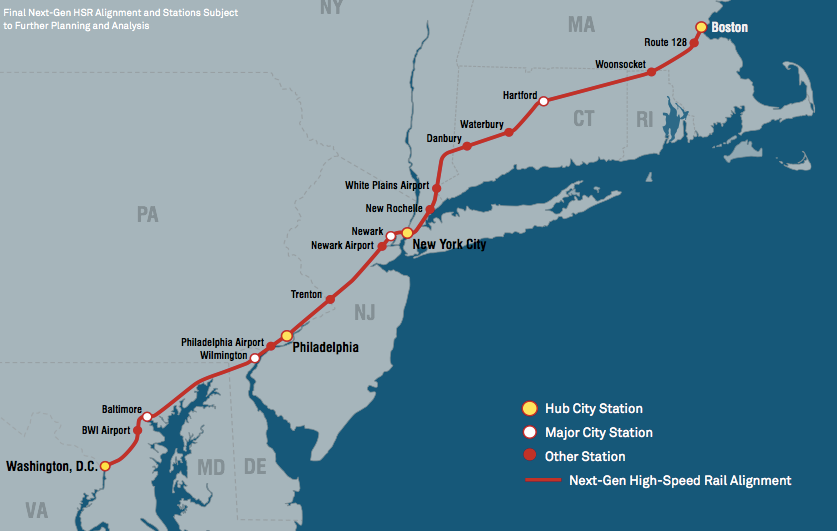
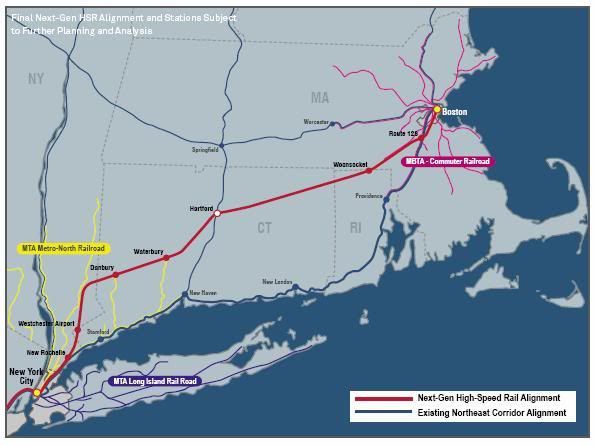
The actual Sunday Train portion is about one element of the Amtrak proposal for a High Speed Rail corridor for the Northeast: the alignment. At the preliminary proposal stage, an alignment must be selected for study so that preliminary cost and patronage estimates can be performed. However, if the decision is made to go ahead, a range of alignments will be (and, indeed, must be) studied.

So tonight I take a brief look at the alignment options from the report.

______________________________


Amtrak in the NEC: The Next Generation

For those who missed last week's Sunday Train, the "Next Generation" proposal aims to build on the NEC Master Plan to provide Express High Speed Rail service in the Northeastern region, from DC to Boston via NYC.

The Master Plan aims to bring travel times on the highest speed Acela services down by a noticeable amount, but the main priority is on increasing service reliability. The NG-HSR plan aims to bring:
  • NYC/DC times down from 2:42 to 1:55 on the Express and 1:36 on the Flyer;
  • NYC/Boston times down from 3:31 to 1:46 on the Express and 1:23 on the Flyer; and
  • DC/Boston times down from 6:33 on the Acela to 4:06 on the Express and 3:23 on the Flyer.


The Northern Alignments

In the Northern alignments, there are three strategies for getting out of New York City:
  • the Long Island alignments, which then tunnel across and arrive in Connecticut running toward the north by northeast;
  • the New Rochelle alignment, which runs alongside the existing NEC through to New Rochelle, and then either runs along existing NEC shore or along the Air Line (with the modifications required by Express HSR, of course); and
  • Up the Hudson River valley toward Poughkeepsie (forcing me to finally learn to spell Poughkeepsie, Tough Keep Sie except with a P)


There are two basic ways to get into Boston:
  • along the existing NEC, either from Providence or joining the NEC near the boarder at Route 128
  • in from Worcester toward the west by southwest.


And then, depending on the alignment out of New York, there is a wide range of rail and highway alignments to get through Connecticut.

One option that is not in the scope of the preliminary planning is more than one alignment: that is to say, one Regional HSR corridor, similar to the NEC, and focusing on the additional populations connected with Boston on one side and New York City on the other, and one Express HSR corridor, focusing on connecting metro Boston and metro New York.


The Southern Alignments

There are a similar set of southern alignments, but I expect that the alignments to the east of the NEC can be set aside, which leaves the main contenders as being the "Allegheny" alignment and paralleling the existing NEC. Note that for the Allegheny alignment, the Emerging HSR Philadelphia/Harrisburg or "Keystone" corridor takes on added significance, since a Semi-Express could run NYC/Philalphia and then onto the Alleghany Express HSR via the Keystone corridor.

Further, the Keystone corridor could be used to connect the (informal) Appalachian Hub to NYC. Long time readers will recall that one backbone of the Appalachian Hub is a Steel Interstate on the Shenandoah Valley & Tennessee corridor. From the northern end of this backbone at Harrisburg, a service could continue down the Keystone corridor to the Alleghany NG-HSR corridor at Westchester PA (see map) and then on to NYC.


Alignments and Connecting to the Rest of the Country

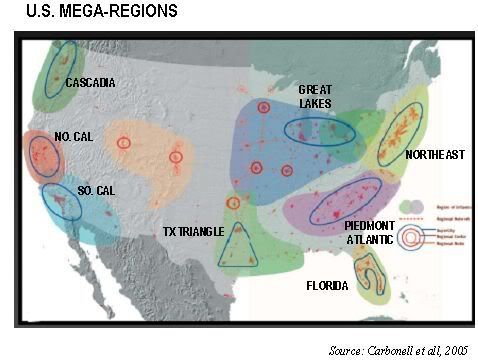
As already suggested above, the choice of alignment in the Northeast can affect how easy it is to integrate into the Express HSR corridors from outside of the Northeast. And the map of potential emerging Mega-Regions in the United States gives one indication why that is important: the Great Lakes / Midwestern Mega-Region and the Piedmont-Atlantic Mega-Region are immediate neighbors to the Northeast, and at distances where Express HSR is a viable competing transport option under current energy prices ~ and where even 110mph Emerging HSR will be a viable competing transport option at the energy prices that we may well see in the decade ahead.

In my view, the westernmost alignments give the best connections. For New York and Massachusetts, the Hudson to Massachussets Highway alignment provide excellent benefits. For Pennsylvania, there are pluses and minuses to the Allegheny alignment ~ a major plus being the opportunity to split a train from Pittsburgh at Harrisburg, with one service heading to Philadelphia and south to DC and the other service heading express to NYC and beyond.

And of course, the western NY/MA alignment provides a substantial headstart both on an Express HSR corridor from NYC to Montreal via Albany and a Regional HSR corridor from Boston to Albany and the upstate New York region of Syracuse / Rochester / Buffalo.

However, for Connecticut, the westernmost alignment mostly bypasses the places they would most want to connect, and so if the western alignment is adopted for the Northern segment, we would want to be serious about pursuing a Regional HSR connecting the center of the state to both NYC and Boston.

The trick will be working out a system for funding. The 10 cents per gallon tariff on imported crude oil that I have previously suggested, with 1/4 of the proceeds to go to HSR funding, would only be a start toward funding any substantial number of miles of Express HSR corridor. However, if focused on 110mph Emerging HSR and 125mph Regional HSR, it seems like it could certainly support a 110mph or 125mph alignment to extend the Northeastern intercity route matrix.


Midnight Oil ~ King of the Mountain

Monday, October 4, 2010

Sunday Train: 1:36 NYC/Boston, 1:23 NYC/DC, $117b, 30yrs

Burning the Midnight Oil for Living Energy Independence

As The Transport Politic reported earlier this week: Amtrak Unveils Ambitious Northeast Corridor Plan, But It Would Take 30 Years to be Realized
After months of sitting on the sidelines as states and regional agencies promoted major new high-speed rail investments, Amtrak has finally announced what it hopes to achieve over the next thirty years: A brand-new, 426-mile, two-track corridor running from Boston to Washington, bringing true [Express] high-speed rail to the Northeast Corridor for the first time.


Some questions and answers, over the fold.
____________________

Why HSR for the Northeast?

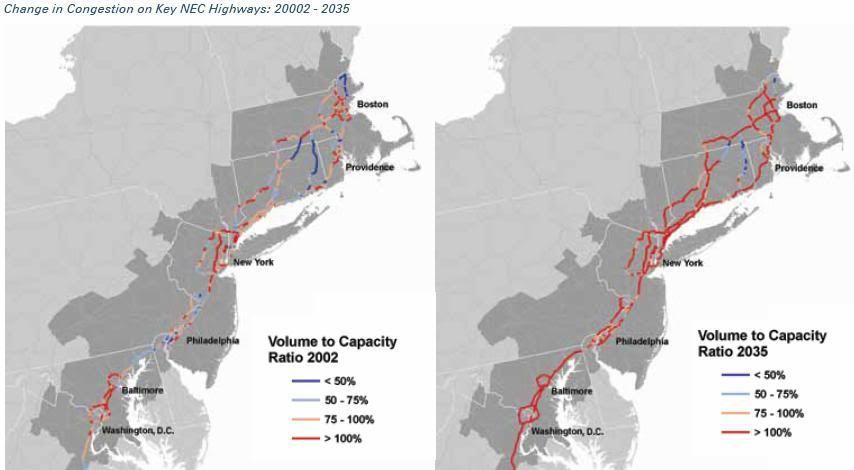
The argument that the [http://www.amtrak.com/servlet/BlobServer?blobcol=urldata&blobtable=MungoBlobs&blobkey=id&blobwhere=1249215312103&blobheader=application%2Fpdf&blobheadername1=Content-disposition&blobheadervalue1=attachment;filename=Amtrak_NECHSRReport92810LR.pdf report (pdf)] presents for doing this at all can be summarized in three pictures. The one to the right is "Emerging Megaregions" view of US social geography in the century ahead. Connecting together these megaregions is conceived of as a major task that will be facing intercity transport in the coming half century.

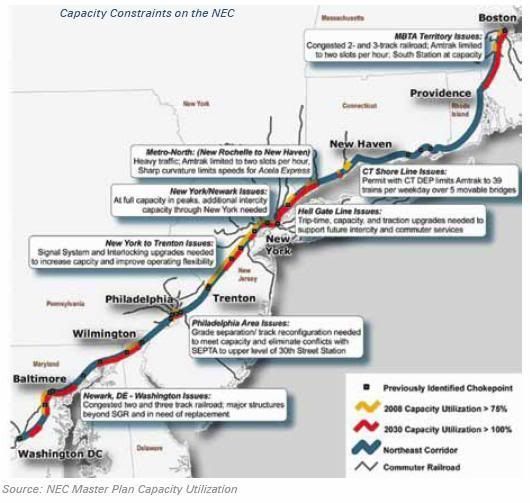
The report projects growth trends. Now, as shaky as any projection is, the alternative to doing them is to just wait until stuff happens and then start planning to fix it, and the risk there is what can be done as an emergency response is far inferior to what can be done if we plan ahead. And these projections lead to capacity projections for both Highway and Rail systems. And those two pictures (highway above, rail below) summarize the balance the of rationale:


On highways local trips crowd out intercity trips. So people will want an alternative. Nowhere is it more likely than the Northeast that much of this demand will spillover into demand for rail transport, but the existing Northeast Corridor is projected to have six main congested segments: north DC, Baltimore, North MD / Delaware, urban Philadelphia, Trenton, Newark/NYC/New Rochelle, and Providence/Boston.


When you need new rail capacity, and the existing corridor is approaching its capacity, a new corridor is one solution to that problem. Given the cost of roadbuilding in the Northeast, where most easy road capacity expansion projects have already been done, $117b is likely to be substantially cheaper than trying to provide the same transport capacity by road, even assuming a fantasy world of ongoing cheap oil.

After all, that was the impetus for the first two bullet train systems, in Japan and France: existing mainline passenger rail corridors reaching capacity. When faced with that problem, build an all new Express HSR corridor, pull existing longer distance intercity passengers into the new corridor, and that frees up capacity on the existing corridor.


Why does it take 30 years?

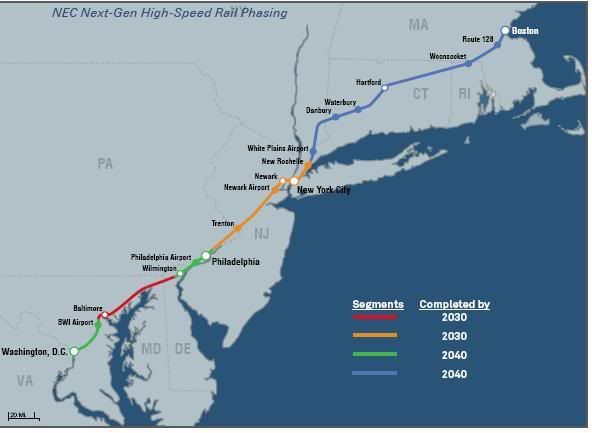
This also explains the "takes 30 years". It could be done in substantially less time, but the planning study looked to provide for two segments to be completed by 2030:
  • Baltimore through Wilmington, in red, and
  • North of Philadelphia through New Rochelle in yellow.

These initial segments are anchored on the existing NEC, so that on completion, they can be used immediately by Acela trains to accelerate Acela services will reducing congestion in these sections. Then the balance of the corridor is finished by 2040.

Indeed, the study assumed completion of the NEC Master Plan over the next ten years, which would lead to a baseline growth in ridership on the NEC from 11.8m in 2010 to 16m in 2020. It is in 2030 that the Master Plan projects to hit new capacity constraints at a ridership of 21.3m, and then grow at a slower rate from then on, reaching 25.3m by 2050. With the HSR corridor included, the baseline projection is 25m by 2030 and 37.5m by 2050.

So within the scope of the planning study, one can say that it is projected to take 30 years because that is when the full system is projected to be required to meet the transport needs of the Northeastern Mega-region. If a quicker completion date were required, it could be accommodated, but this can be seen as a three phase plan:
  • 2020 (or earlier): Complete Amtrak NEC Master Plan
  • 2030: Complete two priority segments of the "Next Gen" HSR corridor
  • Complete the balance of the "Next Gen" HSR Corridor


On other other hand, in a Western Democracy, completing an all new alignment takes time. We might expect to complete a project of this magnitude fifteen to twenty years after we commit to starting, but it still does require substantial planning ahead. So if we were to adopt a "full speed ahead" approach, we might complete work on the NEC Master Plan over the next six years, by 2016, and then roll out a DC/Boston HSR corridor by 2025.

Of course, under the current political climate, we are not going to be doing any such thing.


Why introduce this plan under this political climate?

The way I put it in the comment thread at The Transport Politic is:
If the Master Plan is going to ease immediate capacity bottlenecks by 2017 and capacity is projected to be hit over far more of the corridor by 2030 even in the conservative projections that Amtrak makes, which ignores the effect of Peak Oil, then that would suggest that the Transport Authorization circa 2016/2018 would need to include provision for addressing that capacity constraint, since it takes a decade or more to build an all-new corridor.

That suggests that it would be useful to get a preliminary outline of the shape of that kind of system rolled out in advanced of the preceding Transport Authorization.

Which is now and this.


As shown above, for the section of the corridor that runs the furthest from the NEC, the NEC is an integral part of the transport system, and the Express HSR corridor provides an additional piece for that system.

And of course, I don't expect to get this in the next transport authorization. But I expect that by the time the next transport authorization has expired, if there is a proposal out there, and we have had some experience in various parts of the country with both Regional and Express HSR systems, then we could well see an effort go ahead.

And under that kind of time horizon, if there are is a brand of political propaganda being pushed at the present by an Australian smut merchant and a Saudi Oil Prince, well, so what? With two or more severe oil price shocks highly likely between now and then, the durability of the Texas Tea Party (oil, that is) political strategy is not something to take for granted: we got to keep on planning for the future even if a radical right wing 20% of our population wants to toss this old Republic on the garbage heap of history in service to oil industry interests.


What Can We Do To Help?

There are a number of things we can do to help pursue this. First, completion of any Emerging, Regional, or Express HSR corridor and the launching of services will undermine negative propaganda (being bankrolled in part by oil interests). Second, support for funding of the Amtrak Master Plan for the NEC is a critical element for making this plan possible, since if local rail and shorter-range intercity rail can be made into rivals to Express HSR, it undermines both. Third, go visit the newly established Northeast HSR blog and give it the activity and links that such a site needs to thrive. And, of course, join Transportation for America, to network with people pushing for progressive transportation solutions coast to coast.


Midnight Oil ~ Truganini

Wednesday, March 17, 2010

Sunday Train: Economic Independence will Help Pay For Itself

Burning the Midnight Oil for Living Energy Independence

Last week I presented a draft of a national Steel Interstate plan. The focus was on the Institutional Framework required to be able to build it, including the source for the interest subsidy to finance its up front capital cost.

Possibly lost in the wall of words was an important point, which was focused on by some commentary: the users are paying the capital construction cost. As a country, we need it, so as a country, it makes sense to find a way to jumpstart it and have it available for the oil prices shocks that are coming in this next two decades.

... but once it starts getting used, that's what will cover the original construction cost. One way we can tell we are heading toward Economic Freedom is that it helps pay for itself.
_______________________________

STRACNET Map:

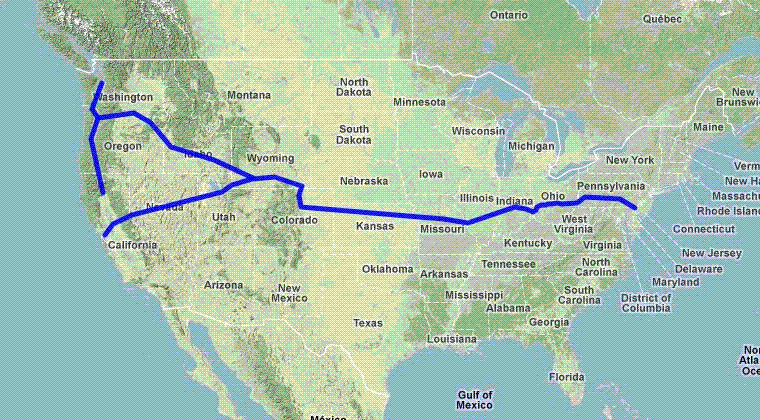
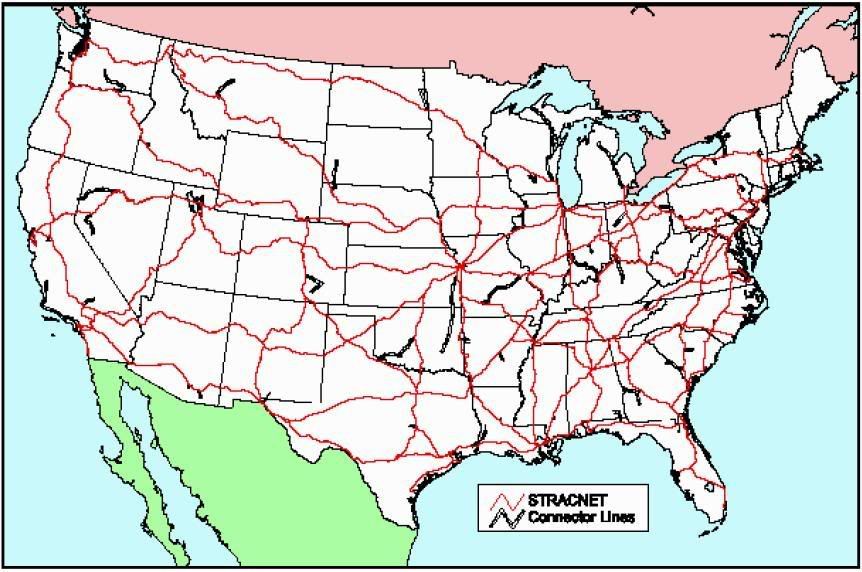
I'll be talking about "STRACNET" below, the Department of Defense STrategic RAil Corridor NETwork, which is the system they developed for protecting their logistical needs in the half century that railroads were shedding track and corridors. The map is to the right. For those playing the home game, draw your own Steel Interstate system by selecting corridors from the red lines in this map.


Parasite Capitalism versus Economic Independence
Indeed, the focus of the Institutional Framework is ensuring that User Fees and Access Fees will refund the original capital cost, while at the same time ensuring that we do not have to dilly dally and delay on getting the process started.

So, yes, its a public investment in Economic Independence. But its a public investment, and part of the return actually is financial return. The Economic Independence helps to pay for itself. In that sense, it is closer to a Tollway than to the Free Rider type of Interstate.

What I want to argue, however, is that this is not unusual.


Parasite Capitalism and Oil Addiction

Certainly much of the "Great U-Turn" political economy that was established starting in the 1970's built upon the existing institutions of the Great American Middle Class economy that preceded it. However, it was very selective in the institutions it focused on: it focused on the art of taking the free ride.

Of course, there is no such thing as a genuinely free ride - what "free ride" means is simply that one party receives the benefit and a second party bears the cost. And the single word that encapsulates that relationship is "parasite". So we can call the economy of the 1970's to the present day, "Parasite Capitalism".

For instance, consider the Housing Bubble economy. This was just the most extreme elaboration of the standard sprawl property development system. And what is the standard sprawl property development system?
  • Get the right to "develop" an undeveloped greenfield site
  • Get someone to subsidize some road infrastructure
  • Get someone to subsidize utility support infrastructure
  • Get permission to do the development
  • Build it and sell it
  • Reap the reward of all your individualistic hard work


And the Highways based transport that the sprawl development relies upon itself relies on the art of the successful parasite. All highway users benefit from gas taxes paid by people driving on city streets that do not qualify for highway funding. The Federal Gas Tax helps people believe the myth that they are "paying" for the road and that its "their" road, when various state and local taxes cover the cost of the roads that generate the traffic on "non-highway" streets that generates the cross-subsidy to Interstate, US, State, County and Township Highways.

Note the last ... its not just Interstates. Lots of little country roads are subsidized by urban motorists.

With urban drivers as the parasite hosts and suburban drivers as the parasites, of course, growing numbers over time have moved to the suburbs, to get from the cost side to the benefit side. Which is great for short term windfall gains for property "developers", because that props up demand in the suburban areas where they have a well entrenched parasite capitalism system in place.

But its not long-term sustainable. Eventually, as the number of hosts dwindles and the number of parasites increases, the benefit available per parasite starts to drop. So it becomes harder and harder to meet all the demands on the highway trust fund with the proceeds of the gas tax that funds it. Add on top the decision to not index the tax rate for inflation ... which could be seen as a short-sighted measure to offset the ongoing increases in the real price of crude oil ... and there is less and less free riding opportunity.


What Did You Call Me?!!

To avoid confusion, I must stress that this is not a moral argument. One of the big shell games of the Great U-Turn is to moralize arguments, so that public consideration of problems does not involve looking at problems and looking for solutions, but instead involves looking at problems and looking for scapegoats.

This is the way the system is built. Its not the product of unconstrained individual personal choice. Looking to place individual blame in each individual suburban resident is like looking for the square of the checkerboard gives it the checkerboard pattern.

We definitely have to rebuild the system, but good people for many years have been fighting the fact that the system is built this way, and its just a hard fight, with no guarantees of victory.

Economic Independence is a big part of advancing from Parasite Capitalism to a system that is sustainable, and Energy Independence is a critical part of that.


Tailoring the Steel Interstates

This is the target of the Steel Interstate system: the long haul truck freight loads. That's where there is massive energy waste to be mined, since a long haul diesel semi truck requires over 10 times the energy to haul a ton of freight as Rapid Electric Rail Freight.

And the users are going to be paying its up-front capital costs, that's the financial value that the private railroads are going to be chasing in order to provide the payments. They are a bunch of corporations, after all, and like any other psychopathic corporation, they will provide precisely as much public benefit as the chase of dollars leads them to do.

Lots of points jump out that demand changes in the map that I drew last week:
  • First, the most important southwesterly line of freight in the Eastern US is the Shenandoah Valley extending into the Tennessee Valley, running inland of the population concentrations on the eastern seaboard
  • Second, there are important southern seaboard ports, and the line I draw, taken directly from the Southeastern HSR corridor plan, does not provide direct access for most of them.
  • Third, the first Stage ought to have lots of length to it, because until the network starts building up, its the longer runs that will be most vulnerable to competition from Steel Interstate rail ... and the more business the Steel Interstate rail wins, the more quickly they pay the capital cost of the line


I also thought that it makes more sense to start up all the four lines on a project development and planning basis, and the launch each with an increment of the interest subsidy funding from the imported oil tariff. So that is four stages rather than five, with all four Development Banks receiving $0.0025 from the initial penny per gallon, and then the four stages each hitting high gear as they get their additional penny in each following year.

So this is what I've done. I've started in Boston at the extreme Northeastern edge of the STRACNET system, come down to New York via Albany (the NEC is awfully crowded, after all, and this is for long haul freight), then to Harrisburg, Pennsylvania to enter the broad central valley of the Appalachian mountains. Follow that down to Chatanooga, then to Nashville and Memphis to run through to Dallas, then down to El Paso and run via Tuscon and Phoenix to Southern California, then up the Central Valley to northern California.

I call this the "Liberty Line", as a major step toward Economic Freedom.

This corridor is first in part because it makes plenty of sense to do it even if roll-out stalls with the first line due to political fighting the main Parasite Capitalists threatened, including those US Oil Companies with substantial overseas oil production interests and hence a strong financial interest in our Economic Addiction to Oil Imports.

Looking at the freight map, there are massive truck freight loads that run entirely north of the Liberty Line, as well as a substantial amount of the traffic that runs on part of the Liberty Line that comes in from further north. So next comes a North/South corridor that I call the "Heartland" Line.

The Heartland Line runs up from Miami to Nashville via Atlanta, then up to Chicago by the most direct STRACNET route, then up to Minneapolis, and finally grabbing land port business by running up to terminate at Winnipeg in Canada.

The second leg of the Heartland Line starts in New Orleans, Louisiana, running up to Nashville and then to Cincinnati via Louisville, Columbus, Cleveland, Buffalo, and then Toronto.

With the Heartland Line development in progress, now is time to launch the National Line stage, which in the first draft was presented as Stage 1. There is a major adjustment here, since looking at the truck freight flows suggests that it is better to access the Pacific Northwest via southern Idaho, and so the National Line is now drawn to fork west of Cheyenne, with the north fork going to Portland, Oregon, and the south fork going to Sacramento to cross the Liberty Line and the Port of Oakland.

The National Line begins at the port of Wilmington, Deleware, which is the most convenient port to Liberty Line junction at Harrisburg. The line crosses to the railhead of Pittsburgh, then follows the National Line through Wheeling and to Columbus, where it a junction with one leg of the Heartland Line. From there I've drawn it as taking the existing STRACNET corridor past Dayton, until it hits the Stracnet Corridor through Indianapolis, and then through the Terre Haute where it has the junction with the other leg of the Heartland Line.

From there the line continues through St. Louis, Kansas City, Denver, up to Cheyenne to run around the Colorado Rockies toward the strongest east/west freight market north of the southern tier of states. From there, as described, it forks, heading up through southern Idaho to connect to the Pacific Northwest, and through Salt Lake City toward Sacramento and then the main Northern California Pacific port of Oakland.

Now I have two main tasks to complete. First, I have a number of southeastern coastal ports that are not on the system and are too important to omit from the system. And second, if there is not going to be a Line running along the biggest of the east/west truck traffic flows west of the Mississippi, on Interstate 40, then there has to be crossing lines that can capture that freight. The Liberty Line can capture western Interstate 40 traffic to or from the Northeast, but there is nothing to intercept freight to or from the southeast.

So the Gulf and Atlantic line runs along the Southeastern Atlantic Coast to junction with the Heartland Line at Jacksonville, then to Mobile, New Orleans, Houston, and connecting to the Liberty Line at El Paso. It has a second leg from Houston that runs to Dallas, crosses I-40 at Lubbock, and continues up to junction with the National Line at Denver.

Which completes the system. It may look like a tangle, but in the Institutional framework, there are four organizations which have the goal in front of them to finish their corridor. And note that as a form of Regional Development Bank, they will not be exercising the Federal government's powers of eminent domain, so they have to focus on hammering out the way of meeting their charter that is sufficiently appealing to the freight railroads to be able to build their line.


And now the headliners: Dreamworld / Midnight Oil

Sunday, March 7, 2010

Sunday Train: A Nationwide Freight and Passenger Regional HSR System

Burning the Midnight Oil for Energy Independence

It often seems there is a deep canyon lying between what we can do and what needs to be done as a community, as a local region, as a state, as a national region, or as a nation.

But the Steel Interstate is a national program that a coalition of determined groups of advocates scattered across the country could get going. It bridges regional interest conflicts, and offers a way to advance some of the interests of:
  • Interstate motorists, by taking a substantial amount of semi truck traffic off the road, reducing both driving stress and road damage
  • Advocates of car independence, by providing a Rapid Rail network that can extend the reach of Regional HSR train services in a financially sustainable way
  • Private sector organized labor, by providing an ongoing project that will employ people in constructing the system and producing materials for the system, and as a direct consequence reduce the import share of national spending, increasing the employment impact of all newly financed spending, private or public
  • The large "army of unemployed" benefit in precisely the same way
  • Advocates of a development of an ecologically sustainable, by saving 90% of the energy cost of long haul freight transport by diesel powered semi-truck
  • Advocates of effective climate change mitigation strategy, in precisely the same way
  • Progressive Patriots, by advancing the cause of Energy Independence and weakening the foundation of the protection racket that oil companies use to gain control over US military power in support of corporate interests and in opposition to US national interest


Of course, I want to talk process, but it seems to be network maps that catches people's interest. So how I will go about this is alternating Map and Process.


Stage 1 Map: The National Line

The genesis of Stage 1, from which the balance of the map follows, was a comment in the dkos edition of the Sunday Train, Sunday Train: Attacks on HSR in Flyover Country, by IndianaDemocrat
So, Ya' Wanna Build A High-Speed Line?
Then build one that will actually have an IMMEDIATE TANGIBLE ECONOMIC BENEFIT.

Reconstruct the National Line form Pittsburgh to St. Louis as a High-Speed, three-rail line.

This bypasses Chicago, reduces cross-country travel times by as much as a day-and-a-half, OR MORE, depending on Chicago delays. Make it a Nationally-owned and operated line, available to all railroads to use. Even the Shortlines, for a fee.

Put that money to use actually doing something that could help breath life back in to manufacturing, instead of a flashy boondoggle.

The Stimulus Flyover projects in Chicago are a start, but little more than band-aids that don't really address the bottleneck problem.

by IndianaDemocrat on Sun Feb 21, 2010 at 08:00:59 PM EST


That's what Line#1 does. Now, as explained later in the process section, each stage is around 3,000 miles, so there's more to it: New York to Pittsburgh is the STRACNET alignment that is generally the route of the Amtrak Pennsylvanian, St. Louis to Denver is a STRACNET freight corridor, and Denver to Oakland, California is generally along the route of the Amtrak California Zephyr.

Before you react to the passenger service appeal of the corridor .... stop. Take a deep breath. This is at its core a plan that is to provide an opportunity for Sustainable Energy Independent long distance freight transport. Consider the truck traffic on Interstate 70 between Pittsburgh and Denver before rejecting the alignment out of hand.

What makes IndianaDemocrat's proposal so powerful is that STRACNET through Ohio and Indiana is a bit of a tangled mess, and it is quite plausible that the loss of the National Line is the reason.

Also, bear in mind that freight trains can change locomotives. Swapping locomotives costs time ... but if the run on an electric corridor is fast enough, both in terms of speed and in terms of capacity to handle traffic without delay, it can easily cover the time-cost for long-distance traffic.

So this is not an isolated corridor, its a trunk corridor that can be accessed by a wide number of the STRACNET corridors.


Stage 1 Process: Foundation Concepts for the Steel Interstate Project

After four to six months writing Sunday Train's, its easy for me to lose track of the fact that while there are some regulars, there are also always some people who are dropping by for the first time. So if the following is old news to the regulars, my apologies.

The Brawny Recovery. Back when the US was Energy Independent, progressive macroeconomist's would patiently explain that there is simply no problem with the government running a deficit during an economic downturn.

After all, "Money" is just a permission slip from the government: its resources that can limit the government's freedom to deficit spend. And during a downturn we have idle resources.

"Except" ... except that now we are no longer Energy Independent. Instead, we are addicted to imported energy. Like any Dependent Economy, there is always a risk that boosting demand for domestic resources will lead to problems in the exchange rate of the local money, causing a crisis in access to the external resource.

So under the situation of growing addiction to Energy Imports that has been pursued as active government policy over the past three decades by both Republican and Democratic administrations ... we can't ignore the impact on our external balance.

So we need to do more than just do "Keynesian Pump Priming": we need to ensure that we spending some of that money on stuff that helps us make stuff. That's the "Brawny Recovery": economic stimulus that also develops our national economic strength.
Ecological and Economic Sustainability. I do not spend a lot of time in the Sunday Train arguing about whether the US Economy is in an unsustainable ecological overshoot, nor about accelerating climate chaos, nor about a wide range of ecological and social failings of our current transport system. But Energy Efficiency ties into these concerns as well. Economic Growth is getting more stuff done that people want done. The massive material wastes built into our present system, means that we have an opportunity to mine what is presently wasted to get economic growth without requiring more material support.

And this is what makes it possible economically to get these projects launched. We are doing a lot of things in ways that only made economic sense with $1 a gallon gasoline or diesel (in 2010 prices). The economic foundation has fallen away, but the institutional supports keep obsolete systems and practices alive like so many zombie transport systems.

Opportunity for Sustainability. It is easy to fall into a status quo bias in which we evaluate every change in terms of what the impact will be under our present way of doing everything else. But I don't believe we can actually keep doing everything else the same way either, so I also look at how easy it is to upgrade something to full sustainability.

For long distance transport, there is no mature transport technology that has a stronger opportunity for sustainability than electric rail. Given the massive energy waste of long haul truck freight, the correct speed is "fast enough to capture freight shipments that would otherwise go on the road." Hence the focus on 100mph Rapid Electric Rail freight, which is fast enough to do precisely that.

STRACNET. STRACNET is the department of defense Strategic Rail Corridor Network. Forty years ago, the Pentagon noticed that rail lines that it depended upon in its planning for logistical support in times of crisis were in the process of being ripped out. So rail corridors with strategic impact were identified, and the STRACNET process was born, whereby the Department of Defense looks at proposals to abandon a rail line that is on STRACNET and tries to hammer out a solution that maintains the logistical capacity it requires.

As in so many other things in our society, we are only "allowed" to do serious national planning if there is a defense component. But we have been wearing massive (and politically motivated) blinkers over the past thirty years: the addiction of our nation's economy to massive oil imports is one of the greatest threats to national security that we face.

The presumption is that these investments will take place on STRACNET corridors - but note that there is some flexibility in this, since regional development banks would be in a position to negotiate with Department of Defense logistics bureaucrats to add or shift STRACNET status from one corridor to another.


Stage 2 Map: The Gulf and Southwestern Line

The next line to roll out ... and under the system proposed below, each line begin rolling out the year after the previous one ... runs from Miami to Los Angeles via Jacksonville, Pensacola, Mobile, New Orleans, Baton Rouge, Houston, San Antonio, El Paso, Tuscon, and Phoenix.

One thing this line focuses on is port traffic, which is why it starts at Miami, runs to Los Angeles, and runs through Mobile, New Orleans, and Houston (with junctions to Galveston).

This is the Florida Atlantic Coast route and then the old Amtrak Sunset Limited, before it was chopped back to NOLA/LA.

You'll probably notice that there is no "whistling past Dixie" here ... more like "whistling through Dixie".


Stage 2 Process: Institutional Foundations

So, if we want to tap the energy efficiency of long distance rail, how would we go about doing it?

First, we learn the lessons of Amtrak in the Northeast Corridor and set the "Line Builder" authority up as a form of public regional development bank from the outset. We charter it with a specific responsibility to get a Rapid Electric Rail corridor established, and specify the cities that it must serve when construction is finished.

How to fund the thing? (Note: I am being "cute" here, using "fund" in its 1930's classical technical sense, and will discuss "finance" in another stage.) If we want an integrated, national network, it has to be publicly owned infrastructure. If we want the network integrated with the existing rail system, it has to be primarily on freight railroad right of way.
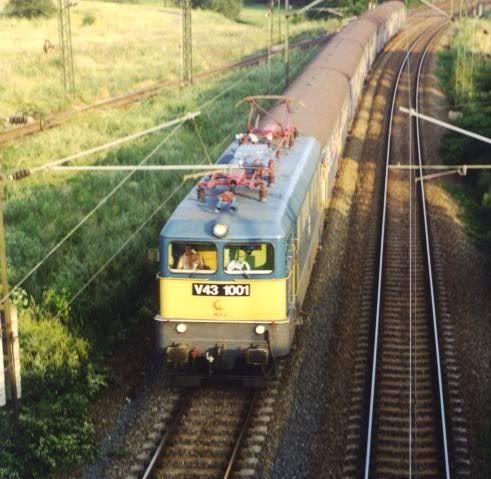
Once a rail path in a rail corridor has been electrified, it is very capital efficient to electrify all tracks in that corridor. So the basis of the regional steel interstate development bank making itself welcome is to provide the infrastructure for all existing track in the corridor, as desired by the right of way owner, in return for cooperation in providing for a Rapid Electric Rail freight path in the corridor.

And then the original capital cost project is funded by charging access fees to the tracks owned by the public authority, and user fees for the electricity consumed by all electric trains, on either the Rapid Rail or Heavy Rail paths.

Indeed, since having the capacity is in the national interest, while its using the capacity that is in the interest of the private railways, its possible to ensure that the terms are attractive by mandating that the user and access fees will be set at the level that provides for full recovery of the original capital cost in four years of 100% capacity utilization.

So the more heavily railroads use the stuff (and therefore the more useful it is to them), the faster the infrastructure is paid back. If capacity utilization is 20%, it will take 20 years to refund the cost ... if capacity utilization is 50%, it will take eight years to refund the cost.

Obviously, during an extended oil price shock, it will be used even more intensively, but there is nothing in this proposal that is waiting for things to change in terms of gas and diesel prices. This thing would have been used at the diesel prices at their trough right after the Panic of 2008 hit in full force..

Indeed, the question that is up in the air is how intensively it will get used and how rapidly rapid electric freight traffic will gain market share. Alan Drake, who developed the most ambitious form of the Steel Interstate system, was able to get modelling of the system done by the Millenium Institution, and this will get used under current economic conditions.

The funding system proposed here and financing system proposed below will allow the infrastructure to be built. If it turns out that we experience another oil price shock, the result will be to accelerate the roll-out of the corridors. However, the proposed institutions are entirely workable under present economic conditions.


Stage 3 Map: The Gulf and Northwestern Line

Its a distinctive fact of the shape of our country that the Great Lakes and Gulf of Mexico makes the country narrower north to south east of the Mississippi, and wider north to south west of the Mississippi. Stage 3 takes advantage of that to provide for the first crosslinking while bringing in the northwestern quadrant that is under-served by the first two corridor.

Stage 3 starts at Mobile, linking to the Gulf and Southwestern Line, and runs up through Birmingham, Nashville, Louisville, and up the STRACNET connector to the STRACNET corridor to Chicago, It crosses the National Line with a high capacity cross-over junction at Terre Haute, Indiana. From Chicago, it runs through Milwaukee, Madison, Minneapolis, and then along the northern STRACNET corridor through North Dakota, Montana, Idaho, and Washington to Seattle.

In Amtrak terms, the Northwestern portion of this corridor is the Empire Builder route.


Stage 3 Process: Financing the System

Looking ahead to a system of repaying the original capital cost over time means that a system is needed for paying the interest expense of the capital spending between the time that the money is spent and the time that the capital cost is paid back. This is what is classically called "Financing" the capital expense.

My proposal cuts to the heart of the matter. The problem with gas taxes is that they are seen as making gas more expensive.

But the US is not Addicted to Energy Imports because we have lost the ability to produce oil. We are the third biggest oil producer in the world, behind Saudi Arabia and Russia but well ahead of Iran, Mexico, China, Canada, UAE, Venezuela, Kuwait, Nigeria, and etc. With roughly 5% of the World's population we produce about 10% of the world's oil.

We are not an "oil poor" country. We are an oil wasting country, consuming about one fourth of the world's supply, 2.5 times our production and 5 times our "global per capita share".

That's why "drill baby drill" was such a load of total bullshit. We already "Drill, Baby Drill" ... the myth that we do not is a convenient lie, and no basis for national policy.

And as the biggest oil waster of the world, our chief power to keep oil prices from skyrocketing is by cutting our massive waste of oil.

So this proposal goes to the heart of the problem. For each rail line, a $0.01 per gallon tariff is imposed on all imports of petroleum and petroleum products. The tariff starts at $0.01, and the regional development bank for the first line can start work, then $0.02 and the second bank can start work, up to $0.05.

A massive step toward independence from the Saudi Oil Sheiks and the Phantom Iranian Menace and the corruption and savagery of Nigeria's national oil policy and Hugo Chavez ... whoever you do not like among the nations we rely on to feed our insanely counter-productive imported oil addiction, a massive step toward reducing the imports "from them".

It may well be that the original interest subsidy will not cover the whole capital cost ... but that's OK, since building the first 2,000 miles will start generated user and access fee revenues which can be recycled into new capital spending until the line is finished. And then, when the construction of the mandated line is finished, the development bank uses the tariff revenue to accelerate repayment of the original capital cost.

And then, when the full capital cost is repaid, the tariff is extinguished.

We import in the neighborhood of 200b gallons of petroleum and petroleum products a year, so a $0.01 tariff yields in the neighborhood of $2b annually. That supports from $40b to $50b in bonds at interest rates of 4% to 5% ... less at higher rates, more at lower. Alan Drake's original proposal was costed at around $450b for over 30,000 miles of track ... so I am taking about $45b for 3,000 miles of track and working on that basis.

That is why these first three lines have all been in the neighborhood of

And building the system to its robust ... that is what allows "in the neighborhood" to work out. A robust funding framework with the flexibility to cope with moderate oil prices and extremely high oil prices is what we need to insure our economy against the potentially rocky road that lies ahead.

This is, after all, an infant industry tariff - a finance rather than protective infant industry tariff to be sure - so once the system is launched, the tariff should go away.

At that point, the longer term mandate of the regional development bank to promote the development of energy independent and carbon neutral transport in systems within its broader catchment kicks in.


Stage 4 Map: The Front Range Line, the Great Lakes Line, and the Southeastern Line

Apologies that the Southeastern Line was inadvertently omitted from the map ... you can see if on the final map below

So far New England extending into the heavily trafficked I-80 and I-76 corridors has not received a line, and there are obviously still large holes in the network. So at Stage Four there are three shorter Lines.

The Great Lakes Line starts in Boston and runs through Springfield MA, Albany and Buffalo, NY, Erie PA, Cleveland and Toledo OH, northern Indiana, into Chicago. The Southeastern Line extends from New York through DC, Richmond VA, Raleigh and Charlotte in NC, and Atlanta GA to connect with the Gulf and Northwestern at Birmingham, AL. And the Front Range Line runs from El Paso through Albuquerque through Colorado Springs to Denver.

The first three corridors are launched in three years, one after the other, each with a dedicated $0.01 in petroleum tariff revenues. These are three shorter lines, so the revenue is split: 0.4 cents goes to the Great Lakes Line, 0.4 cents goes to the Southeastern Line, and 0.2 cents goes to the Front Range Line.


Stage 4 Process: Building the Coalition to Get there

So far, this is just blueprinting. But without an opportunity to get involved, then a blueprint just gathers dust on the shelf. What is needed is to convert the blueprint into an Action Plan.

This requires coalition building. Steel Interstate Advocates need to form local advocacy groups, in all the cities and states served by the corridors ... which is all of them except Hawaii and Alaska. Even states that do not have a corridor have:
  • access to the corridor via their local rail network
  • benefits of the corridor in reducing national oil consumption
  • and participation in the energy independence transport investment by the "Line" development banks once they have finished rolling out the corridors.


But long experience is that face to face meetings are required to actually look people in the eye and talk to them in person and get things moving.

Of course, the groups can be freestanding, but do not have to be freestanding. It can be an interest group working party in a union local. It can be an interest group working party in a local political party. It can be an interest group working party as part of Drinking Liberally. It can be an interest group working party wherever you can pluck up the courage to suggest it.

This is one reason why I've focused on sketching a robust system ... a fine tuned, well oiled machine would be fine for a fine tuned, well oiled political machine to put into action as a demonstration of its prowess. But this is something that we are going to have to make into an issue, over the next year, or three years, or decade if that is what it takes.


Stage 5 Map: The Midwestern Line, the Texarkana Line, and the West Coast Line

Stage Five finishes up the main trunk network ... using STRACENET corridors to provide North/South trunks in the Midwest and West Coast. The Midwest Line runs from San Antonia to Austin, crosses the Texarkana in Dallas/Fort Worth, Oklahoma City, Wichita to Kansas City, then on the STRACNET corridor through Des Moines to Minneapolis. The Texarkana runs from through Dallas/Fort Worth to Little Rock Arkansas, Memphis TN, and connects to the Gulf Coast and Northwestern at Nashville. And the West Coast line runs from San Diego to cross the Gulf and Southwestern east of the LA Basin, up the Central Valley to Sacramento, where it crosses the National Line, then Northern California through Redding, up the STRACNET alignment to Eugene Oregon, and then up to Portland to connect to the Gulf and Northwestern at Seattle.

The Midwestern Line receives 0.4 cents from the fifth tranche of imported oil tariff, the West Coast line 0.4 cents, and the Texarkana receives 0.2 cents.


Stage 5 Process: What Do You Think?

Well, this is a big fat whopping Sunday Train, and will post an hour late to boot ... but what do you think? In order of importance:
  • What do you think is an effective means of organizing to promote a national Steel Interstate system?
  • What do you think about the Line Development Bank system?
  • What else do you think about the mechanics of the proposal?


I expect to get lots of suggestions of different alignments and roll-out sequences ... and I am happy to discuss my why's and wherefore's on each and every line proposed as well as the logic of the sequencing ... but you know, even if not one single line I propose is adopted, and it is rolled out in reverse order ... any serious real world steel interstate system beats the best possible fictitious real world steel interstate system.

So if the lines that people are willing to fight for end up being completely different to the maps I draw up this weekend ... people willing to fight for any steel interstate line is such great news that I'd be sitting pretty.


The Headliners: Midnight Oil - The Power and the Passion


supported by Bethany and Rufus

Sunday, February 28, 2010

Sunday Train: Rescuing the Cardinal from Demise

Burning the Midnight Oil for Living Energy Independence


When looking at the famously mis-titled "Vision for High Speed Rail in America" map trotted out last year, showing those of state-planned High Speed Rail corridors that have already applied for and received official designation as High Speed Rail corridors ... there are ghosts on that map.

The Ghosts of Trains Past, also known as the Amtrak long distance routes.

As discussed on November 8th of last year in Rescuing the Innocent Amtrak Numbers from SubsidyScope, some of these ghosts are healthier than others. One of the ones in the most dire shape is the Cardinal, responsible for the only line on that map that enters either West Virgnia or eastern Kentucky.

Why it does so badly, and how it might be fixed up a bit, after the fold.

---[ Discussion at Agent Orange and elsewhere around the web ]---


Conventional Long Distance Rail Aint Easy

When tossing aside the fatally flawed SubsidyScope treatment of capital depreciation ... and I am still eagerly awaiting their consideration of the subsidies to road and air transport that uses the same approach to capital depreciation ... most long haul Amtrak routes have similar financial performance. If one says, "long haul Amtrak routes recover between 40% and 50% of their operating costs from fare revenue", that would cover ten of fifteen services:
  • from the Southwest Chief (IL/CA) and City of New Orleans (IL/LA) at 49%,
  • through the Silver Meteor (NY/FL), Capital Ltd (DC/IL), Coast Starlight (WA/CA), Crescent (NY/LA), Texas Eagle (IL/TX), California Zephyr (IL/CA),
  • to the Silver Star (NY/FL) and Lakeshore Ltd (MA|NY/IL) at 41%.


There are three that did better in the year that SubsidyScope considered: the specialty Auto Train between Virginia and Florida, at 85%, the Empire Builder from Illinois to Washington and Oregon at 61%, and the Palmetto from New York to Georgia at 55%.

And two that did worse: the Cardinal at 34%, and the Sunset Ltd from Louisiana to California at 23%.

This is not a diary about "fixing long distance rail". Whether 40% to 50% is a reasonable return given the other benefits that long distance rail may provide is not something I am fixing to consider tonight.

Instead, considering the norm of 41% to 49% ... the Cardinal falls short. That means that if the long knives come out, its neck is not far from the chopping block. And that is true even if in fact the average long haul route does provide twice as many external benefits as passenger benefits, and so it is true even if the Cardinal breaks even in an economic sense.

And its worse than that. The Cardinal is a route that runs three times a week in each direction. The final leg of its route to Chicago and first leg of its route from Chicago is "the Hoosier State", which runs as an independent short corridor routes the rest of the week.

And the Hoosier State is in even more dire straits ... where 9 of 26 regional corridor routes have operating cost recovery between 64% and 79%; 20 of 26 have operating cost recovery above 50%; and 25 out of 26 have operating cost recover above 30% ...

... the Hoosier State has operating cost recovery of 15%.

I have seen a comment to the effect that when Senator Byrd is no longer there to defend it, the Cardinal is going to be shut down. While I have no idea how accurate that comment is - it is certainly plausible.


Oh. My. God. How does it hit 34%?


And then you look at the schedule of the Cardinal, and wonder how it gets enough fares to cover 34% of its operating costs.

Consider it as a train to get to Chicago. Westbound, it is scheduled to arrive in Chicago at 10:35 in the morning, after leaving Indianapolis at 6:30am - that is the daily Hoosier State schedule. It is scheduled to arrive in Indianapolis at 4:44am, after leaving Cincinnati at 1:10am. It traveled through Kentucky between 10pm and midnight, and through West Virginia between 6:30pm and 9:35pm, leaving the capital of Charleston WV at 8:10pm.

Scanning up the timetable, the train got into southern West Virginia from western Virginia, and to there from Washington, DC. And that is the real surprise: this route which spends so much of its time heading up toward Chicago from the east by southeast ... originates in New York. Of course, nobody would take it from New York to Chicago, even if they were determined to rider the train, since its the slowest of the New York to Chicago trains.

The problem is, if you stop the train and turn it around at Washington DC, there does not seem to be a lot that is gained ... because the total route end to end is 23:25 from DC to Chicago, and 24:10 from Chicago to DC. So when taking turn-over operations and the schedule slack to cope with the inevitable delays, its hard to tailor the timetable to provide appropriate return trip schedules without losing quite a lot of time sitting idle.

As to how it hits 34%, that could well be on that part between New York and western Virginia ... which is part of the reason why the schedule timing is so poor for the majority of the route.

Except, with a little imagination ... it might be possible to fix the schedule up.


Fixing the Cardinal

The balance of this diary is done on a simple rule. I transport the current scheduled times between cities from existing Amtrak scheduled routes to the route that I am building here. Sure, in the Sunday Train, I've spent more than a little time writing about High Speed Rail ... but here, I am sticking to the conventional rail Amtrak.

That does not guarantee that these timetables are either feasible or, if feasible, exact. I have no inside information on rail system bottlenecks, and so this should be seen as nothing but a rough sketch. However, its a rough sketch draw with the brush of existing scheduled services.

Start out by breaking the Hoosier State free of the Cardinal. It might run, for instance, down from Chicago at 7:30am, and return to Chicago at 7:00pm, if that is what transport studies indicates is the most appealing schedule. It might make one round trip and one single trip, providing different MWF and TRS schedules. It might run from Chicago through Indianapolis to Cincinnati and back each day. If running past Miami of Ohio in the middle of the day makes it look promising, it could add a Miami University station. Whatever looks to be the most attractive to the most passengers riding the train for the longest trips.

Now, don't think about the Cardinal route as a New York route, think about it as a Chicago route. Chicago to Indianapolis is covered. Chicago to Cincinnati through to DC is a much longer ride. And the best way to cut time out of the ride is to make it a sleeper service.

So leave Chicago at 10pm. The train runs through Indianapolis between 4am and 5am, then reached Cincinnati at 7:45am. It gets to Charleston, WV about 12:30pm, starts passing through western Virgnia around 4:30pm, and hits Washington around 10:10pm.

OK, now, we have a train arriving in DC at about 10:10pm ... why not make it a night train as well. I'll have it continue around 11pm heading up toward Pittsburgh, along the Capital Corridor route. It gets to Pittsburgh about 7am, Cleveland about 10am, Toledo 12:30pm, and gets to Chicago about 4pm. That gives it six hours to get ready to start the loop all over again.
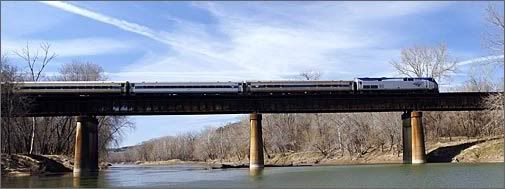
The key to the night train scheduling is to make sure that the reverse trip is a similar night train. So a second train runs the reverse route, leaving Chicago at about noon, getting to Cleveland about 7:15pm and Pittsburgh 10:40pm, then DC at 6:30 the next morning. Leave DC at 8:30 to arrive at Charleston WV 5:30pm, Cincinnati at 10:30pm, and Chicago at about 7:55 the next morning.

Now, this is still a three-times-a-week train, but now the overnight service into Chicago arrives before the Start of Business, getting maximum value from the sleeper train. The same thing happens heading southwest into DC on the Cleveland/Pittsburgh leg.

This route also allows more fine tuning of service to transport demand than is normally possible on such a long route ... because alternate days without a Cardinal service can be provided a complementary service. For example, the original Cardinal could run from New York through DC to Charleston in a day, and return the following day. An alternate daytime Cleveland/Pittsburgh service would connect to the Northeast Corridor further north, running from Chicago to Pittsburgh and then to Philadelphia, with late evening connections still available both north and south.


Its not perfect - but perfection is a fantasy

Of course, this is not a perfect schedule. For one thing, just like the Cardinal, there will be delays, because the route is not designed to allow trains to run without delays.

And of course, its too damn slow.

However, it provides Ohio's two largest cities with intercity train service that is not between midnight and 6am. Each obtains daytime connections with part of its economic hinterland - up the Ohio River Valley for Cincinnati and along Lake Eries for Cleveland. And existing service to West Virginia and Kentucky is provided at a more appealing time of day.

If the Cardinal is going to get its operating cost recovery ratio up into the 40%~50% range, and get its neck off the chopping block ... turning its philosophy from the "one of the most out of the way conceivable trips from New York to Chicago" to a long Appalachian Loop out of Chicago with transfers at Washington DC may well be the way to go about it.


Midnight Oil: Truganini

Sunday, November 8, 2009

Sunday Train: Rescuing the Innocent Amtrak Numbers from SubsidyScope

Burning the Midnight Oil for Living Energy Independence

A few weeks back, SubsidyScope, "launched by The Pew Charitable Trusts, aims to raise public awareness about the role of federal subsidies in the economy", pursued its mandate into transport subsidies, coming out with a study with the headline figure of $32 subsidy per passenger for Amtrak.

Why Amtrak? Why not provide a headline figure on federal subsidy per motorist or airplane passenger? Critics of the report suggest that the answer is simple - consider, for instance, Charleston WV mayor Danny Jones:
Jones admits Amtrak relies heavily on subsidies, but so do other modes of transportation, he said.

"I think it's just easier to see how much of it's subsidized with Amtrak," he said.


And there is a lot of merit in that. Further, SubsidyScope is not focusing on Government subsidy, but on Federal subsidy. Not only is it harder to analyze government subsidies to driving and flying, given how many direct and indirect subsidies there are to take into account - but many of the subsidies are at the state and local government level, so for SubsidyScope's purposes they "don't count".

Even granting the grossly flawed mandate of looking at government subsidy without considering social benefit and of looking at only the Federal portion of that subsidy - SubsidyScope's analysis have a further glaring flaw, in that they do an entirely static analysis. This was pointed out shortly after the release of the study by Robert Cruickshank at the California HSR blog in his post of 27 October, 2009, How Much Per Driver Did US Freeways Lose?:
The number one flaw of the Pew report, by far, is it does not compare 2008 numbers to previous years. The report merely examines Amtrak route performance in 2008 alone. As you all remember, 2008 was a rather interesting year for American transportation. Most passenger trains - from Amtrak to the local subways and streetcars - experienced significant spikes in ridership as a result of the spike in gas prices.

Any study of 2008 passenger rail that does not take into account these effects is not credible. At all. And a study that doesn't even compare to past years is a joke.


Robert Cruickshank uses information from the Capital Corridor Joint Power Authority to show that even before the spike in ridership due to the Oil Price Shock in 2008, a 100% increase in state subsidy over the past decade has been met by a 269% increase in ridership, with four times the number of trains and the state subsidy per passenger mile dropping from $0.33 to $0.18.

Of course, the SubsidyScope analysis further confuses the issue by headlining subsidy per passenger, rather than subsidy per passenger-mile. This is, of course, absurd: it treats trips from Harrisburg to Philadelphia, from Washington DC to New York, and from Chicago to Seattle as each delivering identical "travel" benefit.
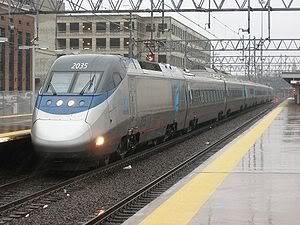
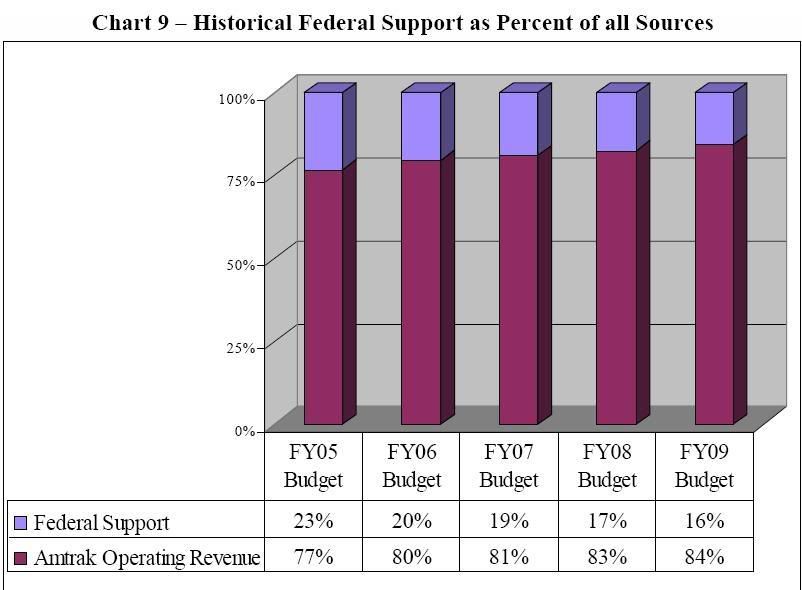
Indeed, Amtrak's figures themselves (p. 11, right) reveal that Federal subsidies are a declining share of Amtrak revenue.


Focusing on the Amtrak Routes

SubsidyScope extends its analysis to routes by by taking Amtrak figures on route performance, and then allocating costs that are not allocated by Amtrak to the routes, with a principle cost being depreciation.

The way that Subsidyscope does this is by working out the total unallocated costs, dividing by the number of passengers, and subtracting those from the per passenger profit/loss derived from Amtrak route information.

That is, if one passenger travels from Chicago to Fargo, North Dakota, Mayor Jones travels from Charleston WV to Chicago, and a third passenger travels from Providence, Rhode Island to Boston, each of them are considered to be participating in the same depreciation of Amtrak equipment and right of way.

This is, of course, absurd. Some services run in Amtrak corridors, others run in private railroad corridors paying an access fee. Charging depreciation of the Amtrak owned corridor to the passenger where the access fee is included in operating costs is obviously absurd. Charging the same depreciation of Amtrak trains to the passenger between Providence and Boston and the passenger between Chicago and Fargo is just as absurd.

Considering passenger miles instead of just passenger counts is better - indeed, it may be the most reasonable rough estimate for depreciation of Amtrak trains. But it still suffers from the problem of counting the access fee paid to operate on private rail corridors, and then allocating the corridor a share in the depreciation of the rail corridor owned by Amtrak.

Clearly SubsidyScope's analysis is grossly and obviously biased against those routes that run in private corridors and in favor of those that run on Amtrak-owned corridors. It makes a mockery of any pretense of SubsidyScope that it is analyzing the "profit and loss" of specific routes when it makes these capital adjustments.

Indeed, one wonders whether there is an ulterior motive in this gross analytical mistake. For any going concern with some business lines relying on its own infrastructure and others relying on paying access fees for infrastructure owned by someone else - just spreading depreciation uniformly between the different business lines is either gross incompetence or an effort at deliberate deception.

Not having any information to the contrary, I will make the charitable assumption, and presume that SubsidyScope is merely being lazy and grossly incompetent in their adjustment for depreciation.

Whether ascribed to incompetence or to malice, Subsidyscope's analysis is clearly useless for improving our understanding of rail capital cost issues. However, this does not mean the analysis is entirely useless. They do collect the Amtrak route information on operating revenue per corridor and match it up with profit/loss per corridor prior to engaging in their absurd gymnastics in allocating depreciation.

That means that they have collected information that can be used to infer operating recovery ratios by route - that is, the ratio of operating revenues to operating costs (Amtrak's "operating ratio" is cost/revenue, rather than revenue/cost).


Pity the poor numbers, they didn't make SubsidyScope do it

So this is a boring old data report posting. I earnestly apologize for that, but after grasping what a hatchet job SubsidyScope did in terms of their reporting on profit/loss on a per line basis, I just had to go in and see what I could do to recover some information from their shambles.

With respect to operating recovery, there is one flaw inherited from the slanted frame within which SubsidyScope operates. Since they ignore state and local subsidies, that means they treat state subsidies for state-subsidized services as part of revenues. For purposes of computing operating ratios, they should be excluded.

Now, I am going to do something similar to what I have just blasted SubsidyScope for doing, and do a simple pro-rata allocation of the total state subsidy share of state corridor route revenues to each state corridor route. In my defense, I will say:
  • first, I know this is less than ideal, while SubsidyScope writes up a much more egregious pro-rata allocation as if it gives a precise answer;
  • second, if anyone has the specific subsidies on a specific corridor, I will happily enter it into that corridor, and adjust the balance of pro-rata shares to reflect that; and,
  • I am doing this analysis for free on a couple of Sunday afternoons, while someone got paid to make this kind of rough, back of the envelope calculation for SubsidyScope


If you are looking for something over and above looking at the operating ratios that I have rescued from SubsidyScope's numbers abuse - well, I hope you have already found it. The balance of this post is just a glance at these numbers.


The Northeast Corridor

The Northeast Corridor trains stand on their own. Of course, when running on track owned by Amtrak, access fees will be lower - and at the same time, this is where the bulk of capital depreciation on corridor infrastructure itself will be located. Still, according to SubsidyScope's figures, the entire Northeast Corridor yields an operating surplus.

The tables are set up with routes with operating recovery ratios at or above the total for the group in the left hand column, and those below the group's operating recovery ratio in the right hand column.


Northeast CorridorOp Ratio Northeast CorridorOp Ratio
NEC Overall 158%
Acela 183% NE Regional 139%


The State Corridor and State-Subsidized Routes

Corridor trains include the largest number of services that are eligible for direct replacement with an Emerging/Regional HSR service, as well as services that can be started relatively early in the development of the Steel Interstate system.

The most striking feature that emerges from SubsidyScope's information is the cluster of corridor service that are in the neighborhood of 60% operating recovery. A package of structural improvements - and, obviously improving effective trip speed will be a critical improvement - that can bring a "typical" corridor service from 60% to 100% operating recovery would bring the majority of routes and the corridor services as a whole into or close to an operating surplus.

The reasons for setting up the table into columns relative to the average for the group is for exploring the factors that help explain operating ratio. The table can be split in terms of above and below average length, or frequency, or population per route mile, or population per hour, or average on-time performance, and it can be seen at a glance when a factor tends lines up with the operating ratios. But that analysis will wait for some later set of Sunday afternoons.

While the average operating ratio for the State Corridor trains is not affected, bear in mind that the following involves a pro-rata distribution of state operating subsidies.

Corridor Route Op Ratio Corridor Route Op Ratio
Corridor Services 58%
Chicago-St. Louis IL/MO 79% Blue Water MI/IL 55%
Newport News DC/VA77% Zephyr IL54%
Carolinian NY/NC71% Vermonter VT/DC 54%
Illinois-Saluki IL 70% Albany-Toronto NY/ONT54%
Adirondock NY/Quebec69% Capital CA 53%
Heartland TX/OK67% Piedmont NC52%
Hiawatha IL/WI 66% Empire NY48%
Ethan Allen NY/VT65% Missouri River MO45%
Downeaster ME/MA 64% Pennsylvanian PA/NY43%
San Jaoquins CA61% Wolverine MI/IL39%
Keystone PA 61% Springfield Shuttle MA/CT32%
Cascades OR/BC 61% Hoisier State IN/IL15%
Pere Marquette MI/IL 59%
Pacific Surfliner CA 59%


The Long Distance Services

The long distance services are the ones that can gain the most converting the Strategic Rail Corridor Network into a network of Steel Interstates. Faster and more reliable Electric Rapid Rail service might be more important in terms of reducing cost per mile as in increasing ridership. Wages and salaries are 54% of long distance operating costs, and wages are paid per hour, not per mile - the faster the trip speed, the lower the labor cost per mile. And fuel and utilities is another 17% of operating costs, where electricity is less expensive on an equal-energy basis and electric locomotives are more energy efficient.

The Auto Train stands head and shoulders above the typical long distance route in terms of operating recovery, and would seem likely to have an operating surplus if run on a Steel Interstate.

Of course, our two main long distance transport systems run on operating subsidies, so that it would be biased to expect that long distance trains ought to break even when cars and planes are not expected too. However, even if we expect to continue subsidizing these operations, raising the operating recovery ratios allows us to leverage more transport service with the same level of subsidy. That is, consider a service operating on the basis of 40% service revenue, 60% subsidy. If that same amount of subsidy is maintained, then in terms of operating costs alone:
  • 50% operating recovery allows 1.2 times as much service
  • 60% operating recovery allows 1.5 times as much service
  • 70% operating recovery allows 2 times as much service
  • 80% operating recovery allows 3 times as much service
  • 90% operating recovery allows 6 times as much service


I am not sure what combination of fuel prices and service improvements are required to get these services up to operating break-even - or even whether we ought to be targeting operating break-even. However, it seems quite likely that the operations on a Steel Interstate system would allow the majority of the routes below to get into the range of 70% operating recovery.


Long Distance RouteOp Ratio Long Distance Route Op Ratio
Long Distance 49%
Auto Train VA/FL85% Silver Meteor NY/FL47%
Empire Builder 61% Capital Ltd DC/IL45%
Palmetto NY/GA55% Coast Starlight WA/CA45%
SW Chief IL/CA Crescent NY/LA44%
City of New Orleans IL/LA49% Texas Eagle IL/TX43%
CA Zephyr IL/CA43%
Silver Star NY/FL41%
Lake Shore Ltd MA|NY/IL41%
Cardinal DC/IL34%
Sunset Ltd LA/CA 23%


Conclusions

I have few conclusions, other than dismay that Pew would finance work like the work that SubsidyScope has turned out without demanding its money back. However, I do expect that I will be able to take these tables and find the key factors that tend to drive operating recovery up toward the direction of operating break-even.

Midnight Oil - River Runs Red
   Unauthorized Protest Concert at Exxon HQ