... for Progressive Populism ... for the Arc of the Sun ... for the Next American Revolution ... for Living Energy Independence ... for a Brawny Recovery ...
  I've been like a hare chased by a hound this weekend, darting this way and that, so while I've got a lot of topics I could be writing on, I've got nothing coherent for a full fledged diary. So this week will be bits and pieces and this and that.
The Columbus Dispatch continues its attack on the Triple-C in Ohio
Like so many attack inspired by the reactionary propaganda mills gussied up as "think tanks", the attacks on the Triple-C are more focus-group tested than serious critiques.
In Thomas Suddes commentary: In the big picture, taking the train money seems like a bad idea, following up the original negative Dispatch editorial, Suddes argues:
Maybe; but maybe common-sense people can wonder why Ohio should spend $400 million on trains when I-71 isn't six lanes wide all the way from Columbus to Cleveland. There's a four-lane stretch north of Columbus that redefines eternity -- as an eight-letter word for "crossing Morrow County."
First, Ohio isn't "spending $400m on a train to...". That's Federal funding. The Stimulus II spending on HSR was spread between Express HSR, Emerging HSR upgrades to existing conventional rail systems, and spending on conventional rail systems that would then be in a position for upgrade to Emerging HSR.
Ohio's Triple-C is the latter - providing the most densely populated corridor without a conventional rail service with one, while paving the way for an upgrade to 110mph.
So that is one blatant lie. The blatant lie is perhaps to distract people from the dishonest frame: the reason that Ohio should invest in conventional rail rather than expanding lanes is that its the cheapest way to add capacity. When you constantly do one thing, you sooner or later run out of "cheap and easy" jobs and what's left in the "to do" basket tends to be hard or expensive or both.
And he does go on, but don't read that as encouraging you to link through, unless you need practice disentangling truth from fiction from outright lie in the hands of a "conservative" who claims that "ideas matter" (but not, it seems, telling the truth).
Magnifico had a Train Diary on Friday
Spending to Create Jobs: China and High-speed Rail:
Congress is once again trying to address unemployment in America with another tax cut laden, so-called "jobs" bill. Increasing the federal deficit by handing out more tax cuts is not a good economic stimulus and, most importantly, will not actually create a lot of new jobs.
Since Congress is going to borrow money, they should be using that money to improve the country. For example, the New York Times reports China sees their economic growth engine in a network of fast trains.Faced with mass layoffs at export factories, China ordered that the new rail system be completed by 2012 instead of 2020, throwing more than $100 billion in stimulus at the projects.
Administrators mobilized armies of laborers — 110,000 just for the 820-mile route from Beijing to Shanghai, which will cut travel time there to five hours, from 12, when it opens next year.
That one I do advise clicking through to read.
"With new upgrades, future of rail transportation looks good"
David Zweiful at "Cap Times, Your Progressive Voice" in Wisconsin says, "With new upgrades, future of rail transportation looks good":
Because of our interest in the Talgo cars, this year we flew to Portland, Ore., boarded Portland’s light-rail “Max” system at the airport and were downtown at our hotel within a half an hour. The system is considered the country’s best commuter rail service, running at frequent intervals and making numerous convenient stops for passengers. It’s said there’s no need to own a car if you live in Portland.
After spending the night there, we boarded a train called the “Cascades,” which starts in Eugene, Ore., and runs north to Vancouver, British Columbia. It is also operated by Amtrak.
The ride is all it’s cracked up to be, smooth, quiet and roomy, complete with an airy lounge where folks can buy everything from breakfast sandwiches to a bloody mary. There are numerous outlets for computer hookups, large overhead bins for carry-on luggage and brief cases and easy access between cars. It will be an incredible upgrade to the old equipment that’s used on the seven daily Hiawatha runs between Milwaukee and Chicago today.
I found it odd that he actually rode some trains of the same basic type that will be used in Wisconsin: I understood from those taking dictation from reactionary propaganda mills that finding out about the actual reality on the ground is nowhere near as important as "ideas".
The Christian Science Monitor looks at HSR
In High-speed rail: Stimulus dollars wisely spent?, the venerable CSM gives mostly not unreasonable reporting on the HSR funding.
There is one clunker, however:
But others are leery of what they see as a plan that won't lure Americans from their cars and therefore may not pay off.
"To believe this makes economic sense, you'd have to be foolish," says James Moore, director of the transportation and engineering program at the University of Southern California in Los Angeles. "In the US, autos cover shorter trips better and airlines capture longer trips. That doesn't leave room for high-speed rail to compete."
What precisely is James Moore's area of expertise that allows him to categorically dismiss actual experience of actual system improvements providing actual increases in frequency and reliability resulting in actual increase in ridership ... which to an economist demonstrates that there is a potential market for improvements of this sort?
Well, looking at his curriculum vita (pdf), stuff like: ""The Economic Impacts of a Terrorist Attack on the U.S. Commercial Aviation System,". The only peer reviewed research I found that was related to rail ridership modeling, and that was not related to intercity rail, was "Ten Myths About US Rail Transit Systems." (1999), a hit piece against local rail transport funded by the Reason Foundation.
I swear I had no idea when I started hunting that down that began at "director of the transportation and engineering program at USC" would end up at The Reason Foundation (Sourcewatch). On the other hand, I was not actually surprised.
OK, its already time to post, so better wrap this up, and bring on the headliners.
The Headliners: Midnight Oil
...
No end to the hostility
Now they wanna be somehwere else
No stranger to brutality
Now they'd like to be someone else
Older than kosciusko
Driven back to alice springs
Endless storms and struggle
Now the fires begin to rage
High up in the homelands
Celebration 'cross the land
Builds up like a cyclone
Now the fires begin to rage
...


 Disclaimer: Nothing said here should be taken to imply that airport/train connections are the primary transport task for either light rail, mass transit, conventional intercity rail, or high speed intercity rail. In other words, the focus of an essay in a regular weekly series on one particular topic does not imply anything along the lines of "most important thing".
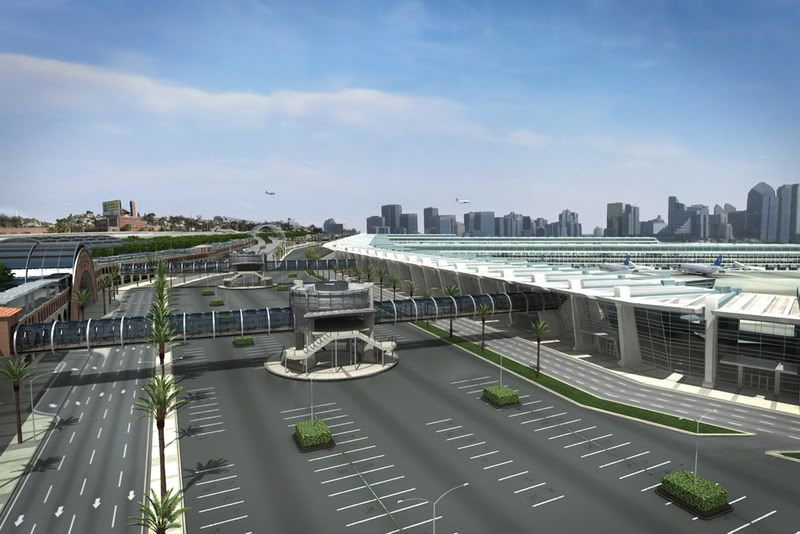 While the ITC is a very interesting proposal in terms of providing direct Trolley, Coaster and Amtrak Pacific Surfliner stops at the airport - Lindbergh Field is between one and two miles from downtown, and the existing Amtrak Pacific Surfliner terminus at Santa Fe is a much stronger location for the downtown San Diego HSR station. It is located on one Trolley line that runs to the border, adjcent to the trolley line to Petco field as well as one of the main downtown bus transfer centers. It is much more convenient to the Convention center and two blocks from the Coronado ferry.
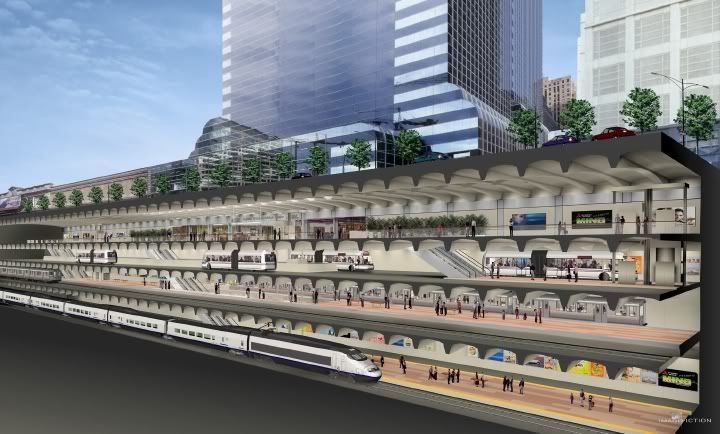 And of course, the reason that the Midwest Hub and Ohio Hub systems can be built out so much more quickly with so many more miles per dollar than the California HSR system is because they are starting out as 110mph Emerging HSR systems, built in existing rail corridors. So they stand to inherit the east/west divide.
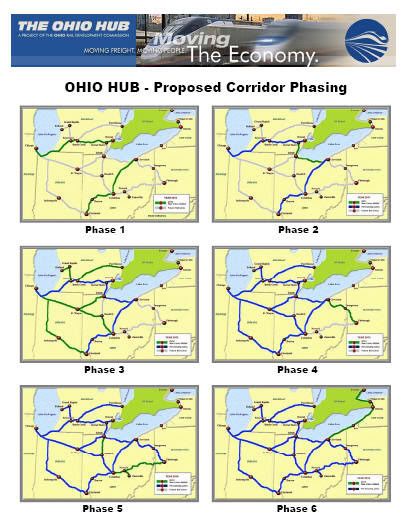 The Chicago / Michigan corridor would be a primary beneficiary among those receiving funding from the $8b appropriated in Stimulus II, but later stages of the Midwest Hub to both Indianapolis and northern Indiana would also benefit from this through access ... and of course the Ohio Hub, which was funded for its core seed corridor at conventional Amtrak speed, plans to connect to Chicago, first via the Michigan corridor, and then via the Indiana corridors.
 Huh, seems me that whatever the state of my various concerns, the agenda of the Sunday Train has been taken over by the White House ... funny how announcing the recipients of a total of $8b will do that.
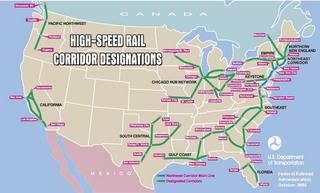 California, $2,344m. This includes $1,850m for the California HSR Stage 1 from San Francisco to Anaheim via San Jose, Fresno, Bakersfield, and the LA Basin. This is, in essence, enough to prime the pump for the California project.
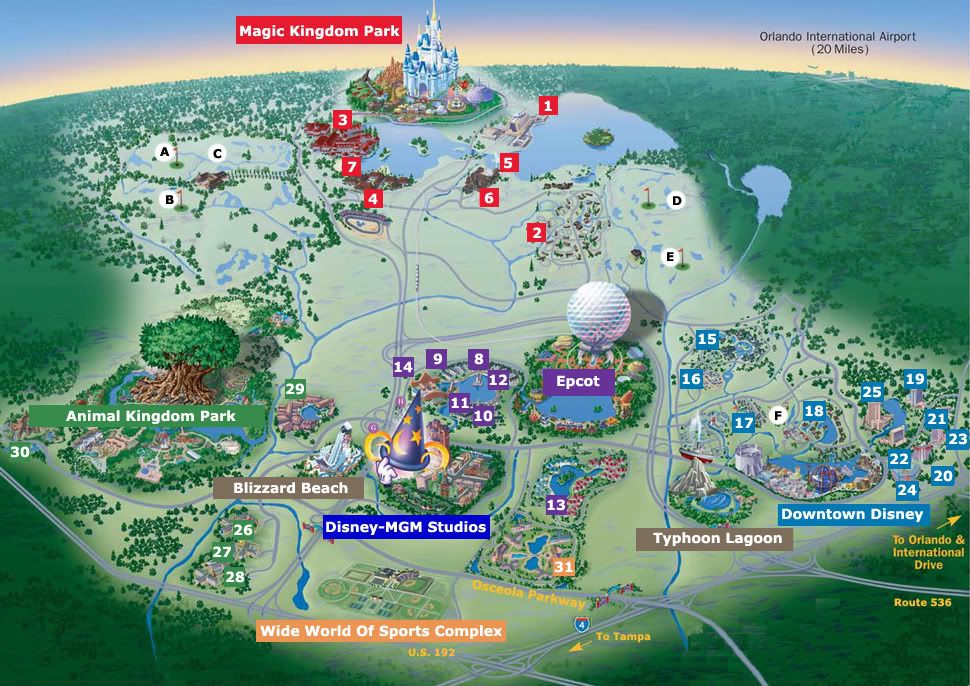 Florida: $1,250m. This is entirely for Express HSR track from Tampa to Orlando. This is a line that has been criticized for not connecting the two downtowns of the two cities. On the other hand, it does go to Disneyworld, and as an on-again, off-again project that kept getting squashed by lack of local funding, the Florida State Legislature was led to believe that their hopes of HSR funding required a commitment to support complementary local rail service. Support for SunRail passed, and so Florida got their Disneyworld train.
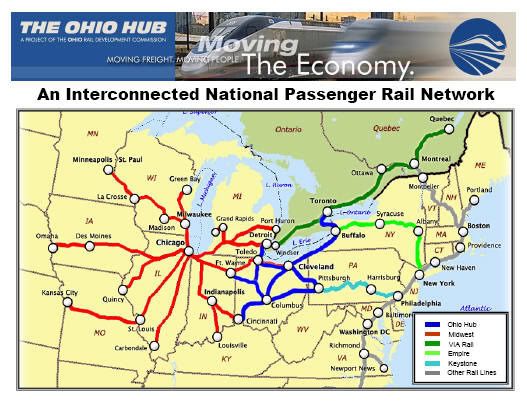 Illinois: $1,236m. The main project here is $1,102m to upgrade parts of the Chicago / St. Louis corridor to 110mph service, cutting end-to-end travel time to four hours, and bringing substantial new populations along the corridor within three hours or less of either Chicago or St. Louis or both. Further improvement of this corridor on the same basis can bring the end-to-end time down to three hours.
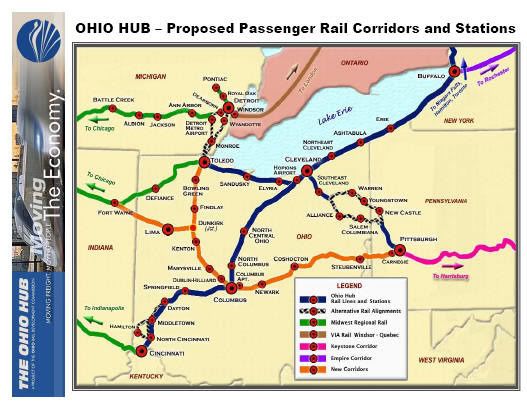 In terms of HSR, establishing this service is a starter on establishing the 110mph version of the Triple C, which with two hour services to Columbus from either end is when the corridor is projected to be capable of generating a substantial operating surplus. It may take a series of upgrades, to get there, but each upgrade will cut trip speeds and improve patronage on the corridor, trimming the required subsidy until it finally goes away.
 Kossack slinkerwink tells us that Vice President "Amtrak Joe" Biden
 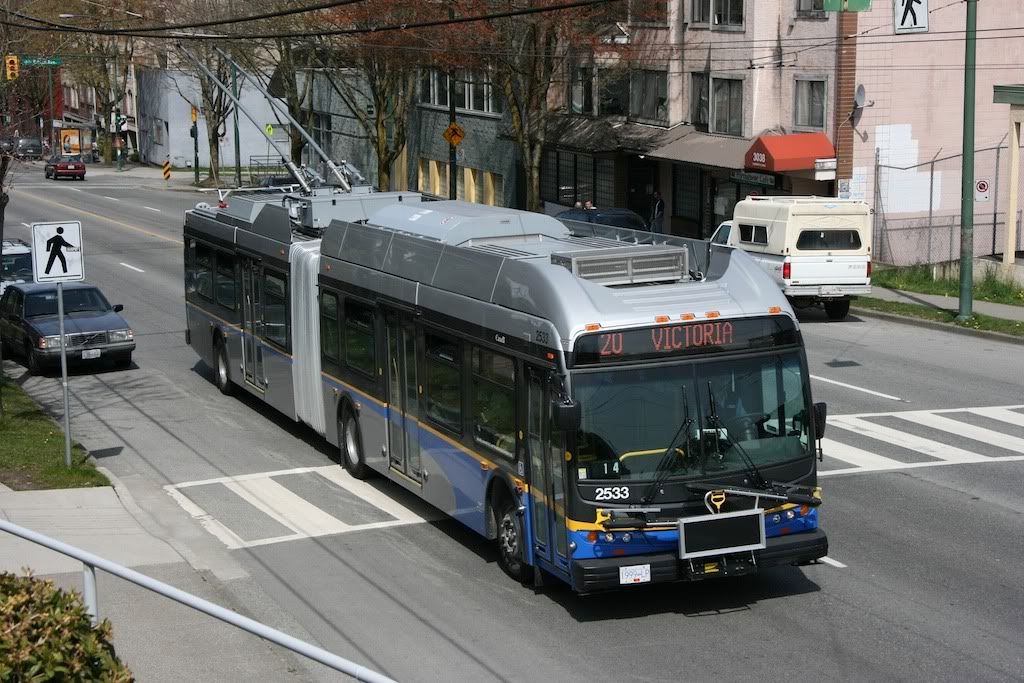 Note that the statement is abbreviated for the title. The full statement is, a common carrier like a train, bus, or plane that running a profit based on passenger revenue while paying its full operating and capital cost is charging too much for its tickets.
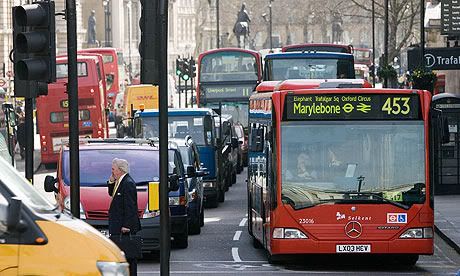 A common carrier transport service provides multiple services.
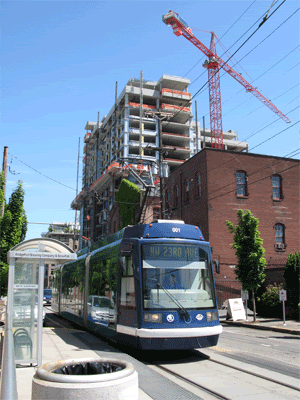 The material efficiencies of use of the rolling stock would be captured in the capital cost of the system - except there are substantial material costs that we simply ignore. Handing a free ride, for example, to those dumping CO2 into the atmosphere despite the fact that they have done nothing to establish that it is safe to do so - is only one of the more egregious examples.
 Those private users of a congested public resource like the public roadway would pay users of common carriers based on the relative space efficiency of that common carrier. So mass transit would get the most subsidy per seat, then various forms of light rail, then (actual) Bus Rapid Transit and Quality Buses, then shuttle buses. This payment would be for seats occupied over the load factor that has the same space consumption as the average private vehicle.
 And all property owners served by common carriers would pay a property tax to reflect the portion of their property value supported by the existence of the common carrier. Since it is dedicated transport corridors that have clearly discernable property value benefits, this payment would be distributed by the frequency of trips on dedicated transport corridors to distinct destinations.