Populist movements don't build themselves ...

... It doesn't matter what the "horse race" outcome of the campaign is, if we fight the campaign. Fighting it, we learn how to fight. Learning how to fight political battles, we become citizens again. Becoming citizens again, we reclaim the Republic that lies dormant beneath the bread and circuses of modern American society.

Showing posts with label health insurance reform. Show all posts

Monday, January 18, 2010

C'mon, Joe, Take the Neutron Bomb to this Filibuster

Kossack slinkerwink tells us that Vice President "Amtrak Joe" Biden has spoken out against the filibuster:
Vice President Joe Biden said at a Florida fundraiser Sunday that the 60-seat threshold for passing legislation in the Senate put a dangerous new roadblock in the way of American government.

"As long as I have served ... I've never seen, as my uncle once said, the constitution stood on its head as they've done. This is the first time every single solitary decisions has required 60 senators," Biden said. "No democracy has survived needing a supermajority."


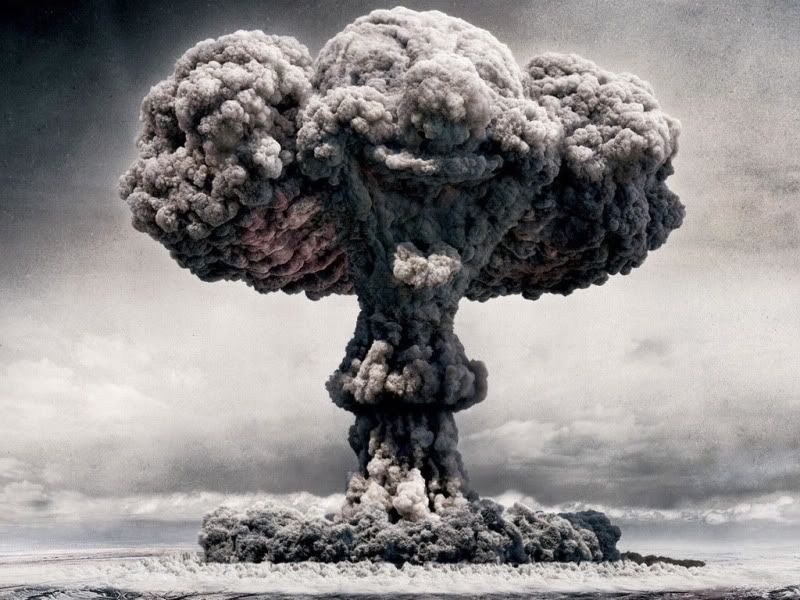
Well, if this is about the survival of our Democracy, I say it may be time to recall the parliamentary maneuver threatened by the Republicans in 2005, dubbed the "nuclear option". Since this is a more precisely targeted version of that parliamentary maneuver, I refer to it as the "Neutron Bomb".


Recall those distant days of 2005 ...

Kossack homunq explained on 12 January:
1. the 2005 "Nuclear option".

Wikipedia, emphasis mine:
A senator makes a point of order calling for an immediate vote on the measure before the body, outlining what circumstances allow for this. The presiding officer of the Senate, usually the vice president of the United States or the president pro tempore, makes a parliamentary ruling upholding the senator's point of order. The Constitution is cited at this point, since otherwise the presiding officer is bound by precedent. A supporter of the filibuster may challenge the ruling by asking, "Is the decision of the Chair to stand as the judgment of the Senate?" This is referred to as "appealing from the Chair." An opponent of the filibuster will then move to table the appeal. As tabling is non-debatable, a vote is held immediately. A simple majority decides the issue. If the appeal is successfully tabled, then the presiding officer's ruling that the filibuster is unconstitutional is thereby upheld. Thus a simple majority is able to cut off debate, and the Senate moves to a vote on the substantive issue under consideration. The effect of the nuclear option is not limited to the single question under consideration, as it would be in a cloture vote. Rather, the nuclear option effects a change in the operational rules of the Senate, so that the filibuster or dilatory tactic would thereafter be barred by the new precedent.


humonq goes on to argue that:
Note that the nuclear option needs at least one, and probably two, people to assert that the current filibuster is unconstitutional. In 2005, the Republican argument was that Judicial filibusters were unconstitutional, but legislative ones are constitutional. This relied on some pretty thin reasoning that Article II, Section 2, of the U.S. Constitution, which says the president "shall nominate, and by and with the Advice and Consent of the Senate, shall appoint ... Judges...", requires an up-or-down vote.

I'll come back to the nuclear option later (I bet you can see where I'm going), but for now, just note that the nuclear option as proposed in 2005 is NOT relevant to legislative logjam, because it would only eliminate judicial filibusters.


Take Out Your Copy of the Constitution ...

Except ... notice that the threat to use the Nuclear Option was not based on the reasoning standing up in the Supreme Court, but in the precedent set when 51 Senators, or 50 Senators plus the VP, votes to table the appeal to the decision of the chair.

And there is Constititional language that specifically addresses the powers of the Senate on a particular kind of legislation, including the health insurance reform bill as well as the legislation to establish any cap and trade system: which is to say, the first clause of Article I, Section 7 of the Constitution:
Section 7 - Revenue Bills, Legislative Process, Presidential Veto

All bills for raising Revenue shall originate in the House of Representatives; but the Senate may propose or concur with Amendments as on other Bills.


The powers of the Senate with respect to Revenue bills are spelled out: they may propose or concur with Amendments. That's why Senate revenue bills always start with language that basically strips out the whole of the House language except for enabling the law, then put in the Senate version as an amendment.

And notice that the Senate has hobbled its own powers to amend with its toleration of the filibuster process: it is the Senate rules that dictate that an amendment to the House bill may be filibustered.

So, suppose the House bill as passed included a rider that specifies that after passage by the House, and after a certain number of additional legislative days have elapsed, any Senator may bring the bill for a vote, including any amendments that the Senate may have already passed.

Now the Senate might elect to ignore this rider, but of course, as with the threat of the Nuclear Option: it also might not. A Senator makes a point of order that under the terms of the rider, he wishes the measure be brought to a vote. The President of the Senate rules in favor under Article 7 read as meaning that the rider stands unless and until the Senate amends the bill to remove it. An opponent appeals the decision of the chair. That is moved to be tabled (which cannot be filibustered). The motion to table passes, possibly by 50+Biden. And then the measure is brought to a vote.

Now, note, if the House does this at the current point in the process, that would be with whatever other amendments deemed necessary to allow the Senate version of the bill to pass the House. If the Senate passes it without amendment, it goes straight to the President's desk, as being passed in the same form by both chambers. If some amendments have been made before the filibuster logjam is broken with this maneuver, then the House would have to pass that version, and then it could go to the President.

So, the minimum requirements would appear to be:
  • A house majority, willing to pass the rider
  • 41 Senators willing to protect the rider with the threat or action of filibuster of any amendment that would remove it
  • One Senator willing to move under the rider when the time has elapsed
  • One Chair willing to rule on Constitutional Grounds that the rider applies unless and until amended by the Senate
  • 51 Senators, or 50 Senators + Biden, willing to explode the Neutron Bomb on filibusters on Revenue Bills


... except, you will recall, the "Nuclear Option" was never used, yet the Democrats caved on nominating odious Supreme Court justices.

Note that while many Senators are more or less in the pockets of health insurance companies, some are more deeply in the pockets of Oil Companies or sometimes Coal Companies. And if the Energy Companies think that it is more likely that they could defeat the Neutron Bomb directly in the context of cap and trade ... they might instruct their bought and paid for Senators to stand down on forcing the Neutron Bomb to be exploded in the Health Care debate.

Since once you've blown that particular hole in the "continuing rules" of the Senate, its open, and a similar rider could be employed whenever the House knows it has 41 Senators willing to defend it and 51 votes for passage ... bearing in mind that repeating a precedent is not as politically fraught hard as setting one.

So if the House Republicans (and Liebericans) cave (as they did before Christmas under threat of snowstorm) and do not filibuster so that the bill goes to a vote without anyone triggering the neutron bomb option ... well, then that leaves the neutron bomb back in the silo.

Though ... note that as the by the minority of the filibuster power continues, it would face a growing risk that the Neutron Bomb will eventually be exploded.

Wednesday, September 16, 2009

Putting the Vicious Health Insurance Dogs on a Leash

Burning the Midnight Oil for the Next American Revolution

From one of my comments in buhddydarma's most excellent diary:
I'd liken it to a vicious dog behind a fence. Given access to the fence, he will worry it and try to dig under it, or hang out by the gate and eventually get out. Like a group of corporation with massive profits locked behind a regulatory wall, who will eventually find a way to get a loophole put into the wall.

Tie the dog up in the yard so he can't get at the fence, the combination is more effective than either alone.

A robust public option works like the leash tying the dog up. The corporate insurance companies cannot squeeze too much harder than the public choice without losing market share, so it will be much harder for them to organize to break the regulations in the health care exchanges.

______________________________

Don't get confused by the "five percenters". This was President Obama trying to mollify the Republicans and also make the extremists look ... like extremists.

But in the preliminary CBO analysis of HR3200, which is where the 5 percent seems to come from, this really is a rhetorical trick designed to make a robust public choice sound less effective than it would be. And if we lose sight of how effective a robust public choice could be, we will not fight hard enough to (1) get it in the bill and (2) kill phony substitutes.

Through to 2019, HR 3200 is scored as adding 11m through Medicaid (since I'm blogging in genteel poverty, I'm one of those), 2m through employer provided insurance, and 30m through the exchanges, with 6m switching (comparing 2019 projection w/out to 2019 projection with) from non-employer provided health care primarily into the exchanges, for a net increase in 37m.

Everyone in the health insurance exchange benefits from the public choice - even those with private insurance. So that is 30m beneficiaries, which is:
  • 100% of those in the public exchanges
  • 80% of the increase in coverage
  • 60% of citizens and documented migrants w/out coverage
  • 50% of all people residing in the US w/out coverage


And, yes, 10% of those projected to have insurance after the reform. But the majority of the gap between the percentages in that list and "10% comes from including those people projected to continue to receive employer-based health insurance.

Their stake in the reform is supposed to be reforms that protect what they already have.


Don't get lost in CBO projections

Of course, this is all simply CBO projections. Don't forgot what you know about how our politics and economy really works when wading through the CBO numbers.

And so that brings us right back to the vicious dog model of corporate health insurance. If there are corporate insurance only health exchanges, we all know full well that we will be fighting ongoing battles over corporate health insurance companies trying to open the health insurance exchanges to precisely those people where the public subsidy is more lucrative to their bottom line than employer-provided health insurance.

And if we win some, we will surely lose some.

And so the CBO projection will, of course, fall far short of the entries into the health insurance exchanges and it will be far more than 30m suffering directly because there is no robust public choice in the health insurance exchanges.


Who would a progressive deny this protection to?

Of course, one reason for using percents is that using millions make it seem a bit brutal to say, "a mere 30 million will suffer if we lose the fight on the public option, so lets throw those poor losers to the hounds".


The candy store paupers lie to the share holders
They're crossing their fingers they pay the truth makers
The balance sheet is breaking up the sky
So I'm caught at the junction still waiting for medicine
The sweat of my brow keeps on feeding the engine
Hope the crumbs in my pocket can keep me for another night
And if the blue sky mining company won't come to my rescue
If the sugar refining company won't save me
Who's gonna save me?

Saturday, September 12, 2009

The Robust Public Choice Made Simple

Burning the Midnight Oil for the Next American Revolution
crossposted from The Hillbilly Report

\From some online dictionary somewhere:
Robustness is the quality of being able to withstand stresses, pressures, or changes in procedure or circumstance


So: (1) Public Choice

"No Taxation without Representation". Every single person facing an individual mandate must be provided with the choice of a publicly administered plan. Otherwise the government is forcing the citizen to pay without the elected representatives of the citizen controlling the spending.

You want to put a trigger on the public option. Fine, except the exact same trigger applies to the individual mandate.

You want to restrict access to the public option to some smaller group? Fine, except the same restriction applies to the individual mandate.

The system is not politically legitimate if it requires payment to for-profit commercial corporations.

(2) Robust

It cannot be lumbered down with any restrictions not faced by private insurers.

State by state public options? Really? You are really prepared to restrict the corporations to firms with no commercial activity across state lines? If they are free standing state by state public options, it has to be state by state for profit corporations. Oh, not allowing UHC into the exchanges defeats the purpose of lining private pockets at the public expense? Yeah, kind of thought so.
_________________________

The hard question is how to accomplish it. It would seem that it is necessary for the House Bill to include language that specifically states that the public choice does not face any restrictions not faced by commercial corporations with plans in the exchange, and explicit language that nobody can be subject to a mandate unless they have access to the public choice.

With that language in there, a conference report stripping it out would require a provision doing the dirty work. That provision could be struck by the House when the conferees report.

That is, a conference report included the laundry list of amendments to each sides bill to make them the same bill, and while no new amendments can be offered, AFAIU, a chamber has the right to strike a provision.

That might result in a second conference, but so be it: it seems highly likely that the Senate conferees will not believe that the House progressive caucus will really, truly stand up for what were, after all, the very first "progressive" principles in our history as a nation-state - until they, in fact, do so.

Midnight Oil "Dreamworld" video

Thursday, September 10, 2009

Axelrod: Government by Consent of the Corporation

crossposted to The Hillbilly Report, ProgressiveBlue, Docudharma, MyLeftWing, and Daily Kos at about 1pm EDT.

David Axelrod made the case for insisting on the public option if there is an individual mandate to buy from health insurance exchanges, on the Rachel Maddow show last night (segment page). Of course, he thought he was making a different case:
And there is an incentive for the insurance industry to go along and not try to fight these, and that is that there is going to be a larger insurance market, and they have to make that calculation, but we are prepared to do it easy or do it hard, we want to make it work for consumers.


One reading of Axelrod is:
"M'lords, the peasants are getting restive, and if you want to avoid a revolt or other crisis - say, a majority of the House of Representatives elected without being beholden to your largesses - you have to make concessions. However, make the calculation - in some versions of this reform, because of the greater number of peasants you will be taxing in your domains, you will be better off."

Now, make the calculation. There is a given set of restrictions on the insurance companies. There are, however:
  • Subsidies to the purchase of insurance to those presently priced out of the market
  • "Pay or play" provisions to penalize firms that do not offer comprehensive health insurance
  • Individual Mandates to penalize individuals that do not obtain health insurance


Even without an individual mandate, the system can set to "expand the market" by directing the "pay" side of "pay or play" into the individual's account at the health insurance exchange, up to, say, the Social Security payroll income tax threshold, after which it the balance goes to fund Medicaid.

And as Ezra Klein has noted, there are expected savings in the medical system as part of the reforms that the CBO will not include - that the CBO will not "score" - because in the view of the CBO they are not certain enough. And the CBO does this all the time - they famously massively overstate the cost of cap and trade air pollution control systems, for example. But there is an approach that can bring these savings onto the table:
Health policy experts David Cutler and Judy Feder, however, have an innovative proposal for making them count. In a paper for the Center for American Progress, they argue for the implementation of "failsafe" policies — crude, surefire interventions — that will kick in if the expected savings don't manifest. Limiting the growth of Medicare payments, for instance. Increasing the excise tax on insurers. Moving the public plan towards Medicare rates.

You can think of a dozen with little trouble. But if you kept them looming behind the curtain — the Oddjob to your Goldfinger — in the event that the expected modernization savings didn't manifest, it would make the anticipated savings visible to CBO, and free up money for affordability


The question, then, is, what is the basic deal being pursued? A system to benefit the individual citizen, with accommodations to "legitimate interests" of commercial corporations - or a system to benefit the commercial corporations, with accommodations to "legitimate interests" of individual citizens?

Is the "health care crisis" that 100,000 people a year are dying preventable deaths, or that the health care and health insurance cost explosion is interfering with other corporations in their pursuit of profit?

Is this a government that derives its legitimacy from consent of the governed citizen, or consent of the governed corporation?


Fighting Back Against Our Taxation By Corporations

At one time, this government was founded on a principle of No Taxation without Representation. And, yes, those taxed and not represented outnumbered those taxed and represented, initially - but we made progress on that. We reached the point where the largest single cause of taxation without representation was the taxed not bothering to show up to vote.

But, no matter how the CBO scores it, a premium paid to purchase a health insurance policy that the government coerces us to buy, is simply a different form of taxation. And if there is no publicly administered plan in that exchange, that is a tax directed to the private government of a corporation, governed under the formal principle of one dollar, one vote, and often governed in fact by a class of senior executives, both in the management of the firm, and in the network of interlocking directorates managing strategic policy for the industry.

Now, some progressive make the simplest possible argument: no public option, no bill. But I do not. I have seen this song and dance long enough to know that if it comes down to no public option, no bill - enough "progressive" Congressmen will cave to allow passage.

However, there is a more powerful and still simple argument that can be made: No Public Option Means No Individual Mandate.

   No Captive Markets

And a powerful argument to be made to, and by, Progressive Congressmen, because the individual mandate is likely to be the single most unpopular element of the bill, and is at the same time the very strongest point for Republicans to craft a reactionary populism ... and it is the strongest point because it would be a reactionary populism based on a kernel of truth, which is that Government by Consent of the Corporation is not seen as legitimate government outside the corporate elite.


They Do Not Even Try To Hide What They Are Doing

Clearly, last night, the script was written. A public option will be included in the House bill. It will not be included in the Senate bill. It will be killed in Conference. The argument will be made - indeed, the talking points by Axelrod gives us the entire argument that will be made - that the resulting bill will be better than nothing.

So, what to do? Well, just like the tea party warm-ups to the August Town Hall Heat Wave, we know what is coming. What say, unlike the tea party warm-ups to the August Town Hall Heat Wave, we get ready for it this time.

We know precisely what we need to do at that point: strike the individual mandate provisions, and leave the rest of the conference report intact. The House, after all, can do that. Double blue dog dare the "Blue Dog" Senators to stand up on the Floor of the Senate arguing in favor of the individual mandate, arguing for corporate taxation without representation.

After all, the individual mandate is "just one part of the bill" - its not worth losing everything else that is in the bill just to get the individual mandate through.

Bring the worm infested core of this rotten political system into full public view on the floor of the Senate, and see whether they blink.

Because of the Progressive Caucus of the House starts to exercise the true weight of their numbers, they can pass health care reform again next year, and make the Senate run on that issue - in 2010, in 2012, in 2014 if necessary.

A member of the Progressive Caucus who stands up to the Insurance Corporations and says "No" to an individual mandate to buy corporate insurance is in a safe seat. The main "risk" will be "losing" them to the House if they pursue a move into the Senate to take the fight into enemy territory.

Which means that this can be an issue that every single Senator in the US Senate will have to face, no matter when they are scheduled to run.

Unless they take it off the table by passing a bill that respects the rule:
  • No Public Choice = No Citizen Mandate


The corporations view us as their playing field:
    We need to teach them to try to level us at their peril.

The following is the context of the above quote, where Axelrod lays out the script (not an official transcript and I am not a trained stenographer, so apologies for any glitches)
... His point was this, though. If we can pass a bill that brings long awaited insurance reforms to people who need them - most people in the country have insurance, this would help them greatly - and help those who don't have insurance today get it at a price they can afford, and also reduce the overall cost of the system, that would be a historic achievement, and that is our goal, that is what we are pointing to, and we ought not make one individual element of that so important that it dwarfs that greater goal.

Maddow: I think that part of the reason that progressives have imbued the idea of the public option with so much importance is because of the fear that there will be a mandate without serious reform, that attempts to regulate the insurance industry won't be effective. And when the President moves from his position in the campaign, which was that he was against individual mandates, to being for individual mandates now, there is concern that regulation of the insurance industry won't make insurance less junky, less resented, as it is now, and we'll all be forced to buy something that isn't very good, that will just pad the insurance companies pockets. Is there sequencing there? Is there a guarantee that the reforms work before individuals are forced to buy coverage?

Well, uh, there, uh, no individual's going to be forced to buy coverage, in the sense that there's going to be a hardship exemption, if they don't want to buy coverage. It's also a fact that when people don't have coverage and get sick, its a burden to the rest of us, so what he said is that everybody has to take responsibility.

But our goal is to make sure that the insurance system works better for everybody, people who have it and people who don't have it and will have it, and we believe these insurance reforms can and will work, and I think there's a broad consensus that they can and will work, but Rachel, we, uh, this whole system is going to be phased in over a period of time, and obviously if things are not working for consumers, we're going to make adjustments. The whole goal here is to bring security and stability to people - and they don't have it today, they can be dumped if they get sick, that happens all the time, if they have a pre-existing condition they don't get insurance, that's a standard policy in the insurance industry, out of pocket costs, you know the largest single cause of bankruptcy are health related issues, if you cap out of pocket costs, you can stop that. And there is an incentive for the insurance industry to go along and not try to fight these, and that is that there is going to be a larger insurance market, and they have to make that calculation, but we are prepared to do it easy or do it hard, we want to make it work for consumers.


Enough of the Warm-Up Act ...

Enough of the warm-up act, now for the headliners.

Midnight Oil: Blue Sky Mine video clip


My gut is wrenched out it is crunched up and broken
A life that is led is no more than a token
Who'll strike the flint upon the stone and tell me why
If I yell out at night there's a reply of bruised silence
The screen is no comfort I can't speak my sentence
They blew the lights at heaven's gate and I don't know why

But if I work all day at the blue sky mine
(There'll be food on the table tonight)
Still I walk up and down on the blue sky mine
(There'll be pay in your pocket tonight)

The candy store paupers lie to the share holders
They're crossing their fingers they pay the truth makers
The balance sheet is breaking up the sky
So I'm caught at the junction still waiting for medicine
The sweat of my brow keeps on feeding the engine
Hope the crumbs in my pocket can keep me for another night
And if the blue sky mining company won't come to my rescue
If the sugar refining company won't save me
Who's gonna save me?

Tuesday, August 18, 2009

Playing Hardball with the Senate: Bring out the Nuclear Option

Burning the Midnight Oil for Progressive Populism

OK say, just hypothetically, that you are an administration looking to get one of your two signature policies passed. And the Senate, deeply entrenched in the pockets of the affected industry, looked like it will gut your legislation so badly that getting the result passed will stink of failure almost as much as the stench of failure if it is defeated.

Suppose its so bad that the Senate action is the most likely way for your party to lose the Majority in the House is for the disappointed Democratic supporters of so-called "Blue Dogs" to stay home in the midterms while fire up Republican opponents turn out in large numbers.

That would be the time to bring out the "nuclear option" ... the threat to radically change the Senate Filibuster rule so it can no longer be used as a roadblock to reform.


A short note on terminology

Yes, this soon after the anniversary of Hiroshima, it is striking that calling elimination go the filibuster "the nuclear option" is absurd hyperbole. It is, however, the term that is used, since the Republicans (back in the days when a "permanent Republican Majority" was a theory floating around) proposed eliminating filibusters on judicial appointments.


The Greatest Reform

Eliminate the filibuster, which is to say, restore the point from the original Senate rules of order that made a motion to bring the previous motion to a vote in order. That would make half the Senate plus One (or half the Senate plus the VP, when they are on the same side of the issue) sufficient to close debate - that is the rule that is used to make it impossible to have a filibuster in most committees and legislatures and boards around the world.


The Wikipedia Machine says that Aaron Burr proposed eliminating the rule, because it seemed redundant and had only been used once in the prior four years. However, the framing point here is that at the founding of the Senate, a filibuster was not possible: if a measure had the votes to win, debate could be closed off by the same winning margin.


The Great Reform

Don't know how likely the Greatest Reform is. However, if not likely, here's a version that runs on the "Make the Senators Do Their Goddamned Jobs" frame.

Under our system, each House can initiate legislation, and each House acts as a House of Review for legislation initiated by the other body. Now, the Senate can work under whatever arcane rules it wants to for initiating legislation, and indeed it can stage a sit-down strike on initiating legislation at all ... especially since early in the last century, it is now made up of elected representatives from every state in the union.

However, why should a House of Review have the right to refuse to fracking review the goddamned work of the House of Government, which is also made up of elected representatives from every state in the union.

So the "Great Reform" (but not Greatest Reform) is simply this: if the Senate has not brought its own version of legislation passed by the House to the floor in two calender months, it is in order to bring the original house legislation to the floor for an up or down vote without debate or amendment. Two months is plenty of time to get an existing bill out of committee and to the floor for a vote.

Note that legislation brought to the floor in this way does not require a conference committee and a second passage of the reconciled bill through both houses ... it is both houses passing the same wording, so it goes straight to the President for signature.

If the Senate wants to change something, bring an amended version to the floor. If the Senate wants to defeat something, bring the legislation to the floor and vote it down. But the Senate can no longer have a minority of Senators simply go on strike and refuse to do their goddamned job on something already enacted by the other chamber.

Note that if this was presented as legislation by the President (and there are various bills that touch on Congressional procedures ... various versions of PAYGO are an example) ... and in the event that it passes ... it would then be protected from being overturned by either a Senate filibuster, or a House majority in opposition to changing the rules.

Of course it would be subject to a filibuster threat, but the Senate filibustering on the principle of protecting its right to sit on its fat ass and do nothing would be a fine spectacle for setting up a rare increase in Senate majority by the party taking the White House in the first mid-term election.


The Small Reform

The Small Reform is more procedural than that one. It is changing the rules of the Senate so that the 3/5 required for cloture is 3/5 of the members present, and making quorum calls out of order once the Senate has been in session 24 continuous hours.

This would turn the filibuster back into the high political theatre it once was - and it would force the supporters of the filibuster to bring in their cots. They have to stay there and rotate control of the floor, and once a cloture vote has been brought to the batters box procedurally, the supporters of cloture are in a position to bum rush the room when the ranks of the filibusterers wane.

You can just see some of the hijinks ... the cable news channels will love to retell the story of the Senator that flew out of town, then put the slip on snoops watching the airport by catching the sleeper train back and walked in leading 50 Senators to bring the bill to a vote as seven of the filibusterers had headed off to caucus and fell asleep in the caucus room.


Once Rahm Gets Over His Hissy Fit ...

If we stand firm and push hard, the Progressive Caucus will stand firm on the public option. We are, collectively, stronger than Rahm Fracking Emanuel. He can swear and scream and carry on, but we are a threat to the job security of most members of the Progressive Caucus, if we get our backs up and support a primary opponent ... and Rahm Fracking Emanuel is not.
However, after he had beaten his head against that brick wall for long enough for it to sink into even his thick skull, this is where Rahm takes his "I don't give a frack what is in the bill, I want a win" act on the road to the Senate, and threatens to take away their filibuster toy unless they get something through that the Progressive Caucus will pass.


Conclusion

What, you think I can reach a conclusion on this without feedback? If you do, your more nuts than that lady at the townhall who said ...

... oh, never mind. Just have at it.