Populist movements don't build themselves ...

... It doesn't matter what the "horse race" outcome of the campaign is, if we fight the campaign. Fighting it, we learn how to fight. Learning how to fight political battles, we become citizens again. Becoming citizens again, we reclaim the Republic that lies dormant beneath the bread and circuses of modern American society.

Sunday, February 7, 2010

Sunday Train: Taking the Train to the Airport

Burning the Midnight Oil for Living Energy Independence

Disclaimer: Nothing said here should be taken to imply that airport/train connections are the primary transport task for either light rail, mass transit, conventional intercity rail, or high speed intercity rail. In other words, the focus of an essay in a regular weekly series on one particular topic does not imply anything along the lines of "most important thing".

However, recently, I keep running into the issue of taking the train to the airport. I read an recent article in an air travel industry publication that focused on the airport connections associated with the projects funded in the $8b HSR funding. I read an older piece about the proposed intermodal station in Chicago that would allow our Ohio trains to get to O'Hare. And the proposal to terminate the California HSR at the redesigned Lindbergh Field came up as part of the discussion at the California HSR blog.

So with the Super Bowl coming up to distract things, I succumbed to what was clearly fate, and am going to discuss taking the train to the airport.


The Green Dimension

It is, I hope, widely understood that the carbon footprint of flying is very high. What might not be as widely understood is that the shorter routes tend to be the least efficient routes. On a short flight, the extra fuel-consumption of take-off and landing is shared out among fewer route miles.

And further, aircraft are less efficient flying through the denser air closer to the surface, and more efficient when they reach "cruising altitude". And of course, when flying from, say, Atlanta to Charlotte NC, or Columbus OH to Chicago, you spend the bulk of the flight either climbing to cruising altitude or descending from it.

And under present conditions, HSR demand focuses on trips of one to three hours, which are all short-haul flights in terms of flying. So not only can HSR be powered by sustainably generated electricity (either from the outset for 220mph Express HSR, or as part of ongoing upgrades, for 110mph Emerging HSR) ... but the flights they will replace are those that have a higher carbon footprint per route mile than the average for flying.

Now, whether we will still be flying in 2050, to what extent, and for what types of journeys ... we have to take whatever steps we can to cut our carbon footprint as soon as we can in order to get to 2050 more or less intact. And the above suggests that one early strategy is to make it possible to take a longer flight to an airport and then complete the journey by HSR.


Airports Aint Just Airports

Of course, for this strategy, it makes a difference what kind of airport it is. This is critical to the discussion of the Lindbergh Field Intermodal Transit Center (pdf) option in San Diego, which arises in some of the commentary on the California HSR blog post, How Will HSR Get to Downtown San Diego?.
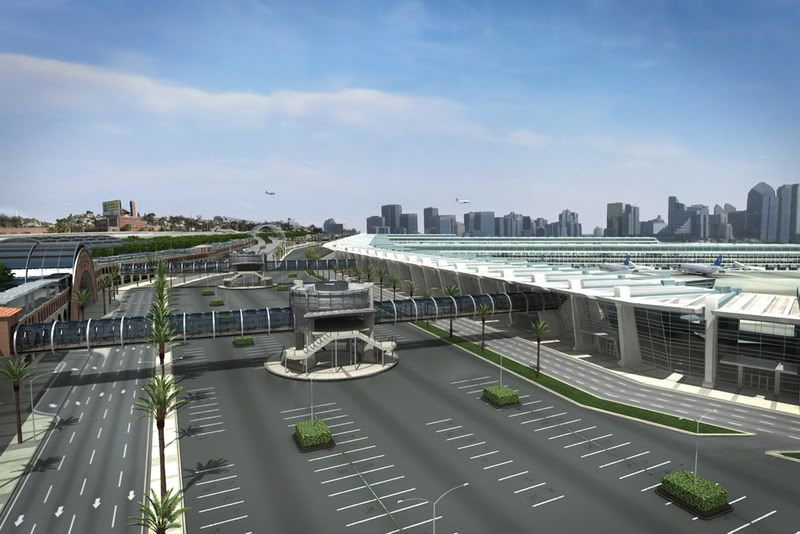
While the ITC is a very interesting proposal in terms of providing direct Trolley, Coaster and Amtrak Pacific Surfliner stops at the airport - Lindbergh Field is between one and two miles from downtown, and the existing Amtrak Pacific Surfliner terminus at Santa Fe is a much stronger location for the downtown San Diego HSR station. It is located on one Trolley line that runs to the border, adjcent to the trolley line to Petco field as well as one of the main downtown bus transfer centers. It is much more convenient to the Convention center and two blocks from the Coronado ferry.

And with respect to the plane/train transfer scenario, San Diego airport is not a main hub airport, nor is its location promising for development into a main hub airport. So for plane/train transfers involving both San Diego and California HSR, the majority of transfers will be somewhere else in the state, with the trip either starting or ending at the San Diego HSR station.

So, while the Intermodal Transit Center is interesting as one transitional design for reducing vehicle miles traveled to the San Diego Airport - its the local rail connections that are critical for that impact. For the High Speed Rail, where San Diego is likely to have one suburban and one downtown station, Lindbergh Field seems to be too close to downtown to be the suburban station and seems to be too far from the key intra-state and interstate transport destinations in San Diego to be the downtown station.


OK, so what about O'Hare

O'Hare airport in Chicago is a clear contrasting example. This is a major western Great Lakes / eastern Midest transport hub. Any HSR network in this region would receive a benefit from connecting to O'Hare.

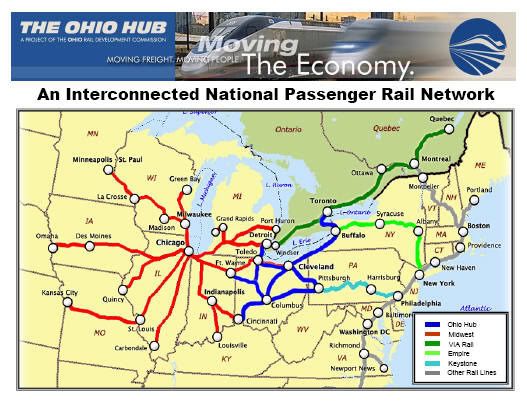
For existing Michigan and Indiana trains, and proposed Ohio Hub trains, the obstacle to getting to the airport is not the existence of an airport station - but rather that fact that O'Hare is on the western side of the Great Chicago Divide.

Most people are aware of the importance of Chicago status as a central rail hub in Chicago's emergence as a major American city. Perhaps fewer are aware of the way that Chicago developed as a rail hub. This was in the late 1800's, when large numbers of ofttimes shady characters were trying to make their fortune by building a railroad. The end result of the chaotic process was a system of lines running from Chicago to the east, and a system of lines running from Chicago to the west, with very little interconnection between the two systems.
And of course, the reason that the Midwest Hub and Ohio Hub systems can be built out so much more quickly with so many more miles per dollar than the California HSR system is because they are starting out as 110mph Emerging HSR systems, built in existing rail corridors. So they stand to inherit the east/west divide.

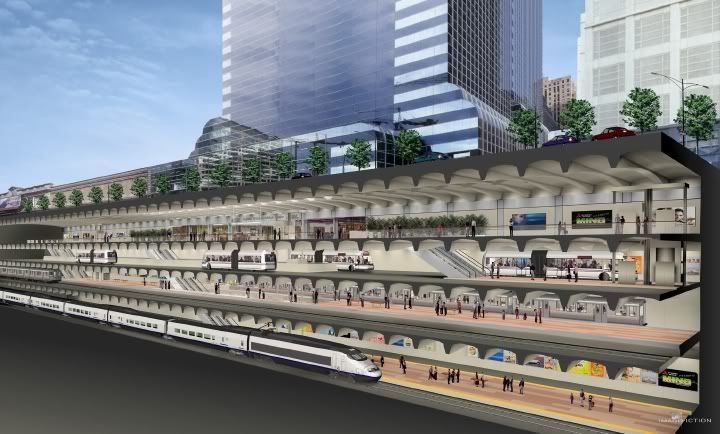
However, it is no secret that this is a problem, and so there are efforts underway to address these problems. One of these efforts is the West Loop Transportation Center

An appealing aspect of this proposal is that it means the downtown Chicago HSR station will be connected directly to Chicago Union Station and the Olgivie Transportation Center.
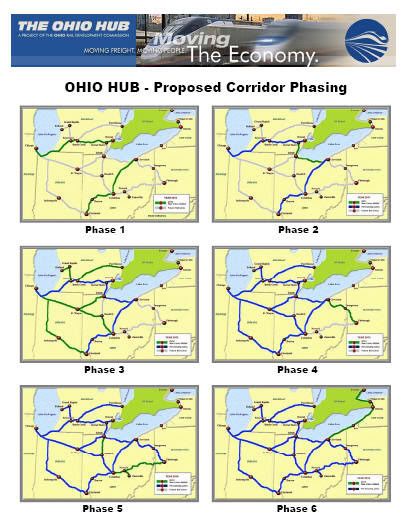
The Chicago / Michigan corridor would be a primary beneficiary among those receiving funding from the $8b appropriated in Stimulus II, but later stages of the Midwest Hub to both Indianapolis and northern Indiana would also benefit from this through access ... and of course the Ohio Hub, which was funded for its core seed corridor at conventional Amtrak speed, plans to connect to Chicago, first via the Michigan corridor, and then via the Indiana corridors.


And a whole collection of potential airport connections ...

Some airport HSR connections are stations directly integrated into an airport terminal complex ... others are HSR connections with local rail that has an airport station ... others are connected to airports by less direct means.

For those choosing between an air/air transfer and an air/train transfer, the HSR station integrated into the airport terminal is obviously the ideal. However, for many people living in rural and outer suburban areas that the HSR passes through, the greater ease of access and quality of service at the regional HSR station will offset an additional transfer to connect to a hub airport.

On the other hand, we are talking about fewer than half of the passengers on a High Speed Rail service - so while an airport station is always an option to consider, going too far out of the way in order to stop at the airport is not automatically the correct choice.

And of course, while in some cases the die has been cast, either by the legacy of airport location choices and availability of transport corridors, in other cases, the decision has not been finalized yet.


Defending Aviation's Market Share

How do we fund airport stations? You might think that since there is an Aviation Trust Fund that we regularly dip into for capital improvements, and since an airport HSR station is an obvious improvement in terms of offering transport alternatives to air passengers, that one way to fund the airport station itself, and in particular the extra capital cost of integrating into the passenger terminal rather than having a station "in the vicinity of" the airport, could apply for funding as a capital improvement to the airport.

Except the ideal is an intermodal through station, the HSR accesses the airport terminal, and where local transport accesses both the airport terminal and the HSR station. Which runs smack dab into the FAA regulations (pdf):
To be AIP and PFC eligible, the airport ground access transportation project must meet the following conditions: (1) The road or facility may only extend to the nearest public highway or facility of sufficient capacity to accommodate airport traffic; (2) the access road or facility must be located on the airport or within a right-of-way acquired by the public agency; and (3) the access road or facility must exclusively serve airport traffic.


There's nothing in the first two that interferes with applying for these funds to cover the incremental capital cost of integrating the HSR station with an airport terminal: the problem is, of course, the third section. This is why so many light rail and other rail projects that go to airports terminate at the airport, since that is the easiest way to guarantee that the infrastructure on the airport property never, ever commits the unpardonable efficiency of serving multiple transport needs at the same time.

Indeed, if you press the point - and as far as I understand it, the FAA does indeed press the point - any through rail corridor must be automatically ineligible, since the passengers that are taking the train through and not using the airport station are automatically receiving service from the road that is not "exclusively for the airport".

This is a national policy that could well be changed. Whether it could be changed by executive order, or requires new Congressional language, I do not know - I am not, after all, a lawyer, not even in the sense of playing on on the Internet - but whichever it is, that is a change that ought to be pursued.

The thing about this regulation is that it doesn't matter how much of the use of the facility is to serve the airport, nor what the cost efficiency of the system is in terms of serving passengers to and from the airport ... the simple fact that another use may be made of the facility is used to rule the project ineligible, so the usefulness and cost-effectiveness of the service to air passengers is never assessed.

A preferable limit for through rail services would be to the incremental capital cost of providing service to a passenger station directly integrated with an airport passenger terminal, restricted to infrastructure located on the airport property itself.

As argued above regarding Lindbergh Field in San Diego, an airport station is not automatically the preferred location for an HSR station. However, with the opportunities to engage in air/train transfers, and the existing ground transport connections to the airport, it is often an option worth considering.

However, because of the space hunger of airport runways, there is often an incremental capital cost in connecting an HSR corridor directly with an airport via an airport terminal station. Where the airport station turns out to be a cost effective way of providing improved transport connections to the airport, the decision should be made in terms of how effectively it serves to provide transport to and from the airports, and the efficiency of also providing additional service to others should not automatically rule it out.

Monday, February 1, 2010

Sunday Train: Going to Disneyland, Disneyworld, and Other Adventures

Burning the Midnight Oil for Living Energy Independence

Huh, seems me that whatever the state of my various concerns, the agenda of the Sunday Train has been taken over by the White House ... funny how announcing the recipients of a total of $8b will do that.
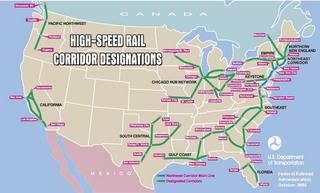
The Transport Politic (aka Yonah Freeman and the TTP commentariat) has a very complete rundown. The allotments over $200m are:
  • California, $2,344m
  • Florida: $1,250m
  • Illinois: $1,236m
  • Wisconsin: $822m
  • Washington: $590m
  • North Carolina: $545m
  • Ohio: $400m


So, what's the money for?


So, what's the money for?

I'll start with the big ticket items.

California, $2,344m. This includes $1,850m for the California HSR Stage 1 from San Francisco to Anaheim via San Jose, Fresno, Bakersfield, and the LA Basin. This is, in essence, enough to prime the pump for the California project.
California has the advantage of $9b in bonding authority already passed in November 2008, but that bonding authority has strings attached. One of those string is that for any given segment, all funding has to be in place before bonds can be sold, bonds cannot fund more than half the cost of a given segment, and to avoid monkey business in the definition of "segment", it has to have a vetted plan for running services without state operating subsidies.

This ARRA funding will allow the California HSR authority to work through 2010 and its projected start of the segment design and build process in 2011 without having to sell bonds up front. Then if an application for additional Federal funds requires matching funds, it will be possible to bring one or more of the defined segments in line for receiving state bond support, which will provide the matching funds.

Obviously, how fast those funds flow will determine how close the CAHSRA can stay to its project timeline ... but with the ARRA funding to prime the pump, California is well placed to proceed with the project at whatever pace that funding flows permit.

And the flip side of the ARRA announcement is a substantial group of states with a stake in having enough HSR funding so that they are not forced to go toe-to-toe with California's substantial application advantages. Any "transparent process", which are codewords for cost-benefit analysis based decisions, will give heavy weight to California for Express HSR. Just as the Northeast Corridor has a close to ideal population distribution for conventional rail, and the Great Lakes / Eastern Midwest a close to an ideal population distribution for 110mph/125mph Emerging/Regional HSR, California has close to an ideal population distribution for Express HSR.

In addition to the Stage 1 corridor funding, the ARRA funding includes $400m for building the shell of a bus terminal into the foundations of the Transbay Terminal bus station in San Francisco. This is a project that is reputedly "ready to go", although of course the actual design of the TBT train box leaves quite a bit to be desired. Never one to quit working before the whistle, I am hoping that the availability of $400m can be used to persuade the Transbay Joint Power Authority to build a less heavily bottlenecked design for trains entering and leaving this undergound train station.

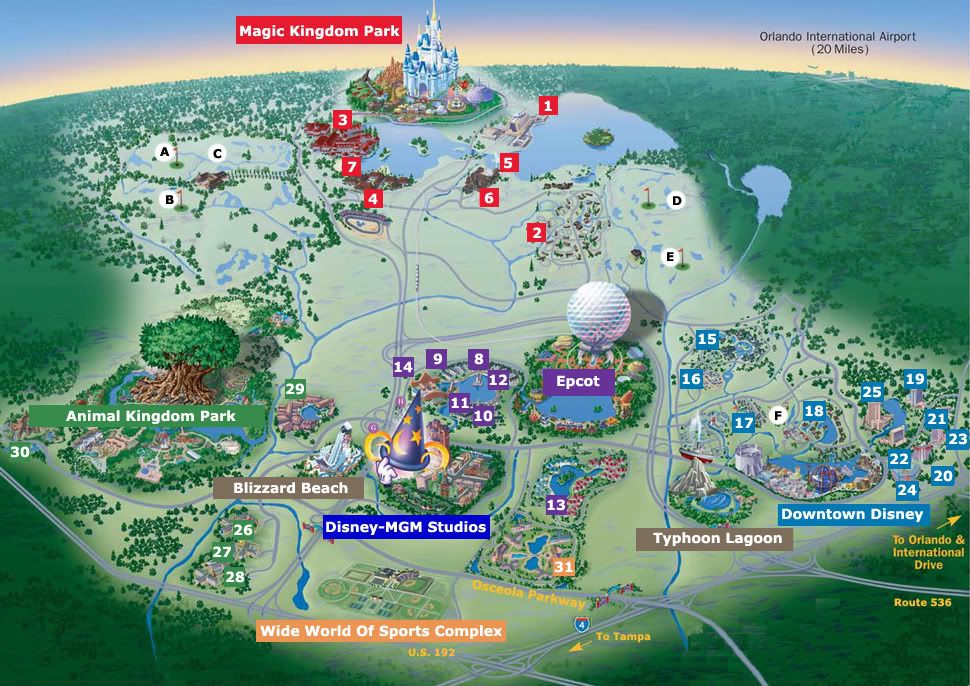
Finally, while Stage 1 does not go to Vegas (despite what the Replicants were saying this time last year) ... it does go to Disneyland. Which sets the stage for the next allocation.

Florida: $1,250m. This is entirely for Express HSR track from Tampa to Orlando. This is a line that has been criticized for not connecting the two downtowns of the two cities. On the other hand, it does go to Disneyworld, and as an on-again, off-again project that kept getting squashed by lack of local funding, the Florida State Legislature was led to believe that their hopes of HSR funding required a commitment to support complementary local rail service. Support for SunRail passed, and so Florida got their Disneyworld train.
If there is ongoing federal funding available, I expect that sooner or later Florida will bite the bullet and sort out an extension of the service - even if not an extension of the corridor - to allow downtown to downtown service. After all, in France, one of the early pioneers in High Speed Rail, its common for the Express HSR services to only run on Express HSR corridors between major metropolitan areas, and to run into and through major metro areas on express electric urban lines.

Illinois: $1,236m. The main project here is $1,102m to upgrade parts of the Chicago / St. Louis corridor to 110mph service, cutting end-to-end travel time to four hours, and bringing substantial new populations along the corridor within three hours or less of either Chicago or St. Louis or both. Further improvement of this corridor on the same basis can bring the end-to-end time down to three hours.
The second main project is $133m for line and station improvements between Chicago and Michigan, including two suburban and one downtown station for Detroit. This is a line that, like the Chicago / St. Louis, has already has a series of smaller incremental improvements.

Wisconsin: $822m. The bulk of this is $810m to establish a Milwaukee-Madison corridor service. This will extend the already well patronized successful Chicago / Milwaukee corridor, and indeed further build patronage on that corridor, since Madison / Chicago is a substantial transport market in its own right along this corridor.

Washington: $590m. This is mostly for bypass tracks for the Cascade Corridor between Oregon and Washington, with some services continuing to Vancouver. I believe there is also some provision for new rolling stock to support additional Vancouver services.
North Carolina: $545m. The bulk of this is $520m to bring the Raleigh/Charlotte corridor up to 90mph, as a first step to eventually bringing it up to 110mph as part of the Southeast HSR Corridor.

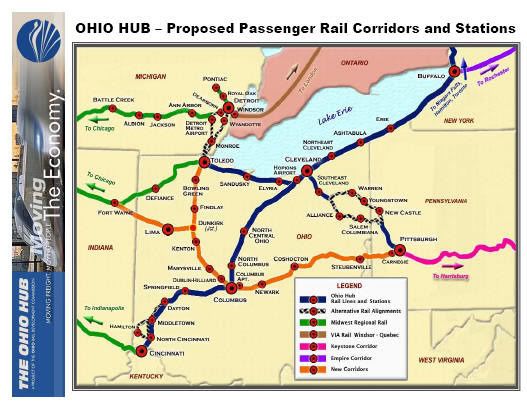
Ohio: $400m. This is all dedicated to establishing the conventional rail starter service for the Triple C route from Cleveland to Columbus and Cincinnati to Columbus. This was a route abandoned in 1971 when Penn Central went bust, and when Columbus was well under half a million in population. However, with the growth of Columbus in the decades since, Columbus is now the second most populous metro area and the corridor the most densely populated corridor in the country without regular rail service.

In terms of HSR, establishing this service is a starter on establishing the 110mph version of the Triple C, which with two hour services to Columbus from either end is when the corridor is projected to be capable of generating a substantial operating surplus. It may take a series of upgrades, to get there, but each upgrade will cut trip speeds and improve patronage on the corridor, trimming the required subsidy until it finally goes away.


Oh, and clever politics too

I've already noted the political intelligence of giving California enough to prime their pump. California Senators and Congressmen will, of course, be pushing for enough further HSR funding to assure that California's HSR system can be constructed more or less on scheduled. And of course, rivals can either try to fight that big House caucus ... or work out a way to ensure there is enough to go around. The politics leans toward the "enough to go around" outcome.

For Florida, people from all over the country go to Disneyworld. In not too long a time from now, many of them will be catching the train from an airport station to Disneyworld, and some of them using the HSR train again for one or another daytrip. This addresses the "if only you had ever been to Europe/Japan and experienced this thing ..." problem.

And of course, Florida is a famous Presidential swing state. Work on the corridor will be progressing before election day in 2012.

Illinois is not a famous Presidential swing state, but after California is one of the prime examples of states that have invested both capital and operating subsidies into improving Amtrak corridor services in its state, and even if the President and Secretary of Transport were not a Democrat and Republican, respectively, from Illinois, it would be wise politics to reward that behavior with the flagship Emerging HSR corridor. Of course, on the SubsidyScope numbers, even at conventional rail speed, its also the leading Great Lakes / Midwestern regional corridor in operating cost ratio, so its also the safest bet in terms of generating a comfortable operating surplus once raised to 110mph.

Washington (and Oregon, but the bulk of the corridor is in Washington, and that's where the highest priority bottlenecks lie) may not lean as strongly Democratic in Presidential politics as Illinois, but is also an example of rewarding those states that have invested into corridor improvements, as in inducement to additional states to follow the same course.

North Carolina is an example of a state that we didn't expect to be a swing state in Presidential politics, but then in 2008, it swung. And North Carolina is right on the boundary line between states that have been making genuine investments in improved rail service, and the states to its immediate south and west that have been paying lip service at most.

And of course, Ohio is a Presidential swing state in the Florida league. Further, the Ohio Triple-C will be in operation before election day, 2012.

In terms of the politics of rewarding states for supporting rail, Ohio is like Florida in the first half of "new friends are silver, old friends are gold" ... after a very tight fight in the Ohio state legislature, the operating subsidies required by the conventional speed Triple-C service were passed by the Republican State Senate. That was when before Strickland's approval rating was battered by the recession, and unless that subsidy offer was taken up by the DoT, there was every chance that it would not be repeated.

On the other hand, once the service is up and running, the call to apply for federal funds to speed segments of the corridor up to 110mph will be much harder to resist than it was to fight against the idea of starting the service up in the first place. So there is every reason to hope for 110mph service to be in place in Ohio sometime before election day, 2016.


And now, the headliners ...
Midnight Oil: The Power and the Passion

Monday, January 18, 2010

C'mon, Joe, Take the Neutron Bomb to this Filibuster

Kossack slinkerwink tells us that Vice President "Amtrak Joe" Biden has spoken out against the filibuster:
Vice President Joe Biden said at a Florida fundraiser Sunday that the 60-seat threshold for passing legislation in the Senate put a dangerous new roadblock in the way of American government.

"As long as I have served ... I've never seen, as my uncle once said, the constitution stood on its head as they've done. This is the first time every single solitary decisions has required 60 senators," Biden said. "No democracy has survived needing a supermajority."


Well, if this is about the survival of our Democracy, I say it may be time to recall the parliamentary maneuver threatened by the Republicans in 2005, dubbed the "nuclear option". Since this is a more precisely targeted version of that parliamentary maneuver, I refer to it as the "Neutron Bomb".


Recall those distant days of 2005 ...

Kossack homunq explained on 12 January:
1. the 2005 "Nuclear option".

Wikipedia, emphasis mine:
A senator makes a point of order calling for an immediate vote on the measure before the body, outlining what circumstances allow for this. The presiding officer of the Senate, usually the vice president of the United States or the president pro tempore, makes a parliamentary ruling upholding the senator's point of order. The Constitution is cited at this point, since otherwise the presiding officer is bound by precedent. A supporter of the filibuster may challenge the ruling by asking, "Is the decision of the Chair to stand as the judgment of the Senate?" This is referred to as "appealing from the Chair." An opponent of the filibuster will then move to table the appeal. As tabling is non-debatable, a vote is held immediately. A simple majority decides the issue. If the appeal is successfully tabled, then the presiding officer's ruling that the filibuster is unconstitutional is thereby upheld. Thus a simple majority is able to cut off debate, and the Senate moves to a vote on the substantive issue under consideration. The effect of the nuclear option is not limited to the single question under consideration, as it would be in a cloture vote. Rather, the nuclear option effects a change in the operational rules of the Senate, so that the filibuster or dilatory tactic would thereafter be barred by the new precedent.


humonq goes on to argue that:
Note that the nuclear option needs at least one, and probably two, people to assert that the current filibuster is unconstitutional. In 2005, the Republican argument was that Judicial filibusters were unconstitutional, but legislative ones are constitutional. This relied on some pretty thin reasoning that Article II, Section 2, of the U.S. Constitution, which says the president "shall nominate, and by and with the Advice and Consent of the Senate, shall appoint ... Judges...", requires an up-or-down vote.

I'll come back to the nuclear option later (I bet you can see where I'm going), but for now, just note that the nuclear option as proposed in 2005 is NOT relevant to legislative logjam, because it would only eliminate judicial filibusters.


Take Out Your Copy of the Constitution ...

Except ... notice that the threat to use the Nuclear Option was not based on the reasoning standing up in the Supreme Court, but in the precedent set when 51 Senators, or 50 Senators plus the VP, votes to table the appeal to the decision of the chair.

And there is Constititional language that specifically addresses the powers of the Senate on a particular kind of legislation, including the health insurance reform bill as well as the legislation to establish any cap and trade system: which is to say, the first clause of Article I, Section 7 of the Constitution:
Section 7 - Revenue Bills, Legislative Process, Presidential Veto

All bills for raising Revenue shall originate in the House of Representatives; but the Senate may propose or concur with Amendments as on other Bills.


The powers of the Senate with respect to Revenue bills are spelled out: they may propose or concur with Amendments. That's why Senate revenue bills always start with language that basically strips out the whole of the House language except for enabling the law, then put in the Senate version as an amendment.

And notice that the Senate has hobbled its own powers to amend with its toleration of the filibuster process: it is the Senate rules that dictate that an amendment to the House bill may be filibustered.

So, suppose the House bill as passed included a rider that specifies that after passage by the House, and after a certain number of additional legislative days have elapsed, any Senator may bring the bill for a vote, including any amendments that the Senate may have already passed.

Now the Senate might elect to ignore this rider, but of course, as with the threat of the Nuclear Option: it also might not. A Senator makes a point of order that under the terms of the rider, he wishes the measure be brought to a vote. The President of the Senate rules in favor under Article 7 read as meaning that the rider stands unless and until the Senate amends the bill to remove it. An opponent appeals the decision of the chair. That is moved to be tabled (which cannot be filibustered). The motion to table passes, possibly by 50+Biden. And then the measure is brought to a vote.

Now, note, if the House does this at the current point in the process, that would be with whatever other amendments deemed necessary to allow the Senate version of the bill to pass the House. If the Senate passes it without amendment, it goes straight to the President's desk, as being passed in the same form by both chambers. If some amendments have been made before the filibuster logjam is broken with this maneuver, then the House would have to pass that version, and then it could go to the President.

So, the minimum requirements would appear to be:
  • A house majority, willing to pass the rider
  • 41 Senators willing to protect the rider with the threat or action of filibuster of any amendment that would remove it
  • One Senator willing to move under the rider when the time has elapsed
  • One Chair willing to rule on Constitutional Grounds that the rider applies unless and until amended by the Senate
  • 51 Senators, or 50 Senators + Biden, willing to explode the Neutron Bomb on filibusters on Revenue Bills


... except, you will recall, the "Nuclear Option" was never used, yet the Democrats caved on nominating odious Supreme Court justices.

Note that while many Senators are more or less in the pockets of health insurance companies, some are more deeply in the pockets of Oil Companies or sometimes Coal Companies. And if the Energy Companies think that it is more likely that they could defeat the Neutron Bomb directly in the context of cap and trade ... they might instruct their bought and paid for Senators to stand down on forcing the Neutron Bomb to be exploded in the Health Care debate.

Since once you've blown that particular hole in the "continuing rules" of the Senate, its open, and a similar rider could be employed whenever the House knows it has 41 Senators willing to defend it and 51 votes for passage ... bearing in mind that repeating a precedent is not as politically fraught hard as setting one.

So if the House Republicans (and Liebericans) cave (as they did before Christmas under threat of snowstorm) and do not filibuster so that the bill goes to a vote without anyone triggering the neutron bomb option ... well, then that leaves the neutron bomb back in the silo.

Though ... note that as the by the minority of the filibuster power continues, it would face a growing risk that the Neutron Bomb will eventually be exploded.

Sunday, January 17, 2010

Sunday Train: A Train Running A Profit is Charging Too Much

Burning the Midnight Oil for Living Energy Independence

Note that the statement is abbreviated for the title. The full statement is, a common carrier like a train, bus, or plane that running a profit based on passenger revenue while paying its full operating and capital cost is charging too much for its tickets.
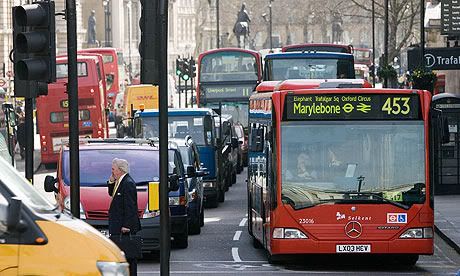
The radical abbreviation of the title is in part because of the radical abbreviation of the lie that is commonly used as a frame. The lie is that a common carrier like a train, bus or plane that is paying for its full operating and capital costs out of passenger revenue ought to run a profit, commonly expressed as a charge of, "SERVICE_XYZ is losing money, it needs to be reformed!", which assumes that Service_XYZ is supposed to be making a profit.

And, of course, in the sense described above, if its a common carrier transport service, of course it shouldn't be making a profit. And further, if under the above conditions, if its making a profit, you're doing it wrong. In the sense given above, PROFIT=FAIL.

This is problematic under our economic system, because under our economic system, running a profit on the full cost of production normally means that you are free to continue without substantial outside interference, while not making a profit implies that you have to go cap in hand begging for money to operate. So if the main assertion is correct, we have a situation where you can be doing it wrong, and be free to continue, or be doing it right, and have to constantly beg for permission to continue doing it right.


The Services Provide by a Common Carrier Transport Service

A common carrier transport service provides multiple services.
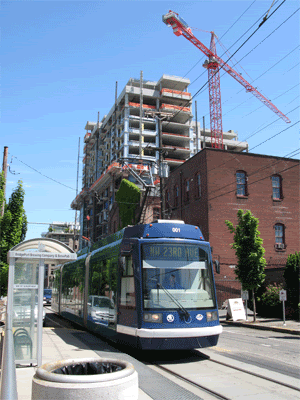
  • The passenger taking the service receives a direct benefit
  • The passenger choosing an alternate means of transport receives an insurance benefit in the form of an available back-up means of transport in case the preferred alternative fails
  • In the US and most Western nations, common carrier transport services are more space-efficient than the most common semi-private private vehicle transport, the automobile, so the passenger taking the common carrier service is providing a congestion benefit to semi-private motorists
  • Common carriers normally operate with designated origin and destination points, which concentrates foot traffic and creates property value
  • When compared to semi-private automotive transport, common carrier rolling stock is normally far more intensively employed, substantially reducing rolling stock material overheads per passenger mile
  • These are in addition to the general external benefits of transport in permitting people to congregate, to the benefit of employers, retailers, and a wide range of service providers
  • These are also in addition to specific advantages or disadvantages of specific technologies, such as the intrinsic energy efficiency and aggregate labor efficiency of coupled vehicles operated in a train over uncoupled vehicles operated individually.


The value of the common carrier ticket reflects the direct benefit to the passenger, and some but not all of the insurance value of the existence of the service. It cannot include congestion benefits, intrinsically experienced by those not taking the common carrier, and does not include any property value benefits.

The material efficiencies of use of the rolling stock would be captured in the capital cost of the system - except there are substantial material costs that we simply ignore. Handing a free ride, for example, to those dumping CO2 into the atmosphere despite the fact that they have done nothing to establish that it is safe to do so - is only one of the more egregious examples.
All common carriers offer intrinsic and automatic transport insurance benefits to users of alternative systems, and that benefit can only be partially captured in ticket prices. It is possible, of course, to charge a higher price to a person that bought a ticket closer to the day of departure, ordinarily presented to the passenger as a discount for buying the ticket a certain period in advance. However, it is not possible to distinguish between a specific transport need that arises close to the departure date and a need to switch to a back-up mode that arises close to the departure date.

So demanding that trains, buses, and planes fully their full economic costs out of ticket revenues alone is always expecting passengers to pay for somebody else's benefit.

This should be no surprise: "user pays" is quite often a shorthand for, "the poor sucker who has had the bad luck to be dubbed 'user' subsidizes the other beneficiaries". In reality, those on the public right of way may be using space freed by common carrier passengers, as well as using the self-insurance of a fall-back option, and if the common carrier transport is more energy and emissions efficient, using the fuel and CO2 dumping capacity freed up by the common carrier transport.

What About Beneficiary Pays, Then?

So, what if we had a Beneficiary Pays system?

Those private users of a congested public resource like the public roadway would pay users of common carriers based on the relative space efficiency of that common carrier. So mass transit would get the most subsidy per seat, then various forms of light rail, then (actual) Bus Rapid Transit and Quality Buses, then shuttle buses. This payment would be for seats occupied over the load factor that has the same space consumption as the average private vehicle.

In our Petroleum Import Strategically Dependent nation, those private users of petroleum consuming vehicles would pay users of common carriers based on the relative petroleum consumption - the maximum subsidy to electric vehicles, then to high load factor trains, then to high load factor buses. This payment would be for seats occupied over the load factor that has the same petroleum consumption as the average private vehicle.

All private vehicle operators would, of course, pay for the existence of common carrier transport. This payment would be for the frequency of trips to distinct destinations.

And all property owners served by common carriers would pay a property tax to reflect the portion of their property value supported by the existence of the common carrier. Since it is dedicated transport corridors that have clearly discernable property value benefits, this payment would be distributed by the frequency of trips on dedicated transport corridors to distinct destinations.

Short Term Versus Long Term

Now, this is not a proposal for Congressional Action in 2010. Just as the radical reactionaries who adopt the pretense of labeling as "conservative" the desire to destroy the gains of the Square Deal and the New Deal pushed both short term and long term messaging, we have to be able to push both short term and long term messaging. And this is part of the long term messaging:
  • ALL the beneficiaries should pay, not just the users


Heck, its short enough to twitter: "All who benefit should pay, not just riders" ... 44 letters. 20 characters for a bit.ly link and you still have 70+ characters for usernames, retweets, and additional remarks.

But short term, keep it in mind when arguing in favor of whatever funding source is being cobbled together to support feasibly ecologically sustainable transport by electric rail, rail that can later be upgraded to electric rail, and electric trolley buses ... throw it into the argument. "ALL who benefit should pay, not just the riders".

Oh, and don't forget the occasional "of course you want the system to make a profit - you are trying to take a free ride off the fares paid by the riders" if you get the mental inhabitant of one of the libertarian fantasy universe engaged in conversation.

Because if well run train system on a well-chosen corridor is running a profit - then cutting the fares and eliminating the profit would offer more benefit all around.


The Headliners: Midnight Oil
Read About It: Oil on the Water Concert


The rich get richer
The poor get the picture
The bombs never hit you when you're down so low

Some got pollution
Some revolution
There must be some solution but I just don't know

Sunday, January 10, 2010

Sunday Train: Freight and Passenger Trains Should Be Friends

Burning the Midnight Oil for Living Energy Independence

Flying home from the Economist's national conference Atlanta (see note1) my brilliant entertainment plan to pass the day lost flying home from Atlanta fell apart.
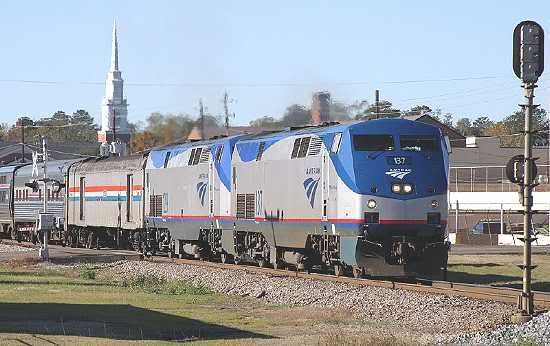
I could not attend even the 8am session on Tuesday, because the flight left at 11:15, and I was warned about TSA security theater delays. So I got on the MARTA train around 8:30, to stand in line to check-in, to stand in line to get through screening, to get to the gate and wait, to get on the plane which waited in line for a runway. It was, however, only half an hour in the air, so that fact that with a 125mph train to Charlotte I could have gone to the morning conference session and arrived in Charlotte sooner is neither here nor there.

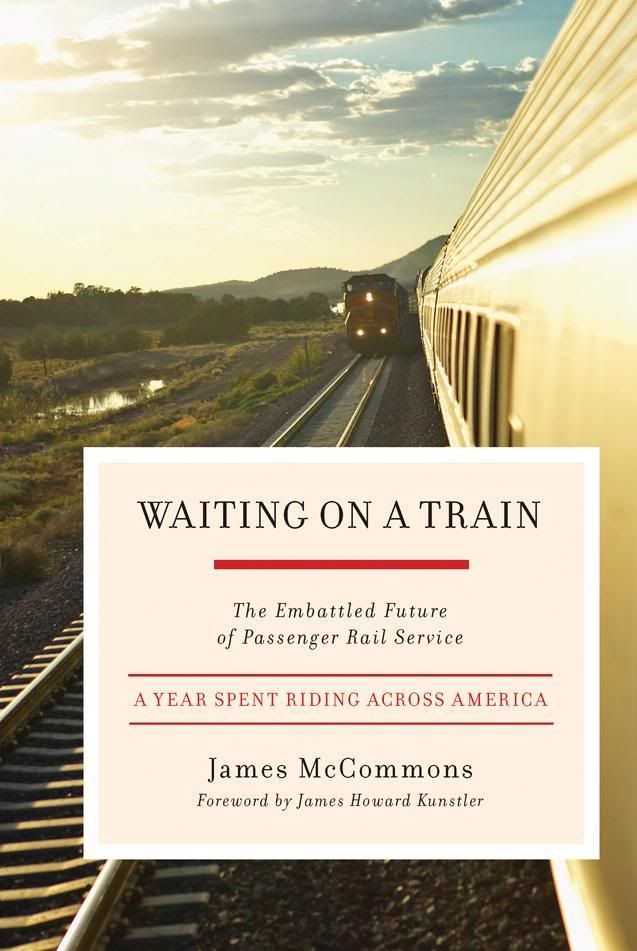
Then I had a 3hr+ layover in Charlotte until the plane back home to NE Ohio. But I had my Netflix and some FullMetal Alchemist DVD's, so no problem. Except my portable DVD player decided to stop working (see note2), so there were no DVD's. Which meant I was forced to fall back on a "pbook" (paper book) I had brought with me - Waiting on a Train, which meant that I finally finished it (and still had several hours to wait after I had done so).

And in particular read the fascinating discussion of the touchy relationship between freight and passenger trains. Regular readers will know that this is a critical point: indeed, the entire Steel-Interstate strategy to getting Higher Speed Rail for Appalachia rests on passenger trains running on infrastructure provided in support of 100mph electric freight trains.


The Bad Old Days Are Not So Many Days Ago

One of the striking passages in the book is the following:
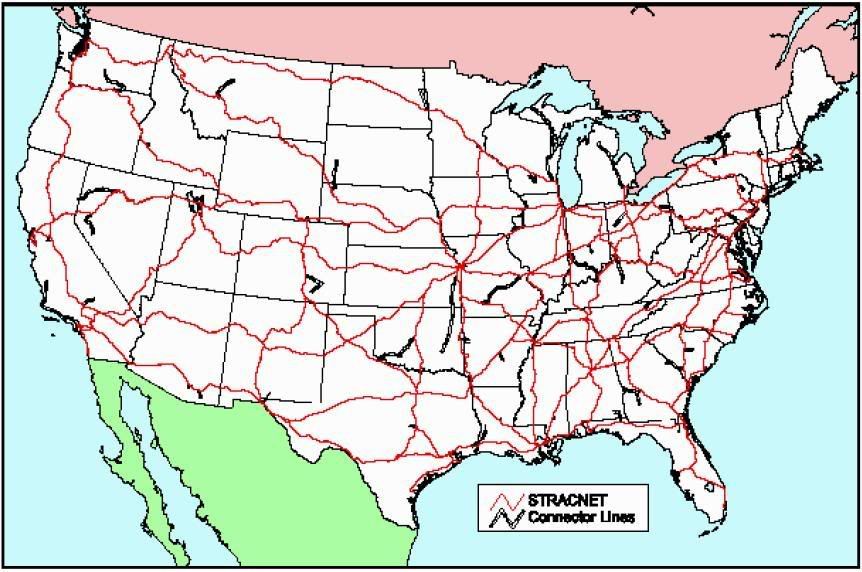
... at breakfast I got an earful from Tom Landolt, an engineer who had retired from UP [Union Pacific] a few months earlier.
...
He said, "Let me tell you a story. I was running a freight train in New Mexico on a real cold night, and the Sunset Limited was coming up behind us. Now, I had a real heavy train, and we had to go up a grade, so I talked with the dispatcher and said I would pull over and let the Amtrak go by. And he said, 'No, sir, we don't pull over for them, they can just slow down.' And I started up that hill and broke down. Now, the Amtrak had to back up more than ten miles, and wasted hours. Now there's no reason for that to happen, but that's the attitude. They just do not give a damn." (pp. 163-5)


That is, however, Union Pacific. By contrast, there is this from the Burlington Northern Santa Fe (the one that Buffet recently bought):
Mitchell looked down at a printout of my submitted questions. "You ask what makes us different. Why do passenger trains on our tracks have such good on-time performance?"

He looked up, "OK, here's the the simple answer: 'We Care.'"

"You care?" I said.

"We do. We really do."

I was remembering Hubbard's "We don't care" anecdote.

"Well, why? What's in it for you guys?"

"Because we believe Amtrak and the commuter services that run on our network are customers. And like all of our customers - coal, grain, or industry - we believe they deserve good treatment. (p. 190)


Of course, caring alone does not guarantee Zero Delays.
In Texas, for example, the ports of Houston and Galveston can get so congested that freight trains back up all the way to Oklahoma City because its a single track railroad. The Temple to Forth Worth section has terrible on-time performance. The ground dries out in the summer and the ballast sinks. In winter, the soil turns to gumbo, the ballast slumps, and the rails become "bumpy". In both instances, slow orders have to be put on until repairs are made. (p. 191)

There is only so far that sincerity can go before reaching the point where capital investment is required for further improvement.


The Bright New Day for Passenger/Freight Rail Cooperation

By the second half of 2008, under the pressure of the capacity constraints that were preventing the Class I railroads from taking full advantage of the windfall of the Oil Price Shock, the major railroads had adopted a new line (though of course, I will believe that Union Pacific is an enthusiastic supporter of the industry line when I hear tell of some direct evidence):
... I went to Washington DC and interviewed Ed Hamberger, President and CEO at the Association of American Railroads ...
...
Hamberger has been President of the AAR since 1998, a time when the organization was suing Amtrak to stop hauling freight cars on its passenger trains. He testified several times in front of congressional committees that Amtrak should pay fully allocated rather than incremental costs. Hamberger is a sharp and articulate guy, comfortable with politics, and the repositioning it sometimes requires. He wasn't unaware of the ironies of what he was about to say, and acknowledged them with some humor.
...
"The industry is taking an aggressive stance to link its message with that of passenger-rail advocates. Perhaps we haven't been as forthcoming in the past as we could have and should have been, but now were are saying: We think the country has to move forward with both freight and passenger-rail service," said Hamberger.

I'd gotten wind of this turnabout in attitude from Don Phillips and Carmicheal, but it was still striking to hear it directly. Its a strategy capsulated in the phrase: "Commuters vote, boxcars don't." Delivering improved passenger service benefits freight railraods.

Although the recession has given railroads some breathing room, the industry is clearly worried about capacity. If just 10 percent of highway freight switched to rails, the railroads would be inundated. As one executive tol me, "Corporate America is ready to move a hell of a lot more goods on trains, but they won't do it if the railroads are incompetent."


Ensuring that Freight and Passenger Rail are Friends on the Steel Interstate

Now, what the railroads are pushing for is an investment tax credit. However, as discussed before, the Steel Interstate strategy opens up the door to something far more dramatic.
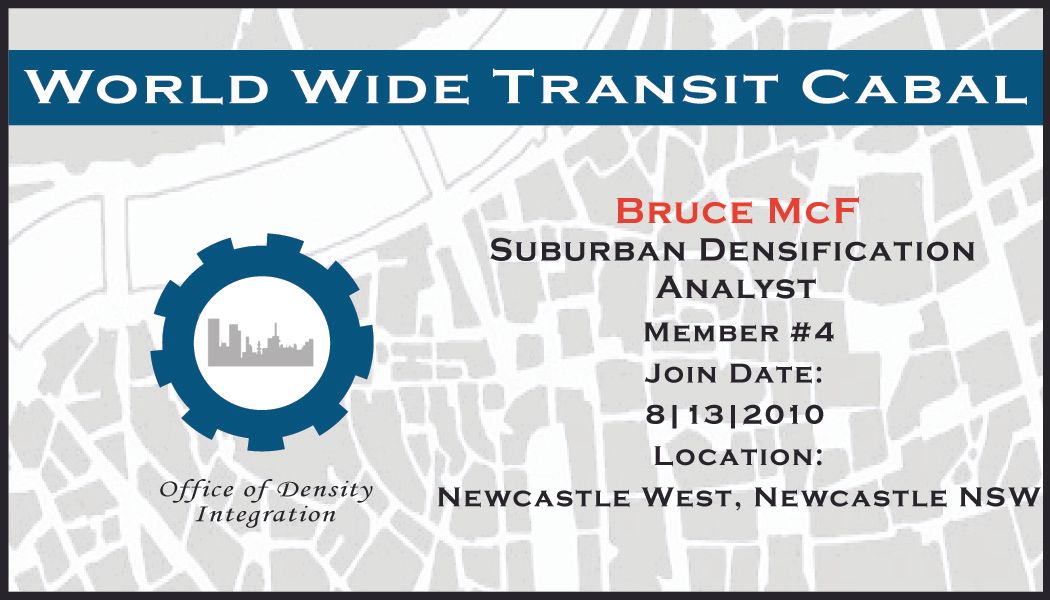
It is a compelling national interest, after all, that if we have an opportunity to shift long haul freight from diesel road freight to electric rail freight, we do so. Irrespective of the source of electricity, the electric rail freight offers reduced CO2 emissions, with further reductions if the power comes from a carbon-neutral source. And at the same time, many of our largest untapped domestic energy resources, such as wind power, originate their power as electric power, so using the power in the form of electricity avoids conversion losses.

Suppose that the original capital cost of infrastructure for 100mph freight paths - and, incidentally, 110mph to 125mph passenger rail paths - is paid for out of user fees and access fees, but the interest on the capital cost is subsidized.

For example, a quarter per barrel import tariff is imported on imported petroleum and petroleum products, rising by a quarter per barrel each year for 10 years. This would yield about $3b per year to finance twenty year tax bonds, which at a real interest rate of 5% would be about $60b new capital spending per year. The public authorities building the Steel Interstates would then buy back the tax bonds with access and user fee income.

These tax bonds could even be structured in a way to make Wall Street speculators happy, promising a given share of the tax revenues, which Wall Street investment banks could then slice and dice to their hearts content into various senior, more stable, and junior, more speculative tiers - except rather than feeding a process of debt-financed consumption, they would be feeding a process of real, physical, protection against massive oil price shocks.

What does this mean for relations between freight and passenger rail? Simple: the fast freight trains on 100mph paths would be running on publicly owned infrastructure, built on the freight railroad's right of way. When the Rapid Rail dispatcher says that the freight is making way, then its the freight dispatcher's choice whether the freight goes onto a siding to wait or returns back onto the heavy freight line to continue making headway.

And as BNSF has shown, when the infrastructure owner cares about the passenger trains running on time, then it becomes possible to perform far better than when faced with the antagonistic (see note3) approach of Union Pacific.

You probably still wouldn't want to be a local commuter railroad relying in whole or part on Union Pacific infrastructure - but if it means an opportunity to winning far more market share from road freight for more quickly than they could on their own, it seems likely that even Union Pacific will be willing to at least pretend to be friends with passenger rail.


The Headliners

Midnight Oil - Truganini

There's a road train going nowhere
Roads are cut, lines are down
We'll be staying at the Roma Bar
Till that monsoon passes on

The backbone of this country's broken
The land is cracked and the land is sore
Farmers are hanging on by their fingertips
We cursed and stumbled across that shore
...


Notes

(Note1: At the conference, I mostly went to the Association for Evolutionary Economics sessions, so didn't see a lot of calculus, though bizarrely I did learn a lot about the Economy - which is of course not what one would ordinarily expect from going to the Economist's national conference.)

(Note2: The DVD player is a V-Zon by Coby, with all sorts of nifty media features - it can play MP3's and several video file formats on both USB keys and SD flash ram cards. Its just that it sucks that when a portable DVD player so dislikes being ported that it stops playing DVD's. By contrast, my Samsung player continues to work as a DVD player even after I stepped on it, breaking its LCD screen. So if you were asking me, I'd recommend Samsung as making a more durable portable DVD player than Coby.)

(Note3: Note that the attitude of Union Pacific is not only antagonist, but it likely results in multiple actions by dispatchers that are, in fact, illegal, under the terms of the agreement reached in the 1970's in which the Class I railroads handed off their responsibilities to provide passenger rail service. The action of the dispatcher reported by the retired UP engineer was certainly illegal.)