Populist movements don't build themselves ...

... It doesn't matter what the "horse race" outcome of the campaign is, if we fight the campaign. Fighting it, we learn how to fight. Learning how to fight political battles, we become citizens again. Becoming citizens again, we reclaim the Republic that lies dormant beneath the bread and circuses of modern American society.

Tuesday, May 11, 2010

Sunday Train: Working on the Railroad for Energy Independence

Burning the Midnight Oil for Living Energy Independence


Well how the frack d'ya like me now?

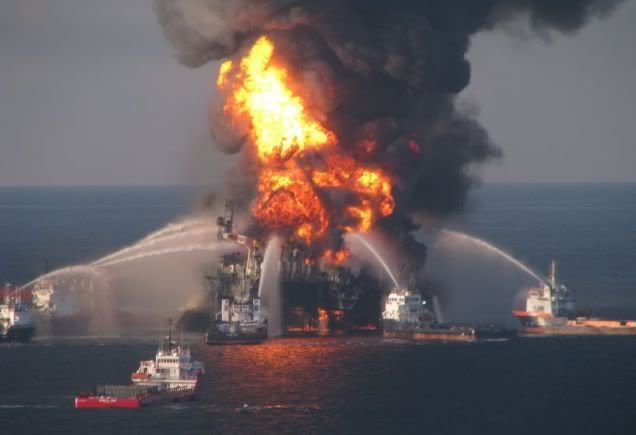
I'm not going to say "toldya so", since many who will be reading this diary said much the same during the "Drill, Baby, Drill" absurdity in 2008 ... but the undersea oil volcano underlines, boldfaces and highlights in red the basic facts of the situation that we face:
  • Our country produces about twice as much crude oil per person as the world average
  • Our country consumes about five times as much crude oil per person as the world average
  • And we have been producing oil a long time, have passed our peak of domestic oil production, and aint ever getting back to it.
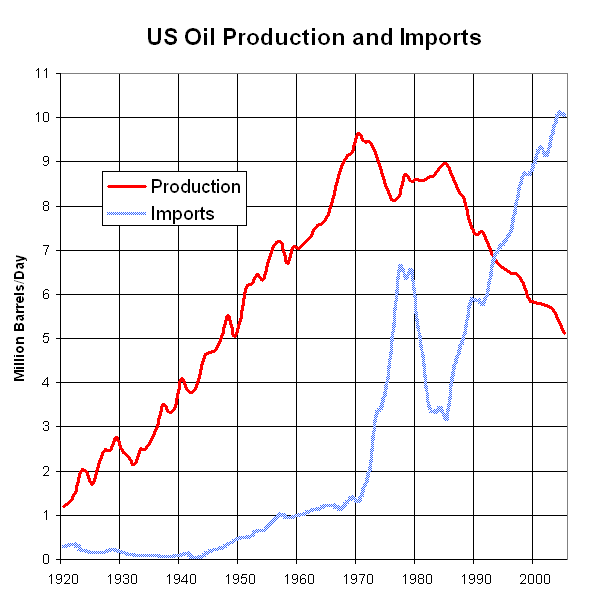

And, anyway, we already tried Drill, Baby, Drill. Its played itself out already.

Obviously, the direction to go to insulate ourselves from oil price shocks and the recessions they cause is to cut our consumption. Which means, in part, Train, Baby, Train.


So, what is it about trains, anyway?

I would admit that I have a big model train set in the basement - except its not mine, its my stepfather's. For me, trains are transport, a way to get from Point A to Point B. Indeed, the mode of transport that has a special place in my heart over and above their functional utility is not trains so much as bikes (and living in NE Ohio, I must hasten to explain "Bikes like Schwinn's are Bikes, not Bikes like Harley's are Bikes").
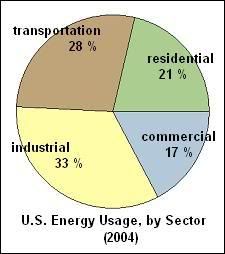

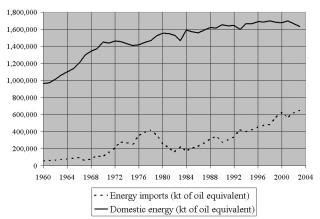
No, this is why trains. We consume 28% of our energy in the transportation sector. If we are going to reduce our oil consumption by 5% a year each year for the next 20 years, that means we have to consume the consumption of petroleum by transport by 5% a year, each year for the next 20 years.

We also have to get off mineral coal, but it turns out that trains can contribute to that as well.

My focus here, today, is how to use the process of breaking our oil addiction as a means of providing the jobs that our economy needs, and does not and will not otherwise have, over the next decade.

Of course, when we focus on oil, transport is even more important. To get more specific, according to the government numbers, transport consumes about 2/3 of our petroleum. We produce about 40% of our oil consumption, and even if we cut our oil consumption by 5% a year ... by the time we have cut 60% of our present oil consumption in 12 years time, we will be producing less oil than we are producing now.
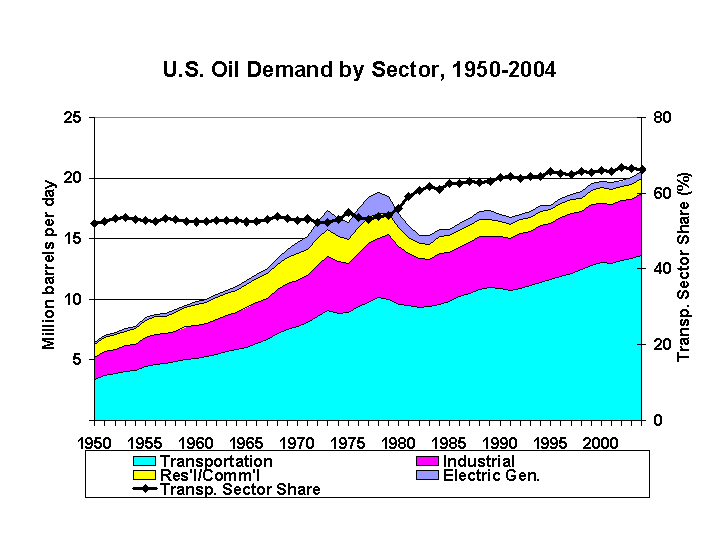

And once we get to the point where we are getting the majority of our transportation energy from sources other than oil, we can start looking to the future. One of the bright, glaring points about "Drill, Baby, Drill", why Drill, Baby, Drill represented the complete abandonment of Republican pretensions about being the grown ups in the room, is that when you pump out and burn oil, its just gone, never to come back.

After all the Republican pretensions I remember hearing ever since being a kid in the 60's and 70's about the Republicans being the party of "responsibility" - their approach to our non-renewable natural resources is "Burn It All As Fast As Possible and the Devil take the Hindmost!".

So, to cut our oil consumption by 5% a year over the decade ahead ... which will still leave us an oil importer, but take us off the front line for being the demand reduction via recession in future oil price shocks ... we need 7 of those 5% reductions to come from transport. And each and every one means more work over the coming decade.

I'll look at three of the seven, today.


1. The Steel Interstate


I described the Steel Interstate approach to Electrified, Rapid Freight Rail a couple of months ago, and then polished up the network map a bit the following week.

So, broad brush strokes here:
  • 15,000miles+ of STRACNET corridors electrified with rail improvements that allow scheduled slots for 100mph Rapid Freight Rail
  • Built primarily in existing freight rail rights of way by distinct government owned, not for profit "Line Development Banks"
  • Those using the infrastructure pay Access and User fees that cover up-front capital costs
  • Interest costs covered by a $0.01/gallon tax on imported petroleum, rising to $0.05/gallon over five years


This is based on the full scale plan offered by Alan Drake and studied by the Millenium Institute, and projected to be able cut our petroleum consumption by about 7%. And of course, the "first half" will result in more than half of that, provided it provides a rough grid that covers the bulk of the long-haul transport markets in the country ... so I'll slate this in as the first of the seven transport "5%/year" projects.

Note that the way I have sketched it out, the Access and User fees are ongoing, on a simple formula, and that a Line Development Bank has completed its line, it would be chartered to devote any capital surplus to the funding of energy-independence transport within its broader service area. So on the back of that funding, the Steel Interstate proposal is also one of the seven required 5% reductions in the second decade of our Freedom from Oil in Twenty Years program.


2. Local Electric Transport

Back in March of 2009, NBBooks wrote $3.195 trillion -TRILLION - for urban RAIL transit.

Where this is derived from is a target for rail transit density:
Building 50,757 kilometers of new rail transit lines, at a cost of $3.195 trillion. is based on building urban rail mass transit systems to the same service density found in New York City, in the next 38 largest urban areas. I began by assuming a desideratum of having a rail transit line no more than 2.5 miles from any point in an urban area. That is, if you took a square of urban area five miles on each side, we want to have a rail transit line running directly across the middle of that square. Slice that 25 square mile area into one mile strips, and you get one mile of rail transit line for every five square miles of urban area, or a density of 0.2 mile of rail transit line for every square mile. Converting square miles to square kilometers, and miles to kilometers, what we are looking for is a density of 0.124 mi {sic.=km} of rail transit line for every square kilometer of urban area.
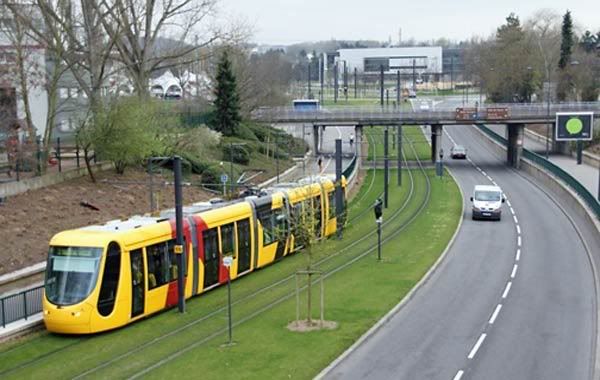

This is a fine density for densely populated areas, but I am of the view that moving to a sustainable settlement system from our current system that is dominated by sprawl-suburban settlement (in terms of representing half or more of all residential population, just as over half of the nation's residents at the previous turn of the century lived in urban rather than suburban areas) will require both rebuilding residential population in core urban areas and establishing urban density walkable neighborhoods along dedicated transport corridors running through suburban areas.

This "clustered network city" approach of suburban transit villages connected to urban centers would seem to permit a looser rail network complemented by a mix of local transport access - by foot, bike, neighborhood electric vehicle, battery/trolleywire trolley bus, etc. So I ease this back to a rail transit line no more than 5 miles from any point in the urban area. That is then, above, a 10 mile square line with a line running down the middle, or a density of 0.1 miles of rail transit line for every square mile ... or 0.62 km line per sq. km.

However, taking the rest of NBBook's estimates, that is $1.6T (trillion with a T). Spread across ten years, $160b/year ... about 1% of our national economy.

How to finance that? Most directly, impose a 5% payroll levy on earned and unearned income received by those making over 7 times median income, roughly $280,000.

In order to achieve broad based oil independence, this would be allocated on a per capita basis to municipalities, counties and reservations, which they could annually allocate for construction or improvement of dedicated transport corridors and dedicated support facilities for electric common carrier transport. Since not all municipalities or counties cannot allocate their share, the annual surplus would be re-allocated to those able to invest their original share.

Is this a 5% piece? I think it likely will be, but I will have to look into that more closely. In any event, it is a piece that will be generating 3.75m jobs per year, every year for a decade.


3. Personal Transport
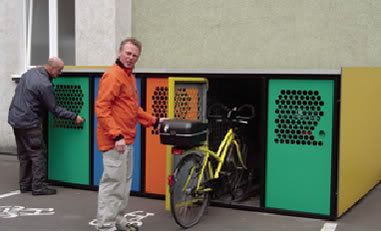

The third piece I would offer today is Personal, or "Active" Transport: Walking and Cycling.

The objection might be raised that this is not a rail project ... but in reality, it is the flip side of the local rail project above. A bike is a fine thing to ride for a couple of miles, but a ten mile ride is not a commute for a regular transport cyclist.

So the focus of increasing Active Transport sufficiently to save 5% of our petroleum imports is the establishment of a walkable zone around stops along the dedicated transport corridors, with a mandatory easement to allow three story, mixed used and stacked townhouse development within a quarter mile of the stop on the corridor.

Given the capital-efficiency of these modes of local transport, the funding can piggy-back onto the above system as well: for all funds drawn from the municipal, country and reservation accounts in support of dedicated transport corridors, 1% must be allocated to qualifying projects in support of Active Transport.


OK, so those are my three ...

... what are yours?


The Headliners: Midnight Oil with Truganini!


There's a road train going nowhere / roads are cut, lines are down ...

Sunday, April 4, 2010

Sunday Train: King of the Mountain, Part 1

Burning the Midnight Oil for Living Energy Independence

I noted near the beginning of the Appalachian Hub series about the special advantages offered by rail electrification for this project.

Now that I have sketched out a process by which a national Steel Interstate network of corridors can, in fact, be built in this coming decade, this is probably a good time to come back and take a look at the challenges that are faced when putting the Steel Interstates through hilly and mountainous terrain.

Of course, if rail electrification was a particular benefit in mountainous terrain, one would expect to see it in places like, say, Switzerland.

Picture of a Swiss electric freight west of the Albula tunnel
_________________

Trans-Alpine Freight and Swiss Rail

When tuning in to news from Switzerland, the big story are so-called "base tunnels". These are tunnels that cut through "the base of a mountain". The Lotschberg Base Tunnel, featured in World's Most Spectacular Tunnels, cuts through the mountain a 1,312 feet lower than the tunnel that it replaces ... that is about a quarter of a mile lower.
Just as the original investments in Japan and France in capital-intensive HSR passenger lines, what is driving this investment in base tunnels is the capacity limits of the present rail routes. As AlpTransit's description (pdf) of the Gothard Base Tunnel Project puts it:
Construction of base tunnels under the Gotthard and Ceneri creates an ultramodern flat rail link whose highest point at 550 metres above sea level is no higher than the city of Berne. This is much lower than the highest point of the existing route through the mountains at 1150 metres. Gradients will be no steeper than where the railway crosses the Jura mountains through the Hauenstein tunnel (Basel – Olten) or the Bözberg tunnel (Basel – Brugg). The route through Switzerland becomes flatter and 40 km shorter. Italy and Germany come much closer together.

Freight trains travelling on the flat route can be longer and pull up to twice today's weight – 4000 tonnes instead of 2000 tonnes. They will be up to twice as fast, too: the fastest freight trains will have a top speed of 160 km/h. Trains like this cannot be used on existing Alpine routes because of the steep gradients and tight curves. When the flat route is complete, it will be possible to transport an equal volume of freight with fewer locomotives and personnel, and less energy.


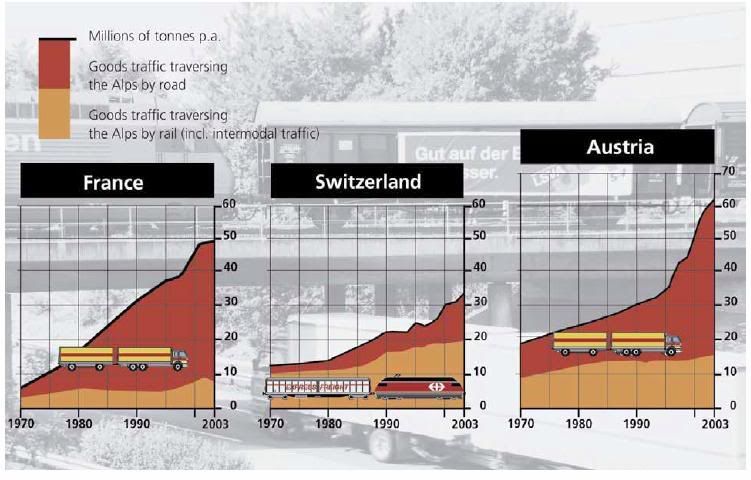
Just as with the Japanese and French investment in Passenger HSR, it is important to put this investment in context. This is not a result of the failures of the existing Swiss electric freight rail system - it is a result of its success. That is, the growth in interstate freight transport is pushing up against the capacity limits of the Swiss system because the Swiss rail system was effective in capturing a substantial share of freight.

This figure from sheet 5 of the Gothard Tunnel pdf makes the point in no uncertain terms. The original Swiss electric freight system has carried a majority of the Trans-alpine freight that passes through Switzerland, while in France and Austria, the majority of freight has been passing by road.
And when digging further into the description of the Base Tunnel makes it clear the benefit that the Swiss have obtained from electric rail.


Why Electrification in Mountain Rail Corridors?

Bear in mind that a normal maximum gradient in many US mainline rail corridors is 1%, or "10 per thousand", when considering the following description of the route being replaced:
The ramps of the present-day railways through the Gotthard and Ceneri have gradients of up to 26 per thousand. The flatness and straightness of the base route – maximum gradient 12.5 per thousand overground and 8.0 per thousand in the base tunnels – allow productive deployment of long, heavy trains through elimination of time-consuming shunting operations. Today, a heavy freight train travelling north-south over the Gotthard and Ceneri mountain routes requires a pushing locomotive because of the steep gradients. The goal of freight trains hauling more than 2000 tonnes travelling through Switzerland without stopping at Erstfeld or Bellinzona, and without midtrain or pushing locomotives, can only be accomplished when both the Gotthard and Ceneri base tunnels are completed.


Consider that: a gradient of 2.5% and "only" being able to move 2,200tons of freight at 50mph.

As the Wikipedia machine notes, the secret to this success in the mountains lies in the higher power-weight ratio of electric locomotives:
The high power of electric locomotives gives them the ability to pull freight at higher speed over gradients, in mixed traffic conditions this increases capacity when the time between trains can be decreased. The higher power of electric locomotives and a electrification can also be a cheaper alternative to a new and less steep railway if trains weights are to be increased on a system.


Putting the Advantages to Work

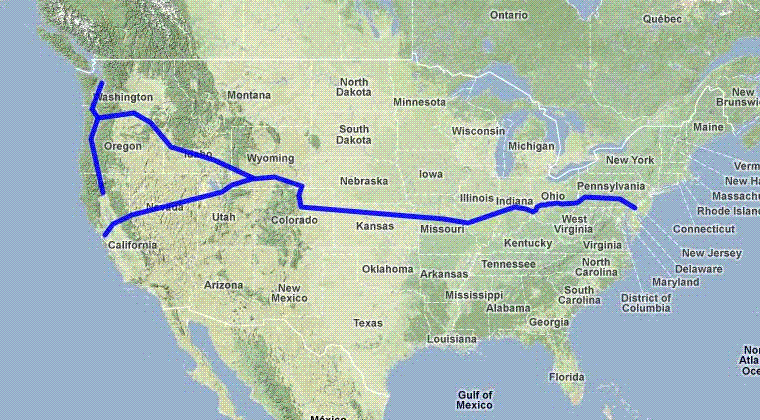
Of course, one way to cope with mountainous terrain is to avoid it. In the proposed Steel Interstate system, line one, the Liberty Line from New England to California, runs along the Shenandoah River Valley, the original "highway to the west", mostly avoiding the type of terrain that the Swiss would consider to be Mountains. To the west, it runs through the lower land of southern New Mexico and Arizona, a similarly easy route through the western cordillera, and then runs up the Central Valley to bring most of California within its catchment.

The roughest terrain that this corridor needs to tackle is the alignment west and north of Chattanooga, where the existing STRACNET corridor does a sweeping S-curve to avoid the rougher terrain where the Interstate has simply been blasted through. This is a key point where the Line Development Bank will have to carefully analyze the alternative alignments, and could well opt for taking the Rapid Freight Rail corridor out of the conventional freight rail corridor, where the Rapid Freight Rail path gains time by operating at a steeper gradient than the conventional rail corridor. That is, operating at 60mph over half the distance may well be a faster path than operating at 100mph along the heavy freight alignment.

Unlike the Swiss freight system, the electrified heavy freight paths will not have to contend with constantly shuttling aside to make way for passenger trains, since the passenger trains will be on the Rapid Rail Paths, whether those are provided by dividing up the time of day that different trains run on a track, by providing separated track in the same right of way, or by providing a Rapid Freight bypass on its own Right of Way.

Once the Chattanooga to Nashville, alignment is determined, that also solves the only stretch of rough terrain that the Heartland Alignment faces, while the Gulf and Atlantic Line only ever runs to, but never through, rough terrain.

In other words, other than the Chattanooga/Nashville alignment, all of the challenging terrain has been focused on the National Line:
  • Harrisburg to Pittsburgh, within the territory tof the Appalachian Hub;
  • east of Salt Lake City and east of Sacramento, on the line to Oakland;
  • the northeastern and northwestern Oregon corridors on the line to Portland; and
  • the Southern Oregon / Northern Californian corridor between the Pacific Northwest and the California Central Valley


Indeed, it has been suggested to me that this is a line that should not exist at all. So in a couple of weeks, in King of the Mountain Part II, I'll take up the focus on the need for a genuinely national network, and the flexibility that the institution of the Line Development Bank gives us in pursuing a genuinely national network, focusing on the proposed Steel Interstate system both with and without the National Line.


The Headliners: Midnight Oil / King of the Mountain


Walking through the high dry grass,
   pushing my way through slow
Yellow belly black snake,
   sleeping on a red rock
Waiting for the stranger to go
Sugar train stops at the crossing,
   cane cockies cursing below
Bad storm coming, better run
   to the top of the mountain
Mountain in the shadow of light,
   rain in the valley below

Friday, April 2, 2010

The Job Free Recovery Continues

Burning the Midnight Oil for a Brawny Recovery

crossposted at ProgressiveBlue

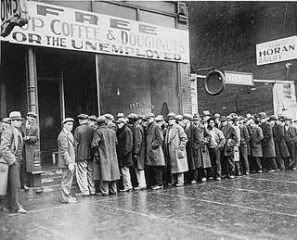
The March Jobs Report has come, and though there appears to have been some employment growth in the rose colored glasses retailing sector, in most other sectors, the headline is that the Job Free Recovery continues.
There are three main numbers to focus on when looking at the monthly employment report:
  • employment
  • the headline unemployment rate, seasonally adjusted
  • the broad ("U6") unemployment rate, seasonally adjusted


... so let's have a look at them.
________________________

The report employment figure showed employment growth of 162,000. Is that good news? Bad news?

Well, its news to the extent that "the normal average season growth in employment" means that the string of job losses have come to an end. The headline unemployment rate was unchanged at 9.7%, while the broad unemployment rate increased from 16.8% to 16.9%, both seasonally adjusted.

When trying to work out what's going on with the business cycle, we look at seasonally adjusted figures, and that is, part of why the headline unemployment rate is constant. The raw figure is down by 0.2% ... but that's on average what is normal in moving from February to March.

The uptick in the seasonally adjusted broad unemployment rate is explained directly in the summary:
The number of persons working part time for economic reasons (sometimes referred to as involuntary part-time workers) increased to 9.1 million in March. These individuals were working part time because their hours had been cut back or because they were unable to find a full-time job. (See table A-8.)


So while employment increased, some of that was part-time work held by people who want full time work. Just as we would expect this early in a recovery, many businesses do not feel that they have to hire people full time when there is a wide choice of perfectly good workers who can be had with no commitment on their part.


How long would it take to get to full employment at this rate?

I saw someone "tweet" that at this rate, it would take a year to get the unemployment rate down by 1%. However, actually, since this increase in employment is very close to the seasonally expected increase, employment could grow "like this" for years without bringing the unemployment rate down by 1%.

"Like this" would, after all, be increases in employment in months where that's normal, and reductions in employment in months where that's normal.

This is why we need a Brawny Recovery: a recovery where we roll up our sleeves and get down to the work of catching up on thirty years of postponed investment in infrastructure, and thirty years of postponed establishment of a New Energy Economy to address the fact that we have an oil-addicted economy.

And there is no way to describe it other than oil addiction. After all, we are still a major oil producer. We produce about twice the world average, per person. However, we consume five times the world average.


Something to demand immediately

Something that can and should be done immediately is for the Federal Government to make up transit system budgets that are directly due to reductions in state and local sales tax receipts.

Of course, this needs to be in proportion to the downturn in tax receipts for given tax rates. We have to avoid setting up a system that encourages and rewards state and local governments that treat a budget crisis as an opportunity to throw the bus under a bus ... as in California, where the Governor seems determined to kill off public transport as a favor to his big oil contributors.

However, it should be backdated. This is something we should have been doing since September 2008, at the latest ... it is, indeed, something we should do for any recession. During a recession, farebox revenues decline, because people that have lost their job no longer have their daily commute. But the cost of operating the services remain fairly stable, and the need to have access to the services often increases. When at the same time dedicated or general fund tax receipts at the state and local level decline due to the recession, transport and transit authorities get hit with a double whammy.

There are lots of things that are a rightful part of a Brawny Recovery: electrification of local public transport corridors, establishment of Electricity Superhighways, establishment of a nationwide electric freight rail system, investment in energy efficiency upgrades to both public and private buildings ...

... but one that can have very rapid impacts is helping local transport cope with the fact that this recovery, like the two before it, look like it will take about a year before genuine employment growth starts to show up.

Not only will this help keep people in useful employment, but it will also ensure that the most vulnerable are not locked out of participating with the real employment growth, when it really does start to appear.

Saturday, March 27, 2010

The 1850's and the Path Ahead

Burning the Midnight Oil for Progressive Populism

Now that the Republican Health Care Reform legislation of the early 90's has been passed with no Republican votes, I've been musing on the Path Ahead.
The Path Ahead on Health Insurance Reform

The path ahead for health insurance reform seems straightforward, at least for as long as the Republicans remain trapped in a strict "Repeal" stance by the angry and noisy opposition to health insurance reform that corporations have stirred up in their base.

First step, electorally punish those Conserva-Dems who voted against reform, so that the "Rockefeller Republicans" who now call themselves Democrats after the alliance of "Taft Republicans" and Dixiecrats purged from the Republican party are less aggressive in undermining progressive policy.

And the second steps are labelled "2a", "2b" and "2c", because they can operate in parallel.
  • Second step, 2a, introduce a Medicare Buy-In for the health insurance exchanges.
  • Second step, 2b, scrap the RomneyCare Individual Mandate and replace it with a 4% Employer Mandate, with the payment made into the employee's health insurance exchange account.
  • Second step, 2c, accelerate the expansion of Medicaid.


Third step, accelerate the introduction of the health program.

Fourth step, allow states to opt their state exchanges into a regional exchange, with the opt-in required for the large number of state exchanges that will have an inadequate variety of policies available.

In order to get any or all of steps 2 into place, language has to be included in the 2011 budget resolution that always any or all of them to proceed via reconcilation. Then if the serious flaws with the RomneyCare version of health care exchanges have been corrected, the health care exchanges can be put into place

It has always been a misnomer to call the current legislation "health care reform" when it has always been primarily health insurance reform. Yet there is a necessary-through-not-sufficient relationship that applies here. Just as arriving at a less broken health insurance system was necessary to even apply bandaids to the health care system, a not-at-all broken publicly administered, not-for-profit health insurance system will allow actual reform of the health care system to proceed.

But then, thinking about how to organize to work for progress on Health Insurance Reform leads to thinking more broadly about achieving progressive social change in the face of our thoroughly corrupted political establishment.


Thinking Ahead by Looking Back

Every once in a while, I finish another chapter of 1831: Year of the Eclipse. I've just finished the chapter talking about the party politics - the Anti-Mason party, the National Republicans, soon to rename themselves the Whigs, Jackon's Democrats, and the petticoat rebellion that led to the dismissal of Jackson's first cabinet.

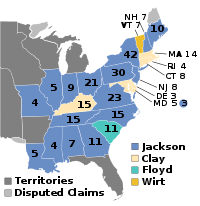
But I've also read some bits and pieces about what is coming up next ... especially for the Whigs. Any electoral college website bears the footprint of what was coming next. In 1832, Clay running as a National Republican, and refusing a fusion ticket with the Anti-Masons, would come second to Jackson ... but the only other candidate receiving more than a single state.

After running an unsuccessful split ticket, involving Harrison, Clay, and several others, designed to deny outright victory to the Democrats and throw the election into the House of Representatives, in 1840 the Whigs ran Harrison, as a "hero of 1812" (who had actually won his victory before the peace treaty was signed), who won election.

In 1852, the Whigs refused to nominate their own incumbent President Fillmore, and lost with General Winfield Scott.

Then in 1856, the Whigs in their last convention nominated Fillmore, who was no longer a member of the Whig Party.

Of course, what tore the Whigs apart was the Great Issue of the Day - Slavery. The Pro-Slavery Whigs purged the anti-slavery Whigs (including, for example, Abraham Lincoln) from their party but were then unable to maintain coherence as a coalition of state parties and collapsed.

By the last gasp of the Whigs, the 19th Century Republican Party had already been formed by pasting together a coalition of anti-slavery Whigs, abolitionists, former Know Nothings, Free Soilers, and others. The rest, as they say, is history.


But what is the Great Issue of the Day

It may seem like we face a blizzard of issues, rather than one. But of course, there is a single source for that blizzard of issues. The great issue of the day is Corporate Feudalism.

With the Republicans firmly entrenched in the most extreme of pro-feudalist camps, and the Democrats divided between "pro-reformed-feudalism" (quite like the pro-slavery Whigs "regulation of the worst excesses of abusive slaveholders") and anti-feudalists, the Democrats of today are in a position quite similar of the Whigs of the 1840's.

From climate chaos through Peak Oil through the cancer epidemic through the military industrial complex shredding our Constitutional rights in pursuit of slightly higher profits for the quarter ... there is a common core to the blizzard of issues that we face.

Now, given the real world conditions, there is no need for a Leninist strategy of deliberately monkey-wrenching things to radicalize the situation. The real world is already throwing monkey wrenches and will throw more and more over time.

We need to build organizations - no need to call them political parties, since they would be what political parties at one time used to be, not what political parties are today - that can take over city hall through the ballot box and put in effective emergency measures if the shit hits the fan. Movements. Likely distinct movements in different, overlapping, regions.

Up from there, we need to have a balance of power position in state legislatures to prevent the state legislature from blocking what needs to be done locally, which includes freeing up the ballot box and keeping it free.


But What Can an Individual Town Do if the Shit hits the Fan?

Consider the basics of a serious economic convulsion (and, no, the Panic of 2008, while a deep recession, was not an economic convulsion on the magnitude of what we face in the next two decades). People need shelter and a place to eat.

Now, even in the Great Depression, three quarters of the population was still employed. Even in Weimer Germany when a wheelbarrow was required to carry the bills to buy a load of bread ... there were people with wheelbarrows buying bread. There is a wide range of "serious problem" between the worst we have experienced since WWII and the worst that an economy can experience without descending into "Mad Max" territory.

A local community will still have some tax revenue, and some ability to obtain resources from the regional and national economy. However, the financial resources will fall far short of the need.

Now, suppose that the national government does not do what it could do, establishing a Job Guarantee program to ensure that labor resources are mobilized and put to work to cope with the challenges that we face. While it is certainly possible for the national government to take effective action - it is by no means guaranteed.

A local community is not powerless. With enough "volunteers", it is possible to grow food in community gardens. With enough "volunteers", it is possible to keep watch on those gardens at night and prevent a loss of the harvest through praedial larceny. With enough "volunteers", it is possible to cook and serve the harvest, combined with imported staples from the region or nationally, in community kitchens. With enough "volunteers", it is possible to keep a much larger number of people fed than can be done with local community US$ tax revenues alone.

In the face of economic convulsions, some buildings will fall vacant, and their owners will be unable to meet their property tax obligations. With enough "volunteers", large open interior spaces in big box or medium box stores can be refitted into livable shelter for individuals and families. With enough "volunteers", the problems of maintaining utilities and retrofitting the buildings to be more self sufficient can be addressed. With enough "volunteers", it is possible to keep a much larger number of people housed in livable accommodation than can be done with local community US$ tax revenues alone.

And why would people volunteer? Well, suppose that you are unemployed, and in return for volunteering to help, you can receive vouchers good for meals at community kitchens, and shelter in community housing.

Indeed, suppose that the local community allows local businesses to meet part of their property tax with volunteer vouchers in lieu of payment. Then with vouchers, you could also obtain additional amenities, beyond just food and shelter.

Of course, it would be difficult to operate any substantial share of an automobile based transport system on this basis ... since gasoline needs to be paid for in whatever currency the petroleum exporter will be demanding in the midst of an economic convulsion. But bicycle based transport ... that is something different, with a far smaller imported input component.


The Headliners: Midnight Oil

So, anyway, I've been thinking about the path ahead. What about you?

Monday, March 22, 2010

Sunday Train: Heritage Opposes Freedom to Choose High Speed Rail

Burning the Midnight Oil for Living Energy Independence

Front paged at Docudharma, Hillbilly Report and at ProgressiveBlue, also available in Orange.

I'm shocked, shocked I say, that a belief tank partly funded by Big Oil and Union Busters would issue a piece attacking High Speed Rail. But they did, claiming that there is a "Coming High Speed Rail Financial Disaster".

Less shocking is that the argument in the piece is tissue-thin, relying on shell games and appeal to stereotype in lieu of evidence.

Of course, just because its an empty argument does not mean its a pointless one. When you are trying to prevent solutions to problems, FUD ... Fear, Uncertainty and Doubt ... can sometimes be as effective as genuine argument.

Well, I hope someone out there is able to frame great counter-arguments that are useful in cracking into Dr. Utt's (Economics) target audience of those with short attention spans and limited access to information. What I can offer here is raw material for those counter-arguments.
_____________________________

Attack what you can, even if its not the policy on offer

The first red flag that the Heritage piece does not intend a serious consideration of current US Department of Transportation High Speed Rail policy is when the author blithely announces:
Although there is no fixed rule as to what constitutes HSR, a common definition is a rail line that operates at an average speed of at least 125 miles per hour (mph).


If talking about bullet trains alone, this number is low - the very first bullet trains half a century ago were going at these speeds, but there have been a lot of improvements since then. If talking about appreciably faster than what is available at present through the United States ... its high.

What "at least 125mph" means is the speed where a rail corridor has to be completely grade separated. That's why the Express HSR corridors are not built to be a little bit above 125mph: there is a substantial capital cost to cross over that hurdle, and once crossed, substantial benefit to operating at 170mph, 190mph, or 220mph.
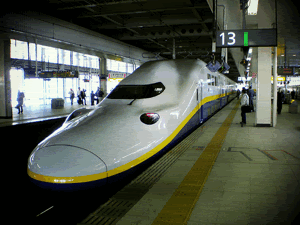
As regular readers of the Sunday Train may be aware, outside the Northeast Corridor, the common maximum speed on US rail mainlines is 79mph. If it sounds odd that the speed limit is set exactly one mph below a normal US "count by 5's" speed limit ...
... as James McCommons recounts in "Waiting on a Train", over half a century ago, the Federal Railroad Authority mandated that all railway corridors supporting traffic at 80mph or higher must provide Positive Train Control signal systems for safety. These are systems that can automatically stop trains if a train is going into a track that is already occupied, or if the engineer is incapacitated.

And the railways mostly responded by setting speed limits of 79mph in their corridors. So while the US has the biggest and brawniest trains with massive heavy freight loads compared to most nations worldwide ... by international standards, that's big and brawny and slow.

In nations that already had regular Interurban Express services running 90mph~100mph, the improvements in technology that allow these trains to maintain that speed when going around curves were incremental improvements. "High Speed" was going substantially faster than that.

And so the first Japanese bullet trains in the 1960's went 125mph, and the first French TGV's in the 1980's went 168mph, with the second generation at 186mph ... and the most recent generation of bullet trains is reaching 220mph around the world.

Now, I'm sure Dr. Utt (Economics) knows perfectly well that the High Speed Rail policy that he is pretending to critique involves all three classes of speed that are higher than conventional US passenger rail. He is just setting the bar to create the frame for the very weakest part of his argument, when he considers the 110mph and 125mph classes of Higher Speed Rail.

To sustain these speeds over long routes requires a substantial investment in a secure and exclusive roadbed built to precise standards and tolerances, using equipment that meets the same high standards. As a result, an HSR line costs much more to build and operate than an ordinary passenger rail line. It is believed that only two HSR lines in the world earn enough revenue to cover operating and capital costs: Paris-Lyon and Tokyo-Osaka


Of course, as I've discussed before, "enough [passenger] revenue to cover operating and capital costs" really means, "pay all operating and capital costs by a fraction of the economic benefit, with everyone else benefiting getting a free ride."

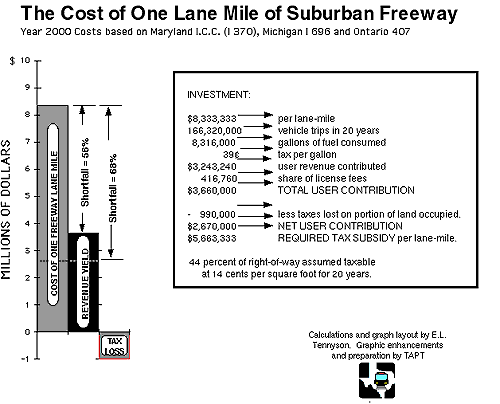
And if we were to apply that same standard to the status quo, Interstate Highways ... Interstate Highways cannot even cover their maintenance alone out of gas taxes paid by traffic on the highways, but have always required cross-subsidy by gas taxes paid to drive on city streets. And now, even that cross-subsidy is not enough, and the shortfall is now being made up out of the General Fund.

So its (1) an absurd standard and (2) an absurd standard that High Speed Rail comes closer to meeting than the Interstate Highway status quo.

The cost of alternative Interstate Highway spending is no mere theoretical comparison. The only two 150mph+ Express HSR systems funded in February were in California and Florida, both in areas projected to have growing population and demand for intercity transport, and both of which present a choice between spending less money to provide transport capacity with High Speed Rail, and more money to provide transport capacity with long distance highways and investment in airport expansions.

So one freedom the Heritage Foundation is fighting against is the freedom to spend public capital subsidies in a cost-effective way.


Deficit Errorism Strikes at Rail Projects!

In addition to the high costs that the HSR program will impose on taxpayers during a period of economic hardship and slow recovery,


When applications made for funding, those applications include a cost and benefit analysis that does indeed claim that the total economic benefit exceeds the total cost. Yet Dr. Utt (Economics) has not to this point even pretended to dispute these claims. He simply jumps from "not profitable for a private business to pursue" to "a net cost to taxpayers".

That logical leap is lubricated by bullshit. If the projects yield economic benefits that are substantially greater than the costs, there is no net "cost imposed on taxpayers". Construction of those HSR corridors would impose:
  • job opportunities on unemployed and underemployed workers, and
  • demand for the product of supplier businesses

... but not net costs on future taxpayers. Instead, the investment in more capital efficient transport more easily powered by domestic sustainable energy yields a net benefit for future taxpayers.

And of course, if there is a particular corridor where the cost of an Express HSR corridor is not justified by the full economic benefit, build a less expensive system ... because Express HSR is just one option.


What there's no argument to make, hope for an ignorant audience

Of course, after criticizing Express HSR for being too expensive, without bothering trying to prove the point, the next step is to argue that the much less expensive Regional HSR projects are no good either. But I wonder how you could attack Regional HSR for being so much cheaper per mile than Express HSR, after resting your whole argument on the high cost per mile of Express HSR? I wonder ...
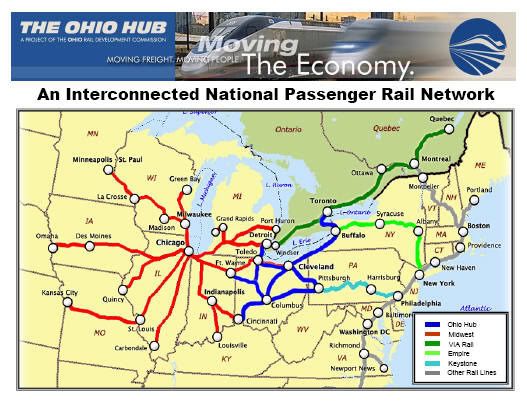
One has to wonder what exactly motivated the FRA review team to endorse the proposed $1.1 billion investment in the Kansas City-St. Louis-Chicago route, which would allow customers to reach their destinations 10 percent faster than they could by driving between Chicago and St. Louis.


Actually, no, nobody has to wonder. After existing improvements in bottlenecks with freight, even according to SubsidyScope's attack on Amtrak, the Chicago/St. Louis corridor recovers 80% of its operating costs from operating revenues at Amtrak speeds.

And that is a service that is slower than driving, which means there are trips that are day trips when driving but overnight trips by train.

It puzzling why a fellow economist would have to "wonder" why more people will make a choice when more people gain the freedom to make that choice. Indeed, on the demand side, its the growing freedom to choose that defines the three tiers of High Speed Rail:
  • Become time-competitive with driving, and people who would rather spend their trip doing something other than driving, have the freedom to make that choose.
  • Become faster than driving, and some people who wanted something faster than driving, especially for inner urban, outer suburban, and rural destinations without a convenient airport, will start choosing the train for the speed.
  • Become time-competitive with flying, and some people will choose the train for the greater comfort and the smaller portion of the trip spent waiting for the trip to start.


Given the willingness that Dr. Utt (Economics) has to engage in misleading framing and deceptive shell game arguments, when he has to resort to simply bluffing by "wondering why" for a question with a perfectly obvious and straightforward answer, he must be on very weak ground indeed.


And then cross-reference to fellow HSR deniers

However extravagant this commitment to jazzed-up 19th century technology may be, the ultimate costs of bringing HSR to the 13 corridors already approved by the FRA will be staggering. California received a $2.3 billion grant toward an HSR rail system with an official cost of $50.2 billion (in 2006 dollars), but independent analysts contend that it will more likely cost $81.4 billion.[6]


There's another shell game here:
  • shell one is the actual policy
  • shell two is the talking point that 110mph diesel and 125mph electric tilt trains, first successfully put into service in the 1950's and not gaining wide use until after active tilt was mastered in the 1980's is "1800's technology"
  • shell three is putting the cost of the California system immediately after the reference to the 110mph and 125mph speed classes ... even though California is a 220mph speed service.


But note the description of a cost quote from what is described as an "independent source". Is it a peer reviewed academic paper? A genuinely independent third party that takes no position on HSR pro or con? No, of course not, its the output of another partly Big Oil funded belief tank, the [http://www.sourcewatch.org/index.php?title=Reason_Foundation "Reason" Foundation]:
[6]Wendell Cox and Joseph Vranich, "The California High Speed Rail Proposal: A Due Diligence Report," Reason Foundation Policy Study No. 370, September 2008, at http://reason.org/files/1b544eba6f1d5f9e8012a8c36676ea7e.pdf (March 11, 2010).

... by Wendell Cox, who makes much of his living as being the "transport expert" who can be relied upon to deliver the pro-road-lobby conclusion.

Dr. Utt is lying about the independence of that source. Its the output of a belief tank that opposes High Speed Rail. That's not an independent source.

Dr. Utt then surveys the "overseas experience" while conveniently avoiding the fact that every system that he talks about, even the over-priced, badly managed UK investment in HSR, dogged by the politically imposed burden of "public private partnerships", generate operating surpluses. The bedrock foundation of this survey is the demand that everyone else who benefits from a transport service must be given a free ride on the back of passenger fares.

After all this time with shell game arguments, misleading frames, and "one wonders" questions where even a misleading argument must not be available, Dr. Utt saves the lie for very near the end. Blink and you would miss it ... especially for those who believe the lie to be true:
Most taxpayers will continue to travel by more cost-effective and largely self-financed modes, such as cars and airplanes.


Of course, the "self-finance" claim for roads is patent nonsense. Interstate Highways have always been cross-subsidized by people driving on city streets that receive no federal gas tax money, by zoning requirements to provide "free parking", and by a host of other explicit and hidden public subsidies. Unlike High Speed Rail, which can cover its own operating costs, intercity transport by road has been provided both capital and operating subsidy ever since the Interstate Highway System was first established.


None of this is surprising

It we cast our eye back across American Economic History, a watershed event that can be used to divide the Fordist period the followed WWII from the Second Gilded Age that started to gain full speed under Ronald Reagan is American Peak Oil ... and even more specifically, March, 1971, when the Texas Railroad Commission removed the quota on oil production.

When oil prices in the US were regulated through production quotas to remain relatively stable in dollar terms, which means falling prices when corrected through inflation, the interests of Big Oil were lined up with strong income growth. The side-effect that this provides a favorable economic setting for organizing workforces was, for capital-intensive corporations such as big oil, a regrettable but tolerable evil.

When the balance of pricing power passed from an elected Commission in the US to the major oil exporting nations, the interests of oil companies and the economic interests of the United States began to diverge. An over-valued US$ provides US-headquartered transnationals with added economic power when pursuing the rights to exploit non-renewable natural resources overseas. Depressed economic conditions in low-income countries are more appealing than rapid economic development.

When any industry has interests that diverge strongly from the national interest, it becomes useful to invest in propaganda mills to help promote argument frames and talking points that are favorable to their interest and help obscure the national interest.

Each of these propaganda mills are, of course, organizations that chase funding from various foundations and corporations ... so when a single right wing propaganda mill adopts a particular position, it would well be a matter of personal conviction by a group of propagandists wihin the mill. But when the Heritage Foundation, Reason Foundation, Cato Institute all take up the case (see Libertarians Against Choice: The Attack on Obama's HSR Policy and the Midwest HSR Association's HSR Fact versus Fiction) ... well, coming up with arguments that serve the interests of those who pay their bills is the common job of all three.

And so this last week, my "HSR" search tag caught mention after mention of the newest Heritage Institute "argument" against the present High Speed Rail policy.


Your Mission, if you Choose to Accept It ...

So, given what is clearly an effort at deceptive propaganda posing as a serious argument, your mission, if you choose to accept it, is to propose simple, clear, fact based responses to this kind of nonsense. While you ponder that, I'll pass the stage on to the headliners.


Midnight Oil: Truganini