Populist movements don't build themselves ...

... It doesn't matter what the "horse race" outcome of the campaign is, if we fight the campaign. Fighting it, we learn how to fight. Learning how to fight political battles, we become citizens again. Becoming citizens again, we reclaim the Republic that lies dormant beneath the bread and circuses of modern American society.

Monday, December 29, 2008

Burning Fires

Real Rail Access for Raleigh (Cap'n Transit Rides Again)
A new streetcar era? by Christof Spieler (Intermodality)
The 3 Rules of Urban Design (GatesofMemphis)
Groundbreaking Energy Ball Wind Turbine for Home Power by Moe Beitiks (Inhabitat)
China, Japan and U.S. Battle for EV Battery Supremacy by John Gartner (MateR Network)
Shanghai: Four rail transit lines to put into service in 2009 (h/t Overhead Wire)
Malls, the Future of Housing? By LISA SELIN DAVIS
(HousingWire magazine, h/t grunman at MLW)

Coalition building between DFH's and 'mainstream" farmers.

Burning the Midnight Oil for the Next American Revolution

Crossposted at ProgressiveBlue


We do not have a progressive populist movement in this country. We do not have an effective change coalition in this country. And the first implies the second, since successful progressive populism has been a component of all of our effective change coalitions for over a century.

To fend off the possible semantic quibble ... yes, by an effective change coalition, I do mean to say change going forward. We have, obviously, had effective reactionary coalitions without a progressive populist component!

In sketching out the potential membership for an effective change coalition, I have previously identified farmers. And so I take special interest when Stranded Wind at the Daily Kos adopts a provocative and potentially quite divisive framing for discussion of organic farming "versus" sustainable production of chemical fertilizer such as ammonia (NH3) derived fertilizers produced with the harvest of sustainable, renewable electric power:
On one side of the field we have the hemp clothes and Birkenstocks set flinging organic tomatoes. The other side has Monsanto's minions, flinging GMO hand grenades with one hand and trying to lasso producers with the other. The official federal referee of the USDA would like to help but their rules are the province of misguided ideologues and sociopathic transnational corporations.

Stuck in the middle is the puzzled farmer, who just wants a fair price for the work he does and some protection for when things go badly. They'd happily plow the earthly remains of all three of the above groups into the soil if it would increase yields and get unsolicited opinions out of their business.


The substantive policy position in the piece is quite sound ... as we pursue a more sustainable and Energy Independent farming economy, we should also be aiming for decentralized production of key feedstocks, since the centralization of the current system leaves us exposed to substantial risk.

However, there is mixed in the echoes of the "US agriculture feeding the world":
First, let's stick a wrench in the complaints of the organic foods crowd. Yes, it would be better if we were more careful with our soil and if we had less chemicals in our food, but we feed six and a half billion with the current system. We're going back to the solar maximum for this planet and that is going to be ugly enough without some Great Leap Forward approach, which would starve more than are already going to face that fate given our fossil fuel depletion and the tight coupling between this and our existing fertilizer sources.


This "US agriculture feeding the world", which features heavily in Monsanto and ADM advertising on Sunday morning political talk shows, has long been used as the cover story for the dumping of subsidized cereal grains that has devastated the local farming capacity of large numbers of low-income nations ... which means, of course, in driving subsistence farmers into mega-cities, ensure a market for the heavily subsidized cereal grains. Obviously, that income stream does not stick in the hands of the "mainstream" farmer ... it just passes through on its way to Monsanto and ADM.


So a bit more care is needed regarding who "we" are when talking about US farm policy. "We" don't feed 6b people with our system ... even if you extent "our" system to mean the EU/US/Oceania agro-industry mono-cropping, then it certainly feeds well over a billion, but nowhere near 6 billion ... not unless you include feedlot animals in the count.

And "our" system has two big redundancies built in.


The first redundancy is the insistence on growing perfectly good food and then feeding it to animals, rather than using animals to convert plant production that is not edible for humans into a supplement for the crops we raise directly for humans.


The second redundancy is the productive potential of low income nations that is held off the market by the practice of dumping US/EU staple grains in low income nations in order to ensure a broader market.

We could be on track for a famine ... but famines are not about food production, they are about food distribution. Recall that Ireland was a net food exporter in each year of the Irish Potato Famine ... beef and butter and grain production was not affected, but beef and butter and grain was headed for the more lucrative markets in England.

And it is a mistake in advocacy strategy to accept a framing of sustainable-produced chemical fertilizers versus organic farming techniques. In high income nations, we should be making soil husbandry payments for all farming methods that restore and rehabilitate soils, and if that means subsidizing a bunch of dirty fucking hippies, so be it. But that does not require imposing organic farming techniques, its simply a competitive advantage of organic farming techniques if we introduce a difference in income between soil establishment and soil mining.

And at the same time, certification for marketing of organic produce requires compliance with something that the market for organic produce recognizes as organic production ... but certification for soil husbandry payments would be in terms of objective measures of the health and retention of the soil, and while it may well include maintaining fertilizer practices that do not lead to excessive fertilizer run-off in the watersheds, the income system would not require production that can be certified as organic production.

And it should be obvious that fertilizer levels that maximize protein content in grains for use as animal feeds, where the majority of the protein will be dumped into the watershed, which results in collapse of riverine and coastal fish stocks, is not a net win in terms of total protein available for human consumption.

Shifting farm income support from subsidy for staple grains to fee for service in soil husbandry opens up organic farming operations to participation, but would include any farmer that adopts sound whole-system soil husbandry.

Since there is no necessary conflict between the needs of "mainstream" farmers, those sharing their watershed, consumers, and dirty fucking hippy organic farmers, the debating point on the extent to which organic farming can carry the load is a side track diversion from a reform of our farm policy.

Controversy and debates are good for getting hits and high comment counts online, but the focus needs to be on finding common ground to build a large enough change coalition large enough so that the controversy and debate is between the change coalition and the entrenched opposition to reform.

Sunday, December 28, 2008

On the Sprawl Disease

Burning the Midnight Oil for Living Energy Independence

Elaborating a comment at the Matthew Yglesias blog

How far should we push the effort to roll back sprawl development?

On the one hand, there is the standard reasoning of marginalist economics, as expressed by a commentator to a Gas Tax post by Yglesias:
Rob and Noah - at the point that the negative effects of carbon emissions are fully internalized, I don’t think we need to fight sprawl anymore. There is some optimal, non-zero level of sprawl, and as long as people are paying the price for their consumption decisions, there’s no justification for using super-optimal taxation to force them into dense residential areas. Another way to put this is, once you’ve removed the negative environmental effects, what’s the matter with sprawl?


This view is, however, full of "status quo bias", where all aspects of the status quo are taken for granted as the "normal way for things to be", excepting whatever specific problem is under discussion. And the result is, of course, the status quo normally fares better than it otherwise would, because each critique of the status quo is evaluated based on some but not all costs of the status quo.

However, the costs of sprawl development are far from exhausted if we just consider the CO2 emissions impacts. There are external costs in the vast acreage that must be devoted to parking ... the four to seven parking places that each car requires, even though it only every occupies one of them at a time. There is the time drained from people's lives by every increasing Vehicle Miles Traveled (VMT) ... and increasing VMT at the same time increases the contribution of each car to traffic congestion. There is the costs imposed on those who can not drive in designing not just our residential system but our work, shopping, education and leisure activities in a way that are biased in favor of cars and against access by common carriers.

And then there is the cost in blood, from victims of our callous tolerance for traffic fatalities to the thousands of American servicemen and women and hundreds of thousands of Iraqis kills in our vain effort to establish a police station state on top of the world's last great stockpiles of inexpensive to produce crude oil.
Now, where would we end up if we reflected all of those costs to the participants in sprawl development?

Once you’ve removed the negative environmental effects and have also reflected the rest of free rider costs from sprawl development back to participants in the sprawl development system … then there is nothing wrong with sprawl, as there would be very little left.

That is not to say that everyone would live in a densely populated large urban area … but that the “sprawl” option would drop out of the mix of settlement choices.

After all, bear in mind that sprawl development is not just “low population density”. It is a whole system of subsidies and regulatory restrictions to create segregated activity zones and the subsidized point to point mixed public/private transport system required to access those dis-integrated locations for distinct activities.

So people living at exurban population densities that have 80%+ of their local trips to a common suburban village center and 80%+ of their ex-local travel occurring via dedicated transport corridors accessed at a common suburban village center … would not be living in "sprawl". It would be something else, much more similar to living in the close hinterland to a small town before the rise of sprawl development.


In this city with no footpath theres a building with no people
There is crime and gun decisions
Theres a street of heat and hawkers, theres a house of hope drifters
Theres a gang that shoots then listens
Theres a place that knows no poverty, a town without pollution
Theres a soul with good intentions
There are canyons full of movie stars, churches made of metal
There are mountains made of muscle
We have leaders who are anxious, we have captains not courageous
Captains tumbling into madness
But theres a main who makes no enemies, a body never breathless
No ambition ever hopeless

Up on bedlam bridge somebody is waiting
Up on bedlam bridge Im shot to heaven
Oh, up on bedalm bridge, waiting

In these locked and shackled neighbourhoods, bridge and tunnel diplomats
See the golden ghettos creeper
Crazy flags from history, songs for the white house gangsters
Guns for hellgate railway sleepers
But theres a main who makes no enemies, a body never breathless
No ambition ever hopeless
So how stands the city on this winters night?
The city on the hill or so they said
The snow is falling down around the armoury
The citys closing in around my head

Up on bedlam bridge...

Drive, wont you drive the engines harder, drive
Drive, wont you turn the engines over, drive

HSR LA to Las Vegas

Burning the Midnight Oil for Living Energy Independence

Crossposted to Docudharma and ProgressiveBlue.

I've been following with interest the discussion of California to Las Vegas HSR at the California HSR blog.

To catch up with the state of play, before the passage of CA-Prop 1A, Senator Majority Leader Harry Reid (D-Confusion), who hails from Nevada, supports a maglev line from Las Vegas to Anaheim, and there was an article in the Las Vegas Sun indicating that Gov. Schwarzenegger and Gov. Gibbons had talked up the maglev:
Near the bottom of a news release detailing Gov. Jim Gibbons’ meeting last month with President-elect Barack Obama was the announcement that Gibbons and California Gov. Arnold Schwarzenegger had agreed to move ahead with the high-speed train project.

“Arnold and I agreed to jointly work together on the project,” said Gibbons, who is planning to travel to Sacramento to talk with Schwarzenegger about it.


Also before the passage of CA-Prop 1A was the DesertXpress proposal to build a private Rapid Passenger Rail system to capture part of the stream of cars heading up the I-15 from LA to Las Vegas. The proposed system starts at Victorville.

Victorville? Why Victorville? From the DesertXpress site:
Of course it would be great if DesertXpress could be extended to downtown Los Angeles, Anaheim and Ontario, and someday it might. But for this initial project, it is critical for the station to serve the Southern California market and be financeable without public tax dollars.

Victorville makes a lot of sense because it is the first major population center northeast of the Cajon Pass through the San Bernardino mountain range separating the High Desert from the Los Angeles basin. Victorville is within only a 30- to 45-minute drive for roughly 5 million people who live in the Inland Empire, Antelope Valley, and the eastern portions of Los Angeles County, and only a one to two hour's drive for most of the rest of the Southland's 21 million residents—many of whom routinely drive at least an hour to and from work each weekday.


However, now that CA-Prop 1A has passed, the wise heads at the California HSR blog (CAHSR blog)) have pointed to an alternate solution that would provide downtown LA and Anaheim service, as well as downtown San Francisco, San Jose, Fresno, and Sacramento service. First, note the proximity of the propsed Victorville station to the closest station on the main trunk CAHSR route between LA and the Bay.

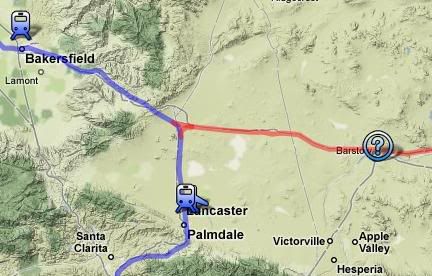
Now, as it turns out, there is an existing rail alignment between Mojave and Barstow, and Rafeal at the California HSR blog has already sketched out a map of a line from the proposed CAHSR system to Las Vegas (google maps), from which I have clipped:


In the post about this issue on the CAHSR blog, there was much discussion of the relative priority of this route. However, the DesertXpress proposal is set forward as a private venture ... they obviously need approval to construct the line in the I-15 alignment, but (unless the financial crisis has changed their view on this) what they require is permission, not funding.

Which points out one possible path ahead. Give the DesertXpress the go-ahead, dependent on electrified rail (but see The STRACNET electrification series for a proposal that reduces the commercial obstacles to electric rail infrastructure on private rail lines), maintaining compatibility with the CAHSR system, permitting a junction at Barlow for the CA-HSR, and guaranteeing fair access to their line by common carriers operating between Las Vegas and the CAHSR system. They can proceed on their planned basis, and when the main trunk of the CA-HSR has been completed, a connecting line between Mojave and Barstow is all that is required to open up the Victorville-Las Vegas line to Anaheim, Las Angeles, Bakersfield, Fresno, San Jose, San Francisco, and when the extension is completed, Sacramento.

Of course, a maglev system is an expensive show-piece project with impressive top speed. However, for anyone living in a transit oriented urban or suburban village, who would have to catch local transit to the HSR station, then the HSR to the maglev transfer station, then the maglev to Vegas ... getting into the Las Vegas bound HSR service at the closest HSR station is a more appealing prospect.

And by the same token, for those who are taking a short hop flight to Vegas, pressing the capacity of the airport in Las Vegas, the ability to go to drive to a closer HSR station and catch a direct HSR service should be more appealing to many than an HSR service to a maglev transfer station. After all, once you have settled in with your laptop or the movie on your portable DVD player, an uninterrupted trip with no uncertainties about a transfer is a more pleasant way to travel ...

... lost in dreaming, while blazing through the desert ...

Saturday, December 27, 2008

Can we afford to cut CO2 emissions during the Panic of 2008-2009?

Burning the Midnight Oil for the Next American Revolution

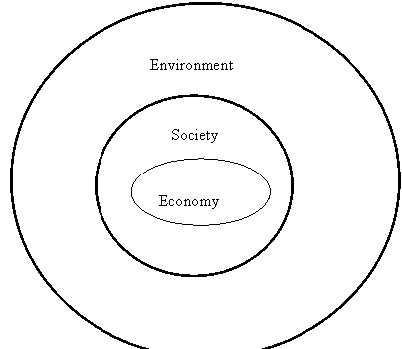
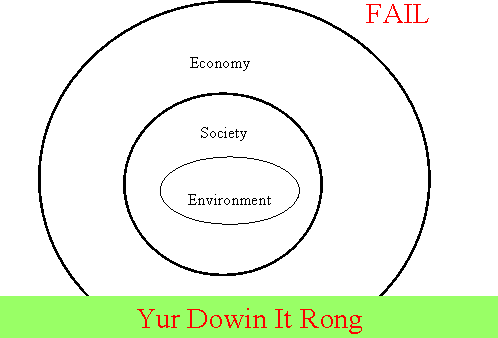
With respect to the questions of whether our economy can afford the society we want and the environmental footprint that we need, others have said it better, so I'll just keep it short and sweet:


Ask the question whether the environmental footprint we need and the society we want can afford our economy. If not, we need to get a new one.

Because the real world says:


... and that's not negotiable, no matter how many words are spilled to reverse it.

Midnight Oil Blue Sky Mine


Hey, hey-hey hey
There'll be food on the table tonight
Hey, hey, hey hey
There'll be pay in your pocket tonight

My gut is wrenched out it is crunched up and broken
A life that is led is no more than a token
Who'll strike the flint upon the stone and tell me why
If I yell out at night there's a reply of bruised silence
The screen is no comfort I can't speak my sentence
They blew the lights at heaven's gate and I don't know why

But if I work all day at the blue sky mine
(There'll be food on the table tonight)
Still I walk up and down on the blue sky mine
(There'll be pay in your pocket tonight)

The candy store paupers lie to the share holders
They're crossing their fingers they pay the truth makers
The balance sheet is breaking up the sky
So I'm caught at the junction still waiting for medicine
The sweat of my brow keeps on feeding the engine
Hope the crumbs in my pocket can keep me for another night
And if the blue sky mining company won't come to my rescue
If the sugar refining company won't save me
Who's gonna save me?

But if I work all day...

And some have sailed from a distant shore
And the company takes what the company wants
And nothing's as precious, as a hole in the ground

Who's gonna save me?
I pray that sense and reason brings us in
Who's gonna save me?
We've got nothing to fear

In the end the rain comes down
Washes clean, the streets of a blue sky town