Populist movements don't build themselves ...

... It doesn't matter what the "horse race" outcome of the campaign is, if we fight the campaign. Fighting it, we learn how to fight. Learning how to fight political battles, we become citizens again. Becoming citizens again, we reclaim the Republic that lies dormant beneath the bread and circuses of modern American society.

Monday, August 16, 2010

Sunday Train: Richard Florida and the End of the Automobile Age

Burning the Midnight Oil for Living Energy Independence

Crossposted to: Hillbilly Report, ProgressiveBlue, Docudharma, European Tribune, and Agent Orange.

This week in The New Republic, Richard Florida presented his vision of High Speed Rail as the central strategic point of leverage in an economic "reset" to get us out of the doldrums resulting from the failure of the 20th century growth model to deliver ongoing, sustained growth any more ... though the way he frame it is:
As dismal as housing prices continue to be, they have yet to hit bottom in some places. Unemployment remains frozen at an overall level of nine-plus percent, and job creation has been anemic. If the crisis belonged to George W. Bush, the recovery has been Obama’s—and it has been a fragile and tentative one at best. Along with billions of dollars in stimulus payments, the president has spent down most of his political capital. So what is his next step?


So ... what is the next step?
_______________

This article is dated 12 August, and given the central role that Florida paints for High Speed Rail, has of course already been addressed by a number of others, including Yonah Freemark at The Transport Politic and Robert Cruickshank at the California HSR Blog.

Florida's thesis:
  • The Economic Growth Engine that dominated the post-WWII US economy generated a form of geographic Keynesianism
  • This Economic Growth Engine has reached its end
  • We must therefore turn to a Growth Engine based on Innovation
  • Innovation is fostered by clustering
  • So the Economic Geography of the Next Growth Engine will be emerging national Mega-Regions
  • High Speed Rail is uniquely suited to connect the distinct cities of a Mega-Region together, so High Speed Rail is the strategic linchpin of launching the Next Growth Economy


The End of Keynesianism and Beginning of Fantasy

There is much that is right and much that is wrong in Florida's argument. One of the signal failings of the story as he presents it is presenting the 20th Century Growth Engine as some kind of natural force, ignoring the substantial entrenched policies that channeled it down the particular paths it took.

And this is strategic for Florida's argument about the nature of the Next Growth Engine, since if these things are natural forces, the projection of the Next Growth Economy from the trends of the twilight of the Automobile Age is straightforward. For example, if:
Our transition from a Fordist mass production economy, based on the assembly line, to a knowledge economy, in which the driving force is creativity and technological innovation, has been under way for some time; the evidence can be seen in the physical decline of the old manufacturing cities and the boom in high-tech centers like Silicon Valley, government boomtowns like Washington DC, and college towns from Boulder to Ann Arbor. Between 1980 and 2006, the U.S. economy added some 20 million new jobs in its creative, professional, and knowledge sectors. Even today, unemployment in this sector of the economy has remained relatively low, and according to Bureau of Labor Statistics projections, is likely to add another seven million jobs in the next decade. By contrast, the manufacturing sector added only one million jobs from 1980 to 2006, and, according to the BLS, will lose 1.2 million by 2020.


This reads as if this just happened, rather than being made to happen by pursuing policies of de-industrialization, and by accepting policies with de-industrialization as a natural consequence, whether promoting the power of transnational corporations with mis-named "trade" agreements that primarily focus on the freedom of corporations to exercise corporate power across national borders, or the "fight inflation first" strategy of the Fed that biases the US exchange rate against the interest of exporters and toward the interests of importers, all the while their primary target is the prevention of full employment.

By stereotyping manufacturing as Fordist mass production, and setting it in opposition to the Knowledge Economy, Florida sets up a false dichotomy where Knowledge-Intensive Manufacturing disappears from view, and so does not have to be considered as a target for national industrial policy.

The story Florida sketches regarding the post-WWII Fordist Growth Economy is, of course, only partial, but is broadly correct.
  • There was a wave of investment in Road Infrastructure by state and especially local governments in the 1920's, and its ebbing was part of the sagging national income that exposed the financial fragility of the late 1920's
  • Federal Investment in Road Infrastructure picked up in the 1930's, providing part of the foundation for the post-WWII wave of suburban development
  • That wave of suburban development was financed in a way that permitted the further finance of automobiles, refrigerators, stoves, furniture,
  • and the income from the manufacture of that whole complex of products helped fuel the ongoing development of the suburbs.


However, Florida skips an important part of the story, which is the system of cross-subsidies that helped fuel that system by channeling income from urban and rural households into the development of sprawl suburbia. A fairly well known example is the Federal gas tax, which many Americans imagine to be a user-pays system for funding roads. In reality, all motorists pay the tax, whether or not their driving is on funded "highways". The majority of city streets are ineligible for funding while a majority of Interstate, National, State, County and Township "highways" on their periphery are eligible for funding, so that in the 1950's, this was a strong cross-subsidy from the urban and pre-WWII inner-suburban majority to the "new suburban" minority.

But this is, of course, only the tip of the iceberg. When utility hook-ups are priced by a flat rate rather than by the cost of providing the hook-up, that represents a substantial subsidy to sprawl development. When zoning imposed required minimum parking, the value taken from the property owners depends on the value of the underlying land, so the "in kind" tax imposed on landowners to subsidize cars with the parking they require is substantially higher in urban and inner suburban areas than in greenfield outer suburbs. Households living in unincorporated area (study area is Wisconsin) tend to receive more of their services from the county where they are located. Direct and tacit subsidy of logging, through undercharging for logging rights and provision of logging roads, implied an undervaluing of the value of existing durable urban structures versus new stick-frame detached housing.

What is the difference if we recognize these cross-subsidies of sprawl suburban development? The basic logic of cross-subsidies is to promote growth of the subsidy recipient at the expense of the subsidy payer, reducing the share of income contributing and increasing the share of income sharing the cross-subsidy. A Growth Engine based on cross-subsidy is destined to eventually run out of gas.

And then, of course, we ran out of gas ... starting in the late 1960's when we hit peak oil, the system of stabilizing US crude oil prices by manipulating production in the big Texas oil fields went by the boards, and the Automobile Age was exposed for the first time to the vagaries of the international oil market ... and after sprawl suburbia had captured over half of the US residential population, placing its flow of cross-subsidies at risk, we reached the neighborhood of global peak oil production, at a time that we consume a quarter of the world supply but only while we still produce a tenth of the world supply.

A gasoline price shock of a mere $4/gallon was one of the three forces contributing to the Panic of 2008: a serious gasoline price shock or an interruption of crude oil imports would have an even more devastating impact.


The Optical Illusion of Interstate Highways

Now, the Interstate Highway System, while not the majority of the cross-subsidy for sprawl development, were an integral part. But for passenger transport, "Interstate Highway" is a misnomer. The bulk of the passenger miles on the Interstate Highway system are local passengers, not interstate passengers.

Where the "Interstate" nature of the Interstate Highway system is dominated by interstate transport is in freight transport.

Yet, while Florida gives lip service to freight ...
That means high-speed rail, which is the only infrastructure fix that promises to speed the velocity of moving people, goods, and ideas while also expanding and intensifying our development patterns.
... it is only lip-service. The focus is on all the entrepreneurs coming into the Megaregional Hub to work out how to provide innovative services to each other and consumers, which services will somehow generate the export revenue to allow all of us to import all of the industrial and consumer goods that we require.


Fleshing Out the Skeleton

So, does HSR offer the opportunity to be the "Reset" technology to allow us to restructure our economic geography on a long term sustainable basis?

Well, any long time readers of Burning the Midnight Oil or others who know me as a long time advocate of HSR will already be expecting my answer: No, of course not. Setting up High Speed Rail as "the" answer to anything is setting it up to "fail" to meet a poorly thought through target.

On of the reasons why "Auto Uber Alles" required heavy cross-subsidy to grow is that it was a "one-size-fits-all" solution. And one size never fits everyone, and never fits many people all that well.

High Speed Rail is a useful part of the mix and, as I have long argued, is the part of the mix that we can get working on right away, given the fact that High Speed Rail has repeatedly shown its ability to generate operating surpluses, even under Automobile Age conditions. That makes HSR a strategic "leading edge" of the new transport system that we shall require for this new century.

However, we must not make the mistake of trying to "re-fight the last war": High Speed Rail corridors will not be providing the bulk of passenger transport, nor will they be providing the bulk of freight transport. Their superior capital efficiency compared to the same intercity passenger transport capacity provided by roadworks is due to the fact that HSR does not try to be a magic "silver bullet" one-size-fits-all solution, rather focuses on being the efficient solution to the problem it solves.

Indeed, despite Richard Florida's focus on innovation, one reason that High Speed Rail looms so large in his vision of the new 21st century is that in High Speed Rail, the essential technical innovations required to allow us to start building have already been made, and there is very little social innovation required. Florida is, in other words, projecting an existing technology into the future.

In local transport, more social innovation is required to reach the point of painting a compelling grand sweeping vision of how we will get from our current, obsolete, system to one that will meet the needs of our new century. So, although this is a more important challenge for our day to day standard of living in 2020 or 2050 ... it is a far less question to consider for those who specialize in painting grand sweeping visions.

And the idea that we will simply abandon making things that do useful things is a fantasy from the twilight of the Age of the Automobile. It rests on the neo-mercantelist strategy of China and others to accept lower terms of trade in return for being allowed to export potential unemployment to the US. The credit creation required to maintain a discounted ¥RMB to US$ exchange rate has been an important part of the credit creation that has been papering over the fading income-generating capacity of the post-WWII Growth Economy.

However, this is also an imbalanced and ultimately unsustainable process. In a sustainable system, our standard of living will depend not on the creation of credit in China, but in the creation of goods and services of value to our own economy and to potential trade partners overseas. Pre-emptively hobbling our capacity to produce valuable products by continuing to engage in aggressive de-industrialization is the path towar being a poorer nation in the future than we need to be.


Midnight Oil ~ Blue Sky Mine


_________________

... but if I had a fast car, would I be so would I as indifferent to the end of the Automobile Age?

Sunday, August 8, 2010

Sunday Train: Kasich says Outsource Ohio HSR jobs to California

Burning the Midnight Oil for Living Energy Independence

... or Virginia or Illinois or upstate New York or North Carolina or Washington and Oregon or ...

... well, any other state except Ohio. Outsourcing Ohio's HSR jobs to other states is a central plank of John Kasich's run to become Governor of Ohio.

Of course, we don't expect people from places like Lehman Brothers to flat out say something like that: instead, they give a plausible sounding sound bite which then falls apart the minute you think about it. Their hope, it seems, is that nobody thinks about it.

So too with Kasich's plan to hand Ohio's $400m in HSR Stimulus Funds back to the Federal Government for another state to use ... he hides his plan behind a red herring.
________________________________

The Background to the Story

Once upon a time, in the 1980's, before the neoliberal trade policy pursued by Bush and agreed to by Clinton shipped Ohio's manufacturing economy overseas, there was an ambitious plan to build a bullet train system for Ohio. It was to be supported by an increase in the state sales tax. It got onto the ballot, and then was voted down.

Fast forward to the 90's. While the Clinton administration lobbied hard to signed President George H.W. Bush's NAFTA agreement into law, it also pushed through a High Speed Rail bill that set up a system of state based High Speed Rail commissions, with enough funding to basically fix up a few of the most dangerous level crossings around the country. Ohio got its High Speed Rail Commission, and went back to the drawing board.

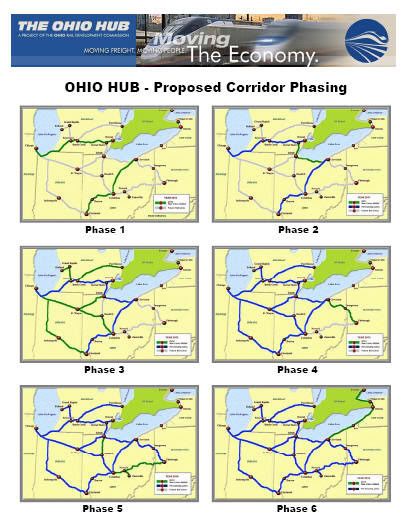
Fast forward to the turn of the 21st century. Under the aggressively anti-rail Resident George W. Bush administration, some states took the lead in promoting incremental improvements to passenger rail, and through a merger with other state rail authorities to form the Ohio Rail Development Corporation, Ohio's "Ohio Hub" plan continued to take shape.

Fast forward to a major lurch of US transportation policy into the final third of the 20th century, $8b in HSR funds were approved as part of Stimulus II, after the Stimulus I under Bush of tax cuts alone failed to prevent the recession that started in 2007 from spiraling down into the worst recession since the two recessions that made up the Great Depression.

Republicans in control of Ohio's State Senate prevented the state from applying for a 110mph corridor between Cleveland, Columbus, Dayton and Cincinnati, but the Strickland state administration was able to wrest agreement to a 79mph "starter line", which would get service started and which could be upgraded by ongoing incremental investment to be converted into a 110mph corridor.

And Ohio won $400m in funding. It is presently negotiating the agreement with the FRA to use $25m for final planning and design, leaving $375m to break ground in Spring of 2011.


Kasich Against Jobs In Ohio

Now, it would normally be hyperbole to say that a candidate for Ohio governor is actually opposed to the creation of jobs in Ohio. I have lived through lots of gubernatorial elections, and normally both candidates are for jobs.

But really, Kasich wants those jobs to go out of state. From Cleveland Scene Weekly
Republican gubernatorial challenger John Kasich is no fan of rail either. His camp didn't respond to interview requests for this story, but a news clip posted on his website about Ohio rail studies is headlined "Train Already Wasting Taxpayer Money." And he said earlier this year that the $400 million Ohio received for rail would be better spent on Ohio's roads and bridges.

But it can't be: The funds are specifically attached to rail. If Kasich becomes governor in November and decides to kill the 3C project, Ohio's money will go to other states. With California, Florida, and the Pacific Northwest, among others, ramping up to build their stimulus-funded routes, someone else will be waiting in line to take the money Ohio leaves on the table.


The 2009 work (pdf) of the American Public Transport Association gives the following job impacts per million dollars for capital works in public transport:
  • Direct job creation, 8.2/$m
  • Indirect (upstream) job creation, 7.8/$m
  • Induced (downstream) job creation, 7.7/$m.


Now, working out the Indirect job creation impact of the Kasich policy to hand the money back for use by another state is tricky ... it requires untangling which upstream spending will leave Ohio in any event, and which upstream spending will stay in Ohio in any event. So I will focus on just the direct jobs, which of course are taking place in Ohio on the 3C corridor, and the induced effect.

Assuming that $25b is spent to do final planning and design, and then Kasich cancels the project, that means $375m is handed over for use by another state. That means:
  • $375m x 8.2 direct jobs/$m = 3,075 direct jobs lost; and
  • $375m x 7.7 induced jobs/$m = 2,887 induced jobs


So its roughly 6,000 jobs that Kasich wants to outsource to another state.


Big Deal, its only 6,000 Jobs

The immediate protective reaction is, well, its only 6,000 jobs. Why, with Ohio's 10.5% headline unemployment rate, 6,000 jobs is surely just a drop in the bucket. Ohio has 625,000 unemployed ... 6,000 is less than 1% of our total unemployed workforce.

But of course, this is just one policy. Kasich summarizes his four main policy platforms as:
  • lower taxes
  • Make government more effective
  • Transform Our Educational System and
  • End the Influence of Special Interests


The first three seem likely to translate into sacking state employees and cutting assistance to local governments forcing them to sack local city, country and village employees, some more sacking of state employees with outsourcing of their jobs to private corporations (and if those private corporations outsource work out of state, well, that would be consistent), and cut public school budgets forcing them to sack teachers.

As far as ending the influence of special interests ... who is it backing Kasich's policy of handing as much of the $400m HSR money back to some other state?
But that award was also met with opposition from the Ohio Contractors Association, the Ohio Trucking Association, and the Ohio Petroleum Marketers and Convenience Store Association — all of them highway-dependent groups


So as far as "ending the influence of special interests" goes, that would seem to be code for, "swapping one set of special interests for the special interests that are backing me".


But, what about the problems with the Starter Line

One thing the Conservative echo chamber excels in is spreading unbacked, empty, but plausible sounding talking points far and wide. The main talking points for the 3C starter line are:
Among their criticisms: Building a rail line will require expensive state subsidies and will never be self-supporting, and train speeds will be so slow and they will run so infrequently that they won't attract ridership. Besides, they add: Nobody in Ohio wants to ride trains anyway.


The argument about the train being slow often goes, "we should jump straight to HSR". And, indeed, if it would have been supported by the Republican State Senate, it certainly should have been.

But that is a red herring. From today, surely the fastest route to a 110mph HSR 3C line is to build the starter line, starting to run in late 2012, and upgrade distinct individual segments to 110mph, cutting trip speed, increasing patronage, and reducing subsidies with each segment upgraded until we have a 110mph 3C line with average trips of 70mph to 80mph and with sufficient frequency that there is no need for surpluses. Cutting the corridor into four segments, two segments per year would see a 110mph corridor by 2016, while one segment per year would see a 110mph corridor by 2018.

How much faster would the "leapfrog the Starter Line" be? With the $400m for the Starter Line in hand, Ohio can get started. After turning the money back, certainly a Kasich administration could not apply for a more ambitious project, so that would be 2011-2014 lost, at least a year for an incoming Democratic governor taking over to clean up Kasich's mess before attention could be turned to it, and then finding money for a state match, since going ahead, a 20% state match looks to be required for Federal HSR capital grants. So maybe 2016 to apply, 2017 to begin construction ... 2018 to finish the 110mph HSR 3C corridor under the "leapfrog" plan would be optimistic.

So, the "leapfrog" would mean getting the HSR corridor no sooner, probably later, and doing without increasingly rapid intercity passenger rail for at least six years. More like a "leap-tortoise" plan.


Conclusions

Well, none of this is surprising. Strickland loses the Governor's race if Buckeyes vote the fact that the economy sucks, Kasich loses the Governor's race if Buckeyes vote the fact that under Kasich it will suck much worse.

More to the point is to fight the talking points that the opponents will be spreading in letters to the editors and newspaper sites across the state. Just Google ""Ohio High Speed Rail" in news.google.com on a regular basis, and look for the Ohio based newspapers:
  • Giving the money back means about 6,000 jobs heading off to another state
  • The "40mph" starter line is designed from the start for the upgrade to cruise at 110mph ~ once its in place, Ohio is in place for a series of Federal HSR funds to do the upgrade, and each upgrade will boost ridership and cut the subsidy
  • The ridership study is based on the assumption of cheap gas: if there is another oil price shock, ridership will explode


Midnight Oil ~ Dreamworld

Friday, August 6, 2010

The Fightback against Cutting Electric Prices with Wind Power

Burning the Midnight Oil for Living Energy Independence

Recently, Jerome a Paris and afew from the European Tribune published a piece in New Scientist on why having sufficient wind turbines in an energy portfolio has been observed to lower energy prices to consumers.

After tweeting that article, I started to receive tweets with links to the anti-wind conservative echo chamber, including The American Thinker, and the Oil-money founded and partly funded Cato Institue.

The piece I am looking at today is a brilliant example of the echo-chamber shell game: how you fill up the echo chamber with outdated, irrelevant, or partial and misleading facts so that there are "facts! facts!" that can be cited in social media, complete with demands "answer the facts!" by those who either are pushing a line for strategic reasons or have been taken in by the argument.

Entitled "Wind Energy's Ghosts", the information in the piece is familiar to anyone who has participated in online discussion of wind power or renewable energy in general and has encountered the oil or coal industry sponsored and inspired pushbask.


Guilt By Association with PIIGS

Bankrupt Europe has a lesson for Congress about wind power.

Wiwo...wiwo...wiwo.

The sound floats on the winds of Ka Le, this southernmost tip of Hawaii's Big Island, where Polynesian colonists first landed some 1,500 years ago.

Some say that Ka Le is haunted -- and it is. But it's haunted not by Hawaii's legendary night marchers. The mysterious sounds are "Na leo o Kamaoa"-- the disembodied voices of 37 skeletal wind turbines abandoned to rust on the hundred-acre site of the former Kamaoa Wind Farm.

The voices of Kamaoa cry out their warning as a new batch of colonists, having looted the taxpayers of Spain, Portugal, and Greece, seeks to expand upon their multi-billion-dollar foothold half a world away on the shores of the distant Potomac River. European wind developers are fleeing the EU's expiring wind subsidies, shuttering factories, laying off workers, and leaving billions of Euros of sovereign debt and a continent-wide financial crisis in their wake. But their game is not over. Already they are tapping a new vein of lucre from the taxpayers and ratepayers of the United States.


Anyone with knowledge of the facts has their bullshit alarm going off already.

What are the examples of "typical" European countries? Spain, Portugal and Greece: three of the so-called "PIIGS" (Portugal, Italy, Ireland, Greece, Spain), which were in the news as facing serious finance constraints because of their inability to float bonds on international bond markets sufficient to cover expected budget deficits.

Of course, this is selecting examples of European countries pursuing expanded wind power based on which ones are having macroeconomic problems, not based on which European countries are most aggressively pursuing wind power. If you line up European countries by wind power penetration at the end of 2007, the list is:
  • Denmark 21.7%
  • Spain, 11.8%
  • Portugal, 9.3%
  • Ireland, 8.4%
  • Germany 7.0%


That is, in fact, the list of the countries that are raising the EU-wide average of 3.8%. So the list of three examples ignores both the nation with the greatest wind power share and the largest economy in the EU, and includes Greece, which is below the EU-wide average.

The logical fallacy here is the Biased Sample fallacy. From the Nizkor Project
This fallacy is committed when a person draws a conclusion about a population based on a sample that is biased or prejudiced in some manner. It has the following form:

Sample S, which is biased, is taken from population P.
Conclusion C is drawn about Population P based on S.


The sample bias works in both directions, excluding the two Eurozone nations with above average wind power penetration that face no pressing fiscal constraint in international bond markets, while including a Eurozone nation among the PIIGS with below average wind power penetration. That was the country in the headlines, of course, so it needed to be included to generate guilt by association between support for wind power and economic instability.

There is, however, a common energy thread that does tie these countries together, but its not wind power penetration in electric markets. As Luis de Sousa reported in The European Tribune in April, in What makes them PIIGS:
In orange, all lined up to the left, are found the PIIGS, the most Oil reliant states in the Union. Coincidence? Certainly not. The riddle is now understanding if they are PIIGS due to their Oil reliance or are Oil reliant because they are PIIGS.


This is what happens when you start from the facts to try to find conclusions, instead of starting from conclusions and looking for facts that seem to back them up: you discover new, sometimes surprising, relationships. And from those relationships, generate new questions to explore and even, maybe, start to see what are the problems facing a country that need to be addressed:
These observations also show where the PIIGS have to work to become competitive economies. Energy Policy cannot target solely the Electricity sector, a serious Programme is needed to reform - revolutionize - the Transport Sector. Road transport has to be re-equated at large: either true alternatives to the present internal combustion engine show up or it simply has to be phased out. Starting with freight (where the impact on daily life is minimal), governments could concentrate on promoting rail and maritime modes, instead of putting up ever more tax and toll cuts to hauliers. PIIGS have also to reconsider their Industrial fabric, that may be too leaning on the Service sector. The Manufacturing Industry has to regain its proper role, perhaps taking advantage of business opportunities in alternative energy and efficiency, and together with Agriculture, increase the overall value per freight-km travelled.


The Mysterious End of the 1970's / 1980's wind power boom

The piece in The American Thinker tells us what happened in the Hawaiian wind farm, but not why:
Built in 1985, at the end of the boom, Kamaoa soon suffered from lack of maintenance. In 1994, the site lease was purchased by Redwood City, CA-based Apollo Energy.


And why did the "boom" end: because of the on-again, off-again US policy. With our reliance on tax subsidies instead of feed-in tariffs to promote wind power, the wind industry in the US is subject to a massive political business cycle effect. As described in Ups and downs in the land of the pioneers in New Energy:
President Reagan ended wind energy promotion

A devastating crash happened in the late 80s. The error rate of the turbines used in California had increasingly driven away investors. And so in 1987 the state government scrapped all subsidies. At the same time, the new Republican president, Ronald Reagan, axed renewable energies research funding from $1.9 billion to $269 million. All the tax breaks Jimmy Carter had introduced were scrapped.

It plunged the wind market into insignificance. While in the late 80s Californian turbines produced 79% of the world’s wind power, the share then declined rapidly. Until the end of the 90s the wind energy capacity installed in the USA stagnated while long-term government promotion funding in Europe drove the technology to its breakthrough.

The American wind energy producers had to cope with ups and downs of promotion funding only ever available for short periods. These boom and bust cycles continue.

Thus the 1992 Energy Policy Act for the first time provided a tax break of 1.5 cents per kilowatt-hour of wind power. But the industry could not benefit from it because in times of market liberalisation many US power sellers invested only cautiously in new generation capacities and generally preferred coal and gas. Meaningful wind growth only resumed in 1998 and 1999. But the tax break running out in June 1999 pushed the project developers to hurry. That year 732 MW went on the grid, substantially topping the previous biggest increase of 442 MW in 1985.

Subsidies come in waves

In subsequent years the US Congress extended the tax break for wind power plants, but in 2000, 2002 and 2004 the promotion gaps were particularly long each time. The market collapsed every time, reviving after the Production Tax Credit (PTC) was reinstated (see chart). The installation figures fluctuated accordingly. The present subsidy is available until 31 December 2007. Many operating in the market firmly expect the next extension to come in good time.


So the US launched the modern utility grade wind turbine technology, but it became a political football, and so the benefit of our early experience was reaped elsewhere. A very similar story to the hybrid gas-electric car, which was promoted under Clinton, forcing the Japanese to pursue catch-up policies, but the abandoned under Bush, so that it was the Japanese who brought it to market and today Ford licenses hybrid power train technology from the Japanese who originally launched their development efforts to avoid falling behind the US.


And Then There Was Altamont

The American Bird Conservancy makes this chilling statement: "Wind farms ... kill birds and bats." Therefore, they support development of wind farms.

Hey wait: what? Well, to put that statement in context:
ABC believes that wind energy is a valuable, non-polluting, renewable power source, capable of reducing our reliance on fossil-fuel burning power-plants that damage the environment through greenhouse gas emissions, pollution, and other environmental hazards. Wind farms, however, kill birds and bats, thereby raising concerns of a different kind. We all want clean, renewable energy, but we cannot sacrifice large numbers of birds and still consider wind power "green."

Despite the fast pace of development of wind power and its great potential to provide green energy, we must not be in a hurry to get it wrong. Continued close collaboration with industry and strong federal regulation that uses tax breaks for doing the right thing and meaningful fines for doing the wrong thing will be the carrot and stick approach that will ensure the next fifty years are positive for birds at wind farms.


Bans for sites that threaten endangered species and threaten critical migratory paths, fines for sites that engage in practices that cause unecessary bird kills, tax credits for sites that adopt best practice to minimize and mitigate bid kills.

Why not just ban? If wind farms kill birds, why not just ban them entirely? Lets put this in an even broader context. In Deconstructing the wind farm bird-kill story (Providence Journal, 20 October 2005, Jack Coleman reports:
In June, two Danish researchers with the Environmental Research Institute announced the results of a six-year radar study of avian impacts from offshore wind turbines -- the first such research. The researchers, Mark Desholm and Johnny Kahlert, focused on a specific wind farm, the 72 turbines off Nysted, in southern Denmark.

Desholm and Kahlert began their work in 1999, while the Nysted project was still in the planning stage; the 360-foot turbines became fully operational in December of 2003. The four years between the start of the research and the wind farm's going online provided the researchers with abundant time to study migrating birds. Their conclusion? "Overall, less than 1 percent of the ducks and geese fly close enough to the turbines to be at any risk of collision."

Their report continues: "The analyses also show that birds remain at a greater distance [from] the turbines during the night, while flying inside the wind farm. Thus, these birds reduce their collision risk.

"In total, less than 1 percent of the waterbirds migrated close enough to the turbines to be at any risk of colliding."
...
A U.S. Government Accountability Office report of Sept. 19 urged federal officials to take a more active role in siting wind farms to avoid bird kill. But the report also pointed out that millions of birds are killed by collisions with buildings and towers, pesticides, and attacks by feral and domestic cats. "In the context of other sources of avian mortalities," said the report, "it does not appear that wind power is responsible for a significant number of dead birds."

And, lest we forget, birds along our coastline are genuinely threatened by the heavy oil that's hauled in barges, which has an unfortunate habit of spilling into the ocean and killing terns, gulls and other birds by the hundreds.


Cats kill birds. Tall buildings kill builds. Transmission towers kill birds. Cars kills birds. And these are not just randomly selected examples: these are more serious risks to birds than wind turbines.

And of course, Mountain Top Removal Coal Mining kills birds, oil spills kill birds (and while the BP oil spill is a massive news story, there are small spills every single year in the Gulf of Mexico).

Some of the problem at Altamont was location, but most of the problem was the now-obsolete design of the wind turbines and towers. The towers were open framework towers - no longer used, because of the loss of efficiency from tower wind turbulance - encouraging raptors to perch on the towers themselves. Because of their relatively small cross section, so the towers were lower, the bottom sweep of the blade much closer to the ground, and the blades spun far more rapidly than modern turbines, make it far harder for a raptor to avoid, especially in mid-stoop.

Add the fact that the cleared ground around the base of the turbines are attractive for rabbit warrens and ground squirrel burrows, so there was a strong incentive for raptors to perch in wind turbine towers and stoop for prey right in the potential path of a wind turbine blade, and the obsolete 1970's era wind turbines at the Altamont Pass are deadly to raptors. 1300 raptors are still killed each year at Altamont Pass, about one raptor kill per year for every four wind turbines.

The current windfarm at Altamont pass has a 576MW capacity with about 4900 wind turbines, for an average capacity of 117kW per turbine. Since modern turbines have capacity in the range of 2MW, that means that about 17 of the obsolete Altamont Pass turbines are required to match the capacity of a single modern wind turbine. So start with the fact that not only is each of the 1970's era wind turbines a much more serious bird killer than each modern wind turbine ... but These capacities are obtained with much broader cross section blades, placed much higher, on closed towers to minimize tower wind turbulence.

Using the thousands of obsolete, bird killing turbines at the Altamont Pass windfarm and similer 1970's and 1980's era wind farms to argue about whether or not modern wind turbines should be promoted is like using the Model T to argue about whether or not the current massive subsidies for driving are justified.

And so ... that's just what the American Thinker does. Six paragraphs, a picture of what are quite clearly small obsolete turbines replaced by modern units (not showing the modern replacements, of course), five block quotes, all presenting evidence that establish quite clearly that if the 1970's era wind turbines were the best we could hope for, wind power would be a not-ready-for-prime-time technology.

Of course, written as if this is represents 21st century wind turbine technology, which makes this an example of the Straw Man fallacy:
Description of Straw Man

The Straw Man fallacy is committed when a person simply ignores a person's actual position and substitutes a distorted, exaggerated or misrepresented version of that position. This sort of "reasoning" has the following pattern:

Person A has position X.
Person B presents position Y (which is a distorted version of X).
Person B attacks position Y.
Therefore X is false/incorrect/flawed.
This sort of "reasoning" is fallacious because attacking a distorted version of a position simply does not constitute an attack on the position itself. One might as well expect an attack on a poor drawing of a person to hurt the person.


Before using Altamont Pass to attack policies promoting utility scale wind power, one has to find a policy promoting utility scale wind power that will lead to adoption of the obsolete and far more expensive per MW, Altamont Pass wind turbine technology instead of modern, and less expensive per MW, wind turbines. But no such policy exists.


Attack The Tax Credits

And then finally, after the irrelevant example of Altamont Pass, the piece ends with an attack on tax credits.

But of course, the link was forwarded to me in response to my circulating a link to a piece on feed in tariffs and the Merit Order Effect.

Recall that in the 1980's, the US went through a wave of deregulation in the power generation industry. We built up our 20th century world class electricity generating and transmission system on the back of heavily regulated monopolies, supplemented by direct public provision. Then, as covered in The Oil Drum in The US Electric Grid: Will it be Our Undoing? - Revisited we deregulated, to allow "the market" to work its wonders. And now, because in a deregulated system there is no single stakeholder with deep pockets and a strong incentive to maintain and upgrade the transmission, we now have a system approaching third world status.

When a utility's primary role is taking care of its own customers, there is a strong incentive to carefully maintain its transmission and distribution system. Once the system is divided into many competing entities, many of whom do not have financial ownership of the transmission system, the situation changes significantly. Some of the impacts include:

1. Declining investment. There is less incentive to maintain transmission lines, since under a fractured system, no one has real responsibility for the lines. Also, profits are higher if equipment is allowed to run until it fails, rather than replacing parts as they approach the ends of their useful lives.

2. Overuse of lines between systems. Prior to deregulation, transmission lines between utilities were designed for use primarily in emergencies. Once widespread trading of electricity began, lines between utilities are put into much heavier use than they had been designed to handle.

3. More rapid deterioration. After deregulation, there is much more cycling on and off of power plants and the structures involved in transmission, to maximize profits by selling electrical power from the plant that can produce it most cheaply. This results in metal parts being heated and cooled repeatedly, causing the metal parts to deteriorate more quickly than they normally would.

4. Unplanned additions to grid. Wind and solar are added to the grid, with the expectation that the grid will accommodate them. "Merchant" (investor owned) natural gas power plants are also added to the grid, sometimes without adequate consideration as to whether sufficient grid capacity exists to accommodate the additional production.

5. Difficulty in assigning costs back. Since the industry is more fragmented, if any transmission lines are added, the cost must somehow be allocated back to the many participants who will benefit. Ultimately, the cost must be paid by a consumer. These consumer rates may in fact be regulated, so it may be difficult to recover the additional cost.

6. Increased line congestion. There is a need for more long distance transmission lines, because of all of the energy trading. There is a great deal of NIMBYism, so approval for placement of new lines is very difficult to obtain. The result is fewer transmission lines than would be preferred, resulting in more and more line congestion.

7. No overall plan. There is a need for an overall plan for an improved system, but with so many players, and so much difficulty in assigning costs to players, very little happens.

8. Little incentive to add generating capacity. As long as there is a possibility of purchasing power elsewhere, there is little incentive to add productive capacity. Profits will be maximized by keeping the system running at as close to capacity as possible, whether or not this causes occasional blackouts.


Long time readers will be aware that I have long pushed for establishment of a Steel Interstate system to provide "border to border" transcontinental electric freight rail, including 100mph Rapid Freight Rail paths. However, to place even the relatively modest power demands of this system on our aging, declining patchwork quilt of a national electric system is asking for trouble. So the proposal also includes using the Steel Interstates to provide Ultra High Voltage Direct Current power transmission lines, which can carry power over 1,000 miles with less than 10% transmission losses.

Libertarians will, of course, complain that financing this as a small fraction of a two and a half cent per gallon tariff on imported crude is a "statist solution". But they have had thirty years of deregulated power market policy to arrive at some "market based" solution that will build up transmission capacity rather than exploit existing capacity while it decays, and have failed miserably.

But, on the question of whether feed-in tariffs are superior to current US policy based on production tax credits: how do attacks on the production tax credits system address that argument. If anything, libertarian attacks focusing on production tax credits support the argument that feed-in tariffs are better.

Under the so-called deregulated system, the government has dictated that power generating be divided into multiple companies, and that power distribution networks bid for power on formal markets. The producers bid what they are willing to sell power for, the grid selects the producers in order from cheapest to most expensive, until all required demand is covered. The price is the bid of the most expensive producer.

All generators have a mix of overhead costs and costs of providing power to the grid. For a peaker merchant gas generator, the overhead is dominated by the turbine, and the cost of providing power is dominated by the cost of the natural gas. At the other extreme, almost all the cost of the wind turbine is overhead, with very low incremental cost of each kW it puts onto the grid.

So the system set up by the government since the 1980's is tilted in favor of gas generators and against wind turbines. Peaker gas plants can dictate the price required to start operating, so when peak demand brings the peaker gas plants online, they cover their costs, even if they only run 5% or 10% of the time. On the other hand, if a large amount of wind capacity is online, then when it is generating, it pulls the wholesale price of power down, and often pulls the price down so far that it cannot cover its overheads.

The feed-in tariff allows a power market to tap the benefit of reduced average cost by fixing a rate that the power company must pay to the wind producer. If set correctly, then when wind power is being produced off-peak, this increases the total cost of power, and when wind power is being produced on-peak, this reduces the total cost of power.

Obviously, this is a question of "discount+premium=???" ... that is, whether a particular feed-in tariff regime delivers a net rate reduction or rate increase to power consumers depends, first, on the level of the feed-in tariff and, second, the pattern of power costs from existing sources. However, the evidence from Europe is that there are feed-in tariff levels that both encourage installation of new windfarms, and also reduce the cost of to consumers. From Wind's latest problem: it ... makes power too cheap ... pulling the buried lede out of a Bloomberg piece:
windmills (...) operators in Europe may have become their own worst enemy, reducing the total price paid for electricity in Germany, Europe’s biggest power market, by as much as 5 billion euros some years
The wind-energy boom in Europe and parts of Texas has begun to reduce bills for consumers.
Spanish power prices fell an annual 26 percent in the first quarter because of the surge in supplies from wind and hydroelectric production


That's the empirical observation. Its doing it. What is the point of engaging in endless hypothetical arguments about whether it can when it already is?

So the response to the critique of production tax credits subsidy is straightforward: if you think that policy sucks, adopt feed-in tariffs for wind power, set at levels where a boom in wind power generation will lead to a drop in the cost of power.

Indeed, if the topic under discussion is feed-in tariffs, then an attack on tax subsidies would seem to be a case of a Red Herring logical fallacy:
Description of Red Herring

A Red Herring is a fallacy in which an irrelevant topic is presented in order to divert attention from the original issue. The basic idea is to "win" an argument by leading attention away from the argument and to another topic. This sort of "reasoning" has the following form:

Topic A is under discussion.
Topic B is introduced under the guise of being relevant to topic A (when topic B is actually not relevant to topic A).
Topic A is abandoned.
This sort of "reasoning" is fallacious because merely changing the topic of discussion hardly counts as an argument against a claim.


Conclusion

Empirically, it is too soon to say, because this is just one observation, but I would hypothesize that if you wish to be popular in the conservative echo chamber, building your argument on three logical fallacies in succession could just be the road to success.


Midnight Oil ~ Kosciosko


Older than Kosciusko
Driven back to Alice Springs
Endless storm and struggle
Marks the spirit of the age
High up in the homelands
Celebration 'cross the land
Builds up like a cyclone
Now the fires begin to rage

Sunday, August 1, 2010

Sunday Train: A Dime A Gallon Tariff on Imported Oil for Energy Independent Transport

Burning the Midnight Oil for Living Energy Independence

The big news from July was: Senate's energy bill: What a disappointment (LA Times Editorial):
Amid tough fights over healthcare and financial reform, Obama's push for cleaner energy ran out of gas long ago. It looked like a losing battle anyway; with Senate Republicans universally opposing a cap-and-trade program or other efforts to reduce greenhouse gases, and some Democrats in heavy manufacturing states also opposed, it may have been impossible to round up the 60 votes needed to overcome a filibuster on a Senate energy bill as strong as the one passed by the House last year. But that doesn't excuse Obama or Reid for surrendering so easily, or so completely.


So we need to do something. And the strategy to stitch together a complex, multiple part, massive sprawling suburb of an Energy Bill that would be all things to all people has failed in precisely the way its opponents intended it to fail: this is a big reason why Big Oil was so heavily invested in the fight against health care reform, to make sure that it took so much time that the Energy Bill would run into election year politics and their direct lobbying efforts and come unglued.

Treason? Well, given that we are far more exposed to a disruption of our energy imports than to any threat to be found in Afghanistan, and are far more exposed to catastrophic climate change than to any threat being secured by our bases in Japan, Germany or any of the balance from the 687,347 acres of overseas military bases ... sure.

But what to do about it?

The proposal here is to get a target that can be fought for, now, and campaigned for, in the fall: as the title says, A Dime A Gallon on Imported Oil for Energy Independence

It won't get all of the way there, of course, but with sufficient leverage it can provide an immediate economic stimulus while getting an essential start on the problem.

The basic policy behind the label is:
  • $0.10 tariff on imported crude oil. Crude oil, after all, is an "unscheduled" commodity under existing WTO agreements, so we are free to put any tariff on it that we wish
  • Four funds (two and a half cents each) for electric transport, active transport, Steel Interstates, and High Speed Rail
  • Spending must be on qualified projects, but money is distributed to state and local accounts on a per capita basis
  • For capital investment projects, account holders in the first ten years can borrow on the OMB projected revenue in the first ten years


A Dime A Gallon: How Much is That

According to the US Energy Information Administration, our annual imports of Crude Oil in 2009 (a low year, because of the recession) were 3,289,675 thousand barrels. Each barrel is 42 gallons, so that is 138,166,350 thousand gallons. Times ten cents is $13,816,635 thousand, or $13.8b.

Divide this into fourths for each project, and that is $3.45b per task. At a real interest rate of 3%, that is up to $29.4b per task or, in other words, about $95 per capita (based on a Census July 2009 figure of 307m.

This is, admittedly, not sufficient for the magnitude of the task ahead, but, unlike the status quo, its a step in the right direction.


Electric Transport Fund

The electric transport fund is divided into state-based accounts, so that, for example, if the following states borrowed the full ten years ahead (based on 2009 Census estimates):
  • California, 36,96m, $3.5b available;
  • Ohio, 11.5m, $1.1b available;
  • Iowa, 3m, $287m available; and
  • New Hampshire, 1.3m, $127m available.


So, what could this money be spent on?
  • Electrification of rail corridors
  • Purchase electric rolling stock
  • Electrification of bus corridors
  • Purchase of electric trolleybuses
  • Purchase of pluggable hybrid buses
  • Charging infrastructure in support of electric vehicles
  • Credits on the purchase of electric vehicles
  • operations of an electrified transport system (this is not capital spending, so it would be out of current revenues)


The state presents a project, its vetted for qualifying as electric transport spending, if approved, the state can direct the money in its account to the project.


Active Transport

This is an area that is often overlooked, but an important aspect of this was addressed in the PBS BluePrint America show Dangerous Crossing. Outer suburbs were, of course, established for people who could afford cars, but as suburbs have grown to account for half of US residences, there is a growing share of suburban populations can't afford or don't wish to spend on a car.

Watch the full episode. See more Need To Know.


And that leads to situations like that documented in Dangerous Crossing:
27-year-old Nimia Larcia lives in a suburban housing complex just outside of Atlanta, Georgia. She moved here from Honduras six years ago in search of a better life.

Suburban America used to be synonymous with good living, not the least of which was because its streets were so much safer than those in the city. Not anymore.

Every morning when Nimia walks from her apartment to her minimum-wage job at a jewelry store, she has to cross one of the most dangerous roads in Georgia: Buford Highway. People in cars race back and forth, many if not most exceeding the 45 mile per hour speed limit.


A system that is designed so that it kills people for crossing a street - on foot is not one that encourages existing transport systems that can be shifted toward oil-independent transport ... and, indeed, active transport to get to a public transport stop is especially dangerous in these kinds of communities:
Demand for transportation is so high here that taxis, freelance car services and private buses race down these roads competing for customers with the public transit system, often using the very same stops.

People rushing to and from buses account for one in four of the accidents here [Buford Highway].


And of course, there is demographic change:
Demographers are warning that millions of older Americans living in car dependent communities could be left isolated, unable even to get to the grocery store. Dunham-Jones is hoping the country will design its way out of these problems. Even Buford Highway, she says, could be transformed with medians, trees and buildings set closer to the road. Changes that are known to slow traffic. But outside of the ivory tower, change does not come easily. Or quickly.

Last year Georgia spent more than two billion dollars on transportation, but only a tiny fraction, less than 1 percent, went specifically to pedestrian safety.


Of course, the typical state -highway- transportation department faces a situation just like Georgia's, with roadworks having dedicated funding while pedestrian facilities do not.

So this is allocated to local communities: incorporated cities, towns and villages, and for residents in unincorporated areas, counties and reservations. Qualifying projects include:
  • Capital spending on sidewalks and pedestrian crossings
  • operating spending on sidewalks (eg snow removal) and maintenance of pedestrian crossings
  • Pedestrian benches and bus stops
  • Dedicated cycleways
  • Shared use bicycle boulevards
  • Public bicycle parking and secured storage
  • Recreational bike and hike trails


Steel Interstates

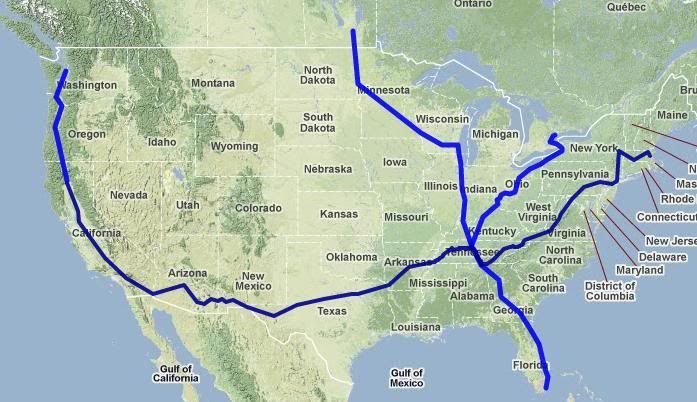
The Sunday Train has covered Steel Interstates several times in the past. The basic idea is to start with the Department of Defense Strategic Rail Corridor Network (STRACNET), and upgrade selected corridors to support electric heavy rail and rapid rail, including 110mph paths (whether by separate track, passing track, or time scheduling), including provision to support High Voltage Direct Current transmission line to connect renewable energy resource grids to renewable energy consumer grids.

This is a single fund, since the purpose is to establish a single network. Unlike the first two funds, this is an interest subsidy on capital funds, with the capital funds themselves paid by user and access fees paid by the various freight railroads and passenger rail operations that might make use of the corridors.


High Speed Rail

The Sunday Train has also covered High Speed Rail projects once or twice in the past.

The High Speed Rail fund is set up with state by state accounts. States such as California, Florida, and Illinois that already have Express or Emerging HSR programs already in progress can simply apply their accounts to existing projects. At the other end of the spectrum, are states that do not have projects in hand, which will be applying the state High Speed Rail account funding to project development, design, and environmental impact assessment.

The Department of Transportation is already in a position to vet whether a project qualifies for HSR funding, with the project evaluation framework established for Stimulus II HSR funding.

For the 220mph Express HSR projects, such as in California and Florida, and for the most promising approach to the 125mph Regional HSR as well, the same project can draw funding from both the HSR fund and the Electrification Fund. This increases the total that could be applied to the California Express HSR project from these account based funds to around $7b for California, and around $3.5b for Florida.

On the other hand states such as Ohio that are (or may be) pursuing the less capital intensive Emerging HSR corridors might focus the HSR funding, around $1.1b in our case, on Emerging HSR and focus the electrification funding on local electric transport.

Of course, states that do not have programs up and running would be in a position to simply draw on the current revenue in the account on project development, to put their state in a position to launch a system.


But the Politics Are ... Possble, Maybe?

As we have seen over the past year and a half, its a lot harder to stop something from being done than to get something done.

While it is nicely symbolic to be using a tariff on imported oil to be financing these things, and while it sidesteps a lot of investment in framing by the drill baby drill crowd ... it also includes a substantial wedge for the opposition. For US based oil production, what a tariff means is that $4.20 gets added to the cost of each imported barrel of crude oil. So while the projects being funded will cut oil production profits in the long term ... its an extra $4.20 per barrel in the pocket of each owner of a domestic oil well.

That's the production offshore of Louisiana, the production of the Bakkan field in North Dakota and Montana, ongoing (if declining) production in Texas ... an extra $4.20 per barrel in the short term, against the substantial reduction in oil dependency a decade from now.


Could it actually get started?

If I were designing a program from scratch hoping for a Presidential candidate to run on in the primaries and then take into the General Election, this probably would not be it. However, pragmatically, that is four to five years in the future, and we don't really have that much time to sit on our hands.

In the aftermath of the abandonment of the Energy Bill, and the aftermath of the BP oil spill ... having foreign oil finance our return to the Energy Independence that we relied on from Independence through two World Wars and the height of the US economic development in the 50's and 60's is the best shot that I can see from here.


Midnight Oil ~ A River Runs Red


...
So we came and we conquered and found
Riches of commons and kings
Who strangled and wrestled the ground
But they never put back anything
Now I'm trapped like a dog in a cage
Wherever the truth is pursued
It must be the curse of the age
What's taken is never renewed

Sunday, June 20, 2010

Sunday Train: Can the US get its Energy Freedom Act Together?

Burning the Midnight Oil for Living Energy Independence

Here we are:
  • a long, long way from full employment and full capacity utilization, when only the ignorant and ideologically insane would imagine any general objections to increased government spending on useful long term
  • and with a gusher in the Gulf reminding us that the Oil Companies are lying liars and listening to their assurances and advice leads to disasters at best and calamities at worst


... and yet there is a genuine question whether or not the Federal government will take the bit between its teeth and push ahead toward funding a 21st century oil-free transportation system.

While it is a fun thing to imagine different institutions to see through the development of different alignments, lurking in the background is the worry: what if our body politic is just broken, and this time we cannot do what needs to be done?
______________________________


The Dread Specter of Deficit Errorism

The main reason for concern is the problem of Deficit Errorism: people engaged in magical thinking of one sort or another who work under a fantasy model in which the Federal Government faces a finance constraint on the spending of its own sovereign currency. This malignant fantasy once again raised its ugly head in the recent Senate vote on extending Unemployment Benefits:
Resolving the impasse that has pitted deficit concerns against traditional social safety net programs provides an object lesson on how hard it is for Congress to legislate at a time when public anger over government spending is growing but the appetite and need for government programs has not waned.


And where does that "growing public anger over government spending" come from? Its stoked by well researched memes irresponsibly spread by corporate media. Find out that people are angry about government bail outs of big banks, and then find a way to direct it to generate poll results that scare Senators into voting against extending unemployment benefits.


Throwing the Baby Out With the Bathwater on "Energy Independence"

But, "oh! That is just the GOP = Generosity of Oil Party". Yet then to listen to Rachel Maddow declare:
Want to know why Energy Independence is still a goal ...? Its because its not a real thing.


Bull excrement. Of course its a real thing. Its because we have talked about it but not done anything about it.

Well, she qualifies this, but then launches into the silly red herring that has so taken the centrist and progressive blogosphere, that cutting our net oil imports down to zero would not be accomplishing anything because "oil is fungible".

The fact that oil is fungible of oil has nothing to do with why every President elected since 1968 except Jimmy Carter has been lying to the American People when pretending to be pursuing Energy Independence. They've been lying about Energy Independence because they have been proposing to pursue it with policies that are incapable of achieving Energy Independence

Oil was just as fungible in the 1940's and 1950's as it is today, and we were Energy Independent then and addicted to imports now.

Bulk wheat, rice and corn is fungible, but a country that is food self-sufficient cannot be starved into submission, no matter how much cross trade they have in any cereal grain or how much they tend to export one crop an import another. A blockade or disruption of external supplies can never be the cause of famine in a food self-sufficient country.

Dependency matters. Dependency is a loss of freedom of action. No matter how much the authors of political fiction that pass as foreign policy speeches for so many elected officials wish to imagine that US military might makes us mighty - we are a giant with shoulders of steel and feet of clay.

Before the 1970's, the United States has never been dependent on outside countries for food or energy or transport or shelter. It is true that at one time we were dependent on outside countries for the equipment required to maintain a manufacturing industry, and worked very hard to eliminate that dependency. And then, once we had ... we were not a wealthy country, we were in income terms at best a middle-income country ... but we were an independent economy, free to pursue our own national interests as we saw them.

But since the 1970's, increasingly, not. Since the 1970's, we have been trapped by our addiction to imported energy.

It is true that this is about oil, and ideally we would target zero oil consumption in 20 years ... but if we achieve 80% to 90% reduction in oil consumption and simply get back to an oil surplus, and at the same time avoid becoming dependent on some other imported energy source ... that would be real, genuine, energy independence.

The reason that the Republicans in the last campaign were lying is because we already tried Drill Baby Drill, and we got our oil imports reversed by tapping lots of little pockets of hard to obtain oil, and then the ongoing decline in our old big oil fields reversed that and imports started exploding again. They were lying about the safety of offshore oil production, but more critically they were lying in pretending that tapping every single oil field physically in reach despite all safety hazards and environmental impact could not conceivably reverse the decline in our oil production.

The Democratic position was not so much a lie as a clever bit of rhetoric that meant far less than it sounded like. Obviously, being in the Western Hemisphere, the US tends to buy more oil from producers like Venezuela and Nigeria and Angola than from producers like Saudi Arabia and Iraq and Iran. So promising to get "independence from Middle Eastern oil" was just empty campaign rhetoric. Its not Energy Independence unless its independence from Imported Oil.

Or, perhaps, if Energy Independence has be ruined by far too many people led to think it has something to do with using using less than 1% of total world oil production on top of our existing 10% of oil production to feed our oil habit consisting of 25% of world oil production ...

... if too many people think that "Energy Independence" means covering a 15 cents on the dollar budget shortfall with less than a penny on the dollar in resources ...

... then hell, call it "Energy Freedom".


An Independent US Economy Requires Oil Free Transport

60%~70% of our oil is imported, 60%~70% of our oil is consumed in transport. If we do not do a serious full court press for Oil Free Transport, then as we experience the coming series of serious oil price shocks - the ones that will let people know that $4/gallon was a pre-earthquake tremor, and by no means the main event - our Economy is screwed.

It really is that simple. While the Generosity of Oil Party sells one after another fantasy simplification of reality, and the Democratic Party establishment seems to aim to make every policy proposal into a hopeless muddles so nobody can tell how far short it has fallen of the lofty campaign rhetoric ... here, at least, we do have a simple, true no matter what the economic conditions are, stable place to plant our flag.

Recession? We need work. We need the government to spend money to directly or indirectly put people to work. But we are a dependent economy, so we do not have the freedom we once had: if our dollar melts down, gasoline and diesel prices will skyrocket and our economy is screwed.

Solution? Spend money on things that will reduce our dependency on oil. Then there is on the one hand less reason for speculators to dump dollars, and on the other hand less damage done if they do.

Overheated economy leading to inflation? In the face of demand-driven inflation, we need to increase productivity and increase productive capacity. The short-circuit to a classic wage-price inflationary spiral is to cut producer price inflation, so that rising wages do not force an equal increase in prices leading to pushed for "catch up" wage increases and so on.

Solution? The simplest, most easily accessible sources of increased efficiency are the massive energy waste build into our transportation and logistics system.

Imported cost inflation? This is the easiest of all: all three episodes of substantial imported cost inflation that we have experience, in the 70's, early 80's, and just recently, have been due to oil price shocks. Reduce our dependency on imported oil, reduce our exposure to oil price shocks.


Getting Around Deficit Errorism

Paradoxically, the malignant fantasies that lead politicians into Deficit Errorism leave the door open for getting serious about oil-free transport.

The thing is, over the long term, the shift of our transport from inefficient oil fed systems to more efficient, domestically powered alternatives will have a stimulus impact just because we are importing less oil. What we need is to get the ball rolling.

So we can fund this with dedicated taxes and other revenue sources, setting up Development Banks that allow borrowing against future dedicated revenue streams. If done right, the bill is in formal terms balanced budget - and of course in terms of the national economy an overall surplus, because cutting our energy imports is a real saving to our national economy.

So, just hypothetically: take the Cantwell / Collins carbon auction system with a 75% Social Dividend built in. Instead of a free for all for the other 25%, allocate 10% according to the location of employment in affected industries, and 15% to subsidizing Connie Mae financing of carbon reducing spending by consumers and businesses. Since Connie Mae financing is primarily funded by the reduced energy cost of the financed projects, the leverage of putting 15% of carbon permit auction revenues is tremendous.

And then, allow five times the present annual Social Dividend to be allocated to Connie Mae financed spending. Now instead of just offsetting the cost of the carbon permits, the system is leveraging more business nationwide for qualifying Connie Mae financed spending.

Then, add to that same bill a 1% plus 5 cents per gallon import tariff on imported petroleum and all petroleum products were countries have a free hand on setting import tariffs. Devote 20% of the revenue to individual accounts for cities, counties and reservations in oil-free transport systems. Devote 20% to each of four Line Development Banks to develop national "Steel Interstate" rail corridors providing electric freight rail, including 100mph rapid freight rail, from coast to coast, combined with a national network of Long Haul HVDC grid to grid transmission lines to connect all domestic renewable electricity resources to the grids serving the nation's electricity consumers.

In rough terms, that is from a quarter to a third of the way there. So fracking pass the bill and get to work on the next one.


The Question Is Not Whether It Can Be Done ...

This is not a theoretical question. This is not something that requires development of amazing new technologies. This is not something waiting for breakthroughs.

Enough breakthroughs have already been made.

New developments would, of course, be nice. Under mature technology, this will rely heavily on utility scale wind power and point-of-use solar power, supplemented by some utility scale peak solar power. Under mature technology, this will rely heavily on electric catenary and trolley-wire rail and trollery-wire/battery trolleybus transport systems, complemented by suburban infill to support pedestrian and cycle access, and supplemented by pluggable hybrid electric buses.

And if we start doing it, that may well not be the final shape of things, because if we start doing things, we may end up finding some new ways of doing things that as they mature take over in unexpected ways.

But even without any big technological advances, we can get this, in terms of the available, already proven hardware. Hardware is not the problem.

What is subject to doubt is whether we can get our act together. We have a clear and straightforward goal to aim at. A goal that our politicians have been lying about and paying lip service to for years. And our decades of time to slowly edge toward a solution has been completely wasted in a combination of phony policies and aggressive counter-attacks from the vested interests who are on the wrong side of history.

But can we get our act together? Can we seize this moment, shed our Addiction to Imported Oil and pursue Energy Freedom?


Midnight Oil ~ River Runs Red